Synanthedon bibionipennis
Strawberry Crown Moth
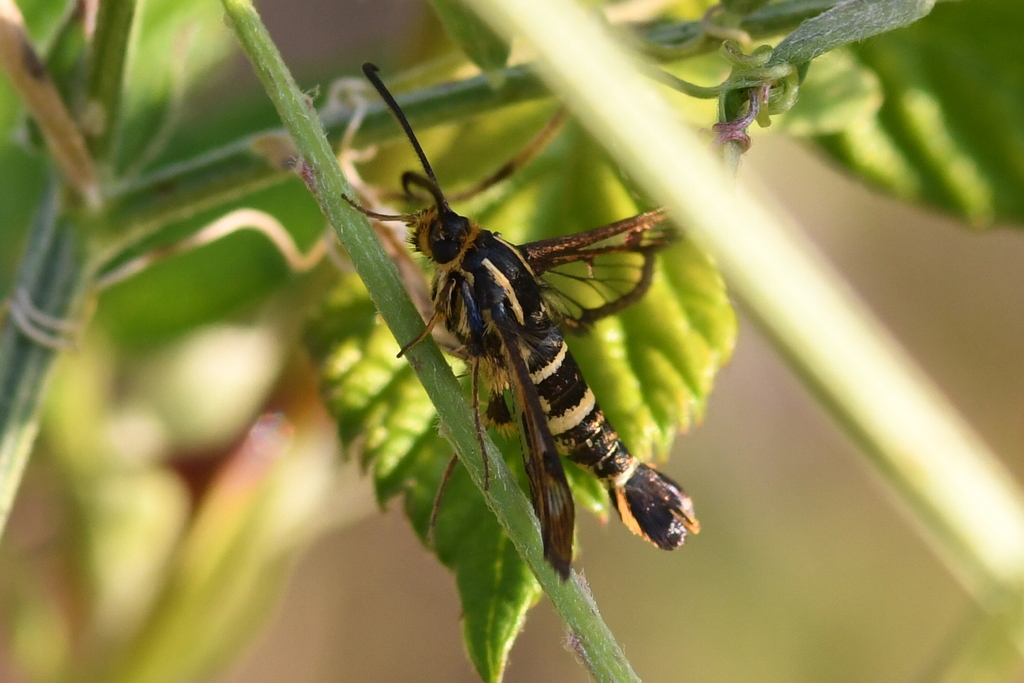
(c) Hawk T., some rights reserved (CC BY) · licence
Family: Sesiidae · Class: Insecta · Order: Lepidoptera
Synanthedon bibionipennis (Strawberry Crown Moth) is a California animal in the Sesiidae family.
The Strawberry Crown Moth is a clearwing moth in the family Sesiidae, characterized by the transparent areas on its wings that distinguish it from most other moth species. Adults typically measure 15 to 20 mm (0.6 to 0.8 inches) in wingspan, with narrow forewings that are predominantly dark with clear, glass-like patches. The hindwings are largely transparent with dark borders. The body is robust and dark-colored, often with metallic blue or green highlights, and features yellow or orange markings that can vary among individuals. The antennae are simple and thread-like, and the species exhibits sexual dimorphism, with males generally smaller and more slender than females. The Strawberry Crown Moth occurs throughout western North America, with a distribution extending from Montana south to Texas and westward to the Pacific coast. The range includes British Columbia south through California, encompassing much of the western United States and southwestern Canada. In California, the species is found in various regions where suitable host plants occur, from coastal areas to inland valleys and foothills. This moth inhabits diverse environments where plants in the Rose family (Rosaceae) are present. Suitable habitats include wild strawberry patches in forest clearings, riparian zones with wild roses, areas with brambles such as blackberries and raspberries, and montane meadows containing cinquefoil species. The species occurs from sea level to moderate elevations in mountainous regions, typically below 2,500 meters (8,200 feet). Both natural and semi-natural habitats support populations, including forest edges, meadows, and occasionally cultivated areas with rose family plants. Larvae are wood borers that feed internally within the crowns, stems, and roots of various Rose family genera including Fragaria (strawberries), Rosa (roses), Rubus (blackberries and raspberries), and Potentilla (cinquefoils). The larvae create tunnels and galleries within plant tissues, feeding on the inner bark and cambium. Development typically requires one to two years, with larvae overwintering within the host plant. Adults emerge in late spring through early summer, generally from May through July, depending on local climate conditions. Females locate suitable host plants through chemical cues and deposit eggs on or near the base of target plants. Males are active during daylight hours and locate females through pheromone detection. The Strawberry Crown Moth does not currently hold federal or state conservation listing status. Population trends and specific conservation concerns for this species are not well-documented in the scientific literature. As a specialist herbivore dependent on native Rose family plants, the species may face localized threats from habitat modification, invasive plant species that displace native hosts, and changes in land use practices. However, the broad distribution across western North America and the widespread occurrence of suitable host plants suggest the species maintains stable populations across much of its range. The moth's ability to utilize multiple host genera within Rosaceae provides some ecological flexibility compared to more narrowly specialized species.
Classification
Class: Insecta · Order: Lepidoptera · Family: Sesiidae
Frequently asked questions
How is Synanthedon bibionipennis classified?
Synanthedon bibionipennis belongs to class Insecta, order Lepidoptera, family Sesiidae.
What family does Synanthedon bibionipennis belong to?
Synanthedon bibionipennis is in the Sesiidae family.
What is Synanthedon bibionipennis?
The Strawberry Crown Moth is a clearwing moth in the family Sesiidae, characterized by the transparent areas on its wings that distinguish it from most other moth species.
Is Synanthedon bibionipennis found in California?
Yes. Synanthedon bibionipennis is recorded in California in The California Species Project's catalogue.
Related species
Other California species in the same genus, family, or bioregion.
Data from The California Species Project — 14,000+ California species with verified data from CNPS, CDFW, USFWS, and more.