Synanthedon polygoni
Buckwheat Borer Moth
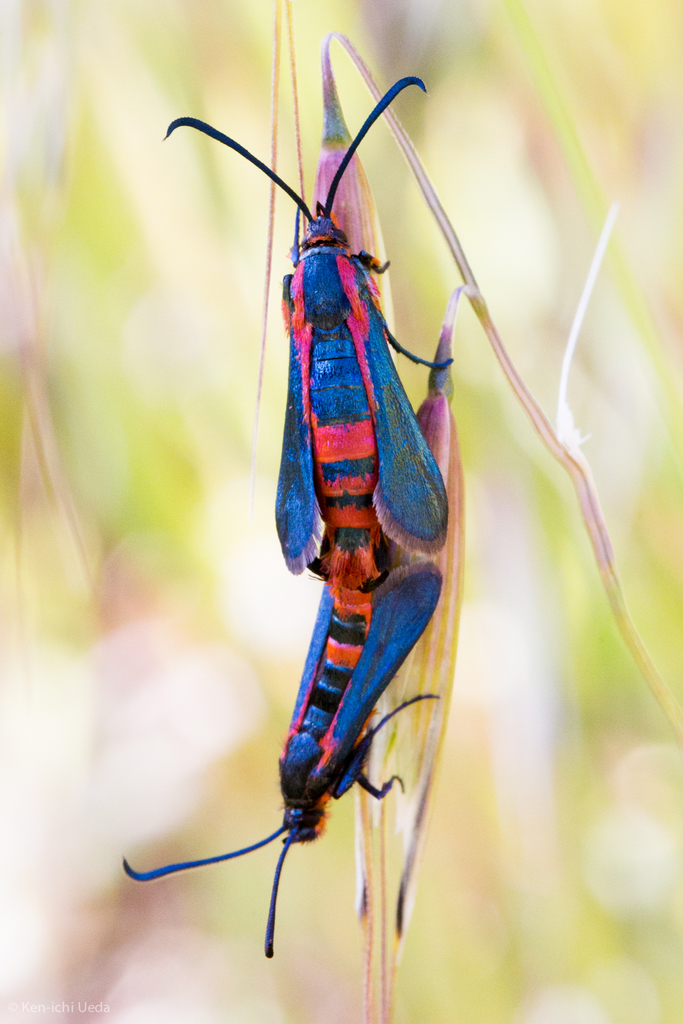
(c) Ken-ichi Ueda, some rights reserved (CC BY) · licence
Family: Sesiidae · Class: Insecta · Order: Lepidoptera
Synanthedon polygoni (Buckwheat Borer Moth) is a California animal in the Sesiidae family.
The Buckwheat Borer Moth (Synanthedon polygoni) is a clearwing moth in the family Sesiidae, a group characterized by transparent wing patches that mimic wasps and bees. Adults are small moths with forewings typically measuring 8 to 12 mm in length. The forewings are predominantly dark brown to black with metallic blue-green reflections, while the hindwings are largely transparent with dark borders. The body is robust and wasp-like, with yellow and black banding on the abdomen that serves as Batesian mimicry. Males possess feathery antennae, while females have simpler, thread-like antennae. The species can be distinguished from related clearwing moths by its association with wild buckwheat hosts and specific wing venation patterns. Synanthedon polygoni is endemic to western North America, with populations documented in California, Nevada, Utah, and Arizona. In California, the species occurs primarily in the southern Sierra Nevada, Transverse Ranges, and Peninsular Ranges. Records exist from Kern, Los Angeles, Riverside, San Bernardino, and Imperial counties, typically at elevations between 300 and 2,100 meters (980 to 6,890 feet). The moth's distribution closely follows that of its host plants in arid and semi-arid regions. The species inhabits desert scrub, chaparral, and pinyon-juniper woodland communities where wild buckwheat species are present. Adults are most commonly found in rocky slopes, washes, and canyon bottoms with well-drained, sandy or gravelly soils. The moth shows strong fidelity to areas supporting robust populations of Eriogonum species, particularly California buckwheat (Eriogonum fasciculatum) and desert trumpet (Eriogonum inflatum). Suitable habitat typically receives 150 to 400 mm (6 to 16 inches) of annual precipitation. Buckwheat Borer Moth larvae are internal stem borers that feed within the woody stems and root crowns of wild buckwheat plants. Females deposit eggs on or near the base of host plants during late spring and early summer. Larvae tunnel through the cambium and heartwood, creating galleries that can extend 10 to 15 cm into the stem. Development from egg to adult typically requires one year, with larvae overwintering within host stems. Pupation occurs in spring within the larval gallery, with adults emerging from May through July. Adults are diurnal and most active during warm, sunny conditions when they visit flowers for nectar and seek mates. Males use pheromone detection to locate females. The Buckwheat Borer Moth currently lacks formal conservation status at federal or state levels. Population trends remain poorly documented due to limited systematic surveys. Potential threats include habitat loss from urban development, altered fire regimes that affect buckwheat communities, and climate change impacts on precipitation patterns in arid regions. The species' specialized host plant requirements and limited dispersal ability make populations vulnerable to localized habitat disturbance. Overgrazing and off-road vehicle activity in desert areas may degrade buckwheat habitat quality.
Classification
Class: Insecta · Order: Lepidoptera · Family: Sesiidae
Frequently asked questions
How is Synanthedon polygoni classified?
Synanthedon polygoni belongs to class Insecta, order Lepidoptera, family Sesiidae.
What family does Synanthedon polygoni belong to?
Synanthedon polygoni is in the Sesiidae family.
What is Synanthedon polygoni?
The Buckwheat Borer Moth (Synanthedon polygoni) is a clearwing moth in the family Sesiidae, a group characterized by transparent wing patches that mimic wasps and bees.
Is Synanthedon polygoni found in California?
Yes. Synanthedon polygoni is recorded in California in The California Species Project's catalogue.
Related species
Other California species in the same genus, family, or bioregion.
Data from The California Species Project — 14,000+ California species with verified data from CNPS, CDFW, USFWS, and more.