Synanthedon resplendens
Sycamore Borer
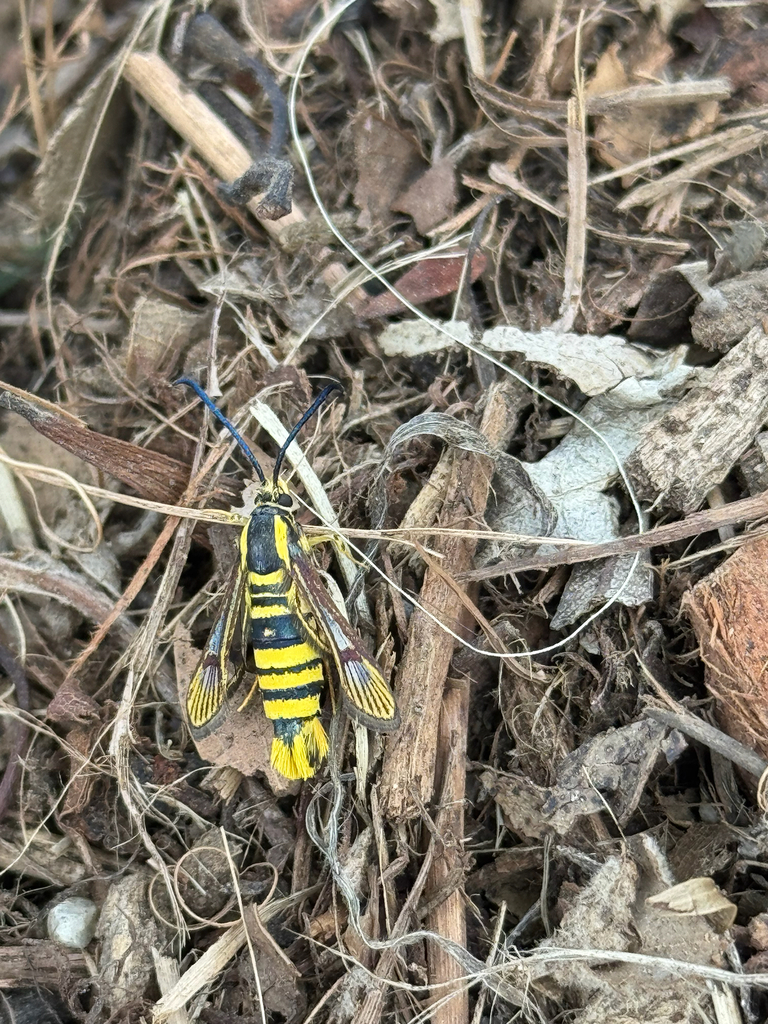
(c) klicklo, some rights reserved (CC BY) · licence
Family: Sesiidae · Class: Insecta · Order: Lepidoptera
Synanthedon resplendens (Sycamore Borer) is a California animal in the Sesiidae family.
The Sycamore Borer is a clearwing moth in the family Sesiidae, characterized by its wasp-like appearance and transparent wing patches typical of this family. Adults are day-flying moths that mimic wasps in both appearance and behavior, with narrow wings and slender bodies. Like other clearwings, they lack the scales on portions of their wings, creating transparent areas that enhance their wasp mimicry. The species occurs in California north to Washington and Idaho, extending eastward to New Mexico. Within California, documented records include multiple counties from the coast to the Sierra Nevada foothills. Specific collection localities include Ventura County (Moor Park, Mount Pinos at 8,000 feet), Marin County (Novato), Kern County (Mount Pinos area), and other scattered locations throughout the state (Lepidopterists' Society records). The elevational range extends from near sea level to at least 8,000 feet based on Mount Pinos collections. Sycamore Borers are closely associated with their host plants in the genus Platanus, particularly California sycamore (Platanus racemosa). California sycamore is a paleoendemism of the California Floristic Province, occurring in riparian woodlands, canyon bottoms, and areas with year-round or seasonal water availability. These habitats typically feature granitic, metamorphic, or sedimentary substrates and support diverse plant communities adapted to mesic conditions. Larvae develop as wood borers within the trunks and branches of sycamore trees, creating galleries beneath the bark where they feed on cambial tissues. The larval boring activity can weaken host trees, particularly when infestations are heavy or trees are already stressed by drought or other factors. Adults are active during daylight hours from spring through late summer, with flight records spanning from April through October based on collection data. Peak activity appears to occur from May through August. Males likely use pheromones to locate females, as is typical in this family. The conservation status of Synanthedon resplendens has not been formally assessed at federal or state levels. However, the species appears on California Department of Fish and Wildlife's Special Animals List, indicating it receives some level of tracking by the California Natural Diversity Database. The species' dependence on sycamore trees as larval hosts makes it potentially vulnerable to threats affecting riparian woodland habitats, including urban development, water diversions, and invasive pest species. Recent invasions of shot hole borers in Southern California pose particular concern for sycamore-dependent species, as these beetles target numerous native tree species including sycamores. Climate change may also affect the species through altered precipitation patterns that impact riparian habitats and host plant health. Population trends and specific conservation needs require further study to assess the species' long-term viability across its range.
Classification
Class: Insecta · Order: Lepidoptera · Family: Sesiidae
Frequently asked questions
How is Synanthedon resplendens classified?
Synanthedon resplendens belongs to class Insecta, order Lepidoptera, family Sesiidae.
What family does Synanthedon resplendens belong to?
Synanthedon resplendens is in the Sesiidae family.
What is Synanthedon resplendens?
The Sycamore Borer is a clearwing moth in the family Sesiidae, characterized by its wasp-like appearance and transparent wing patches typical of this family.
Is Synanthedon resplendens found in California?
Yes. Synanthedon resplendens is recorded in California in The California Species Project's catalogue.
Related species
Other California species in the same genus, family, or bioregion.
Data from The California Species Project — 14,000+ California species with verified data from CNPS, CDFW, USFWS, and more.