Synaphaeta guexi
Spotted Tree Borer
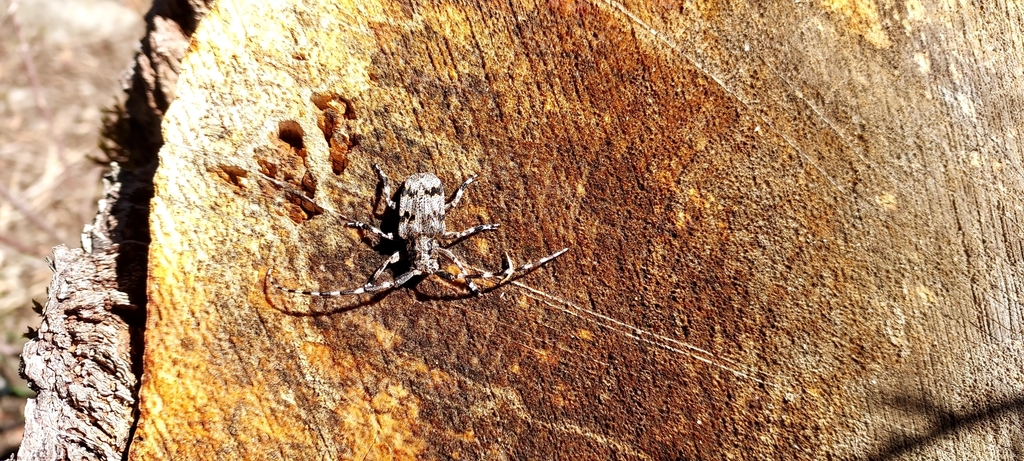
(c) amy pavelchek, some rights reserved (CC BY) · licence
Family: Cerambycidae · Class: Insecta · Order: Coleoptera
Synaphaeta guexi (Spotted Tree Borer) is a California animal in the Cerambycidae family.
The Spotted Tree Borer is a longhorn beetle belonging to the family Cerambycidae, subfamily Lamiinae, tribe Mesosini. This species is classified within the genus Synaphaeta and represents one of three known Synaphaeta species tracked by the U.S. Fish and Wildlife Service taxonomic database. As a member of the longhorn beetle family, Synaphaeta guexi likely exhibits the characteristic elongated antennae and cylindrical body form typical of cerambycids. However, specific morphological details including size measurements, coloration patterns, and distinguishing features have not been well documented in available scientific literature. The common name "Spotted Tree Borer" suggests the presence of spotted markings on the body, though detailed descriptions of these patterns are lacking. The geographic distribution of Synaphaeta guexi appears to be limited, though specific range information has not been comprehensively documented. According to NatureServe Explorer, the species currently holds a global conservation rank of G5 (Secure), suggesting stable populations where it occurs, though documented distribution data is listed as unavailable. Habitat requirements for this species remain poorly characterized in the scientific literature. As a member of the Mesosini tribe within Lamiinae, the species likely inhabits forested environments where larvae develop within woody plant tissues. Many longhorn beetles in this subfamily are associated with specific host trees or shrubs, though the particular plant associations for S. guexi have not been clearly established in available sources. The life history and ecological behaviors of Synaphaeta guexi follow the general pattern of other longhorn beetles. Adults likely emerge to mate and seek suitable host plants for egg-laying. Females presumably deposit eggs in bark crevices or directly into woody tissue. Larvae develop as wood borers, feeding within the sapwood, heartwood, or cambial layers of host plants, creating tunnels that may weaken or kill affected trees. The larval stage likely extends over one or more years before pupation occurs within the host plant. Adults probably emerge through circular exit holes characteristic of cerambycid beetles. Specific details regarding seasonal activity patterns, generation time, and reproductive behavior require further study. Conservation status information for Synaphaeta guexi indicates the species is not currently listed under federal or state endangered species legislation. The NatureServe global rank of G5 suggests populations are considered secure across the species' range as of December 2025. However, this assessment may reflect limited survey data rather than comprehensive population monitoring. The absence of detailed ecological and distributional information represents a significant knowledge gap that hampers effective conservation assessment. Scientific documentation for this species remains extremely limited despite its inclusion in federal taxonomic databases. The information presented here synthesizes available data from the U.S. Fish and Wildlife Service taxonomic tree and NatureServe Explorer. Detailed studies of the species' distribution, host plant relationships, life history, and population status are needed to provide a complete understanding of its ecological requirements and conservation needs.
Classification
Class: Insecta · Order: Coleoptera · Family: Cerambycidae
Frequently asked questions
How is Synaphaeta guexi classified?
Synaphaeta guexi belongs to class Insecta, order Coleoptera, family Cerambycidae.
What family does Synaphaeta guexi belong to?
Synaphaeta guexi is in the Cerambycidae family.
What is Synaphaeta guexi?
The Spotted Tree Borer is a longhorn beetle belonging to the family Cerambycidae, subfamily Lamiinae, tribe Mesosini.
Is Synaphaeta guexi found in California?
Yes. Synaphaeta guexi is recorded in California in The California Species Project's catalogue.
Related species
Other California species in the same genus, family, or bioregion.
Data from The California Species Project — 14,000+ California species with verified data from CNPS, CDFW, USFWS, and more.