Synthliboramphus hypoleucus
Guadalupe murrelet
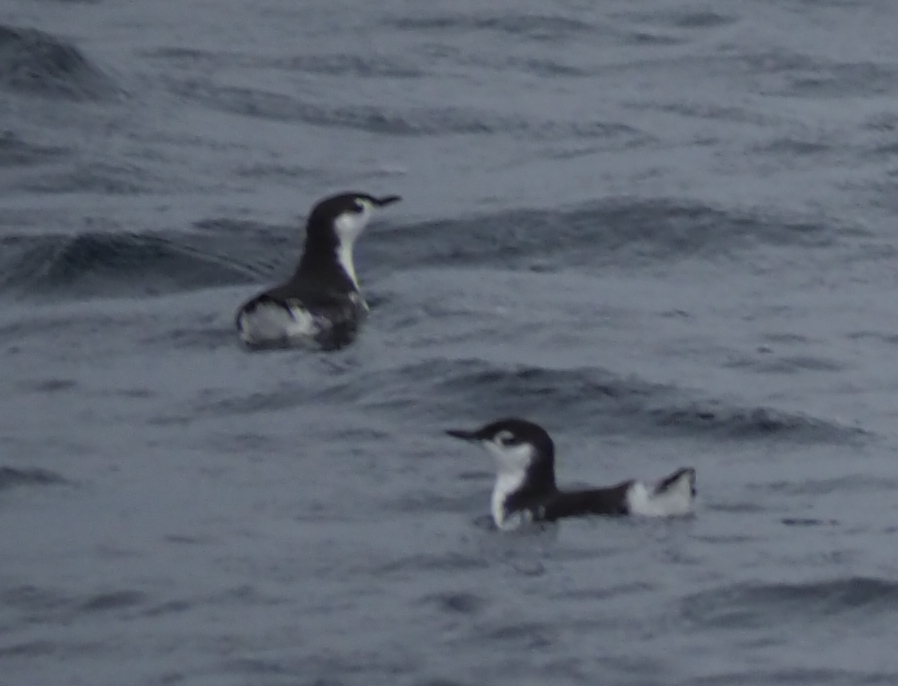
(c) yongestation, some rights reserved (CC BY) · licence
Family: Alcidae · Class: Aves · Order: Charadriiformes
Conservation status: ST
Synthliboramphus hypoleucus (Guadalupe murrelet) is a California animal in the Alcidae family.
The Guadalupe Murrelet is a small seabird in the auk family (Alcidae), measuring approximately 25 centimeters (10 inches) in length with a wingspan of about 40 centimeters (16 inches). Adults display distinctive black and white plumage, with a dark cap extending below the eye, white underparts, and dark upperparts. During breeding season, adults develop white facial plumes and maintain their contrasting coloration. The species exhibits typical alcid characteristics including a compact body, short wings adapted for underwater propulsion, and webbed feet positioned far back on the body. The Guadalupe Murrelet breeds exclusively on islands off the Pacific coast of Baja California and southern California. According to Birds of the World, the breeding range extends from the San Benito Islands in Baja California northward to islands off southern California. At the time of state listing, this species was known as Xantus's Murrelet (Synthliboramphus hypoleucus), with breeding populations concentrated in Baja California. The species occurs in California waters primarily as a post-breeding visitor and during migration, with most individuals moving into warm offshore waters from late July through October. Breeding habitat consists of arid, rocky islands situated within the California Current Upwelling System. According to Birds of the World, these islands provide the specific nesting conditions required by the species. During the non-breeding season, Guadalupe Murrelets inhabit pelagic waters, typically found at least 20 kilometers offshore and possibly extending beyond 90 kilometers from the coast in warm water masses. The species demonstrates strong habitat fidelity to specific oceanographic conditions associated with upwelling systems. Guadalupe Murrelets are pursuit-diving seabirds that forage underwater using their wings for propulsion. They feed primarily on small schooling fish and zooplankton, diving to depths of several meters to capture prey. Breeding occurs during spring and early summer, with pairs nesting in rock crevices and caves on predator-free islands. Like other murrelets, this species exhibits unique reproductive behavior, with chicks leaving the nest at night within days of hatching to join adults at sea. The species demonstrates nocturnal activity patterns around breeding colonies to avoid aerial predators. The Guadalupe Murrelet is listed as threatened under the California Endangered Species Act. California Department of Fish and Wildlife notes that the species is not currently tracked by the California Natural Diversity Database, reflecting the challenges in monitoring this primarily marine species. The species faces threats typical of seabirds, including habitat degradation on breeding islands, introduced predators, marine pollution, and climate change impacts on ocean productivity. Oil spills pose particular risks given the species' marine habitat and the heavy shipping traffic along the California coast. Conservation efforts focus on protecting breeding sites and monitoring population trends, though the species' pelagic nature makes comprehensive population assessment challenging.
Classification
Class: Aves · Order: Charadriiformes · Family: Alcidae
Conservation status
ST
Frequently asked questions
How is Synthliboramphus hypoleucus classified?
Synthliboramphus hypoleucus belongs to class Aves, order Charadriiformes, family Alcidae.
What family does Synthliboramphus hypoleucus belong to?
Synthliboramphus hypoleucus is in the Alcidae family.
Is Synthliboramphus hypoleucus protected or of conservation concern?
Synthliboramphus hypoleucus carries the following status: ST.
What is Synthliboramphus hypoleucus?
The Guadalupe Murrelet is a small seabird in the auk family (Alcidae), measuring approximately 25 centimeters (10 inches) in length with a wingspan of about 40 centimeters (16 inches).
Is Synthliboramphus hypoleucus found in California?
Yes. Synthliboramphus hypoleucus is recorded in California in The California Species Project's catalogue.
Related species
Other California species in the same genus, family, or bioregion.
Data from The California Species Project — 14,000+ California species with verified data from CNPS, CDFW, USFWS, and more.