Synthliboramphus scrippsi
Scripps’s murrelet
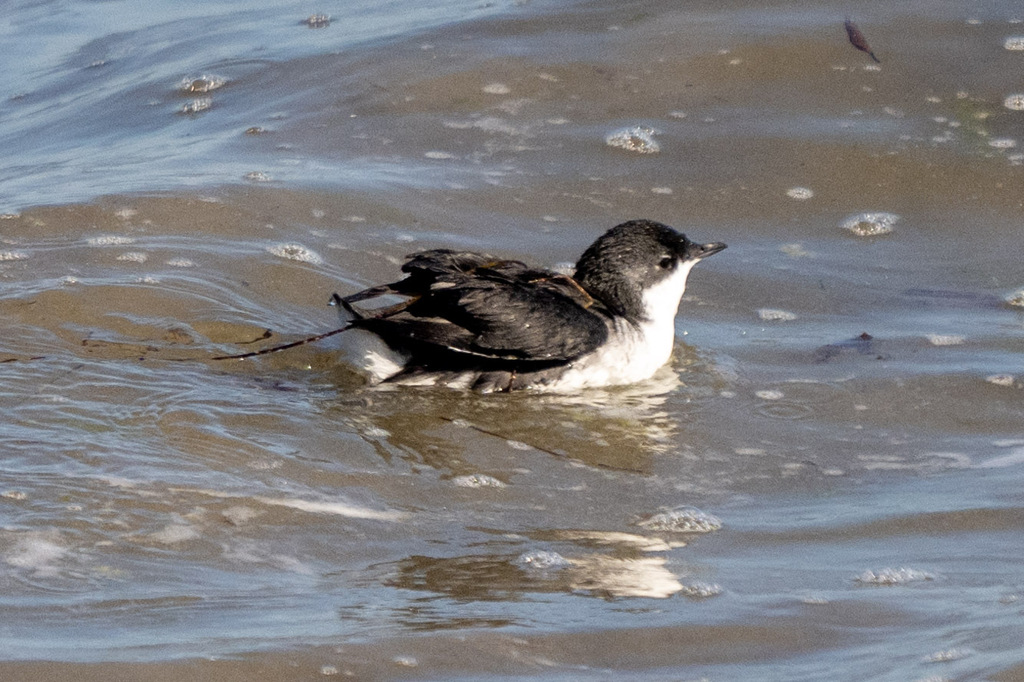
(c) Michael Eisen, some rights reserved (CC BY) · licence
Family: Alcidae · Class: Aves · Order: Charadriiformes
Conservation status: ST · Candidate · G2 S2
Synthliboramphus scrippsi (Scripps’s murrelet) is a California animal in the Alcidae family.
Scripps's murrelet is a small seabird measuring 21-25 cm (8.3-9.8 inches) in length with a wingspan of 40-46 cm (15.7-18.1 inches). Adults weigh approximately 140-200 grams (4.9-7.1 ounces). During breeding season, the species displays distinctive black upperparts extending from the crown to the back, contrasting sharply with white underparts. The head shows a characteristic black cap that extends below the eye, with a thin white crescent above the eye. In winter plumage, the black areas fade to dark gray. The bill is small, pointed, and dark-colored, adapted for underwater foraging. Scripps's murrelet breeds exclusively on islands off the California and Baja California coasts. In California, breeding populations occur on the Channel Islands, including Anacapa, Santa Barbara, Santa Catalina, San Clemente, and Santa Cruz Islands. The species' current breeding range represents a significant reduction from historical distribution. Non-breeding individuals disperse along the Pacific Coast from central California to southern Baja California, typically remaining within 50 km of shore in nearshore marine waters. The species inhabits offshore marine environments and rocky island coastlines. Breeding occurs on offshore islands with suitable nesting habitat, including rocky crevices, caves, and areas beneath dense vegetation or debris. Nesting sites are typically located within 100 meters of the ocean and range from sea level to 300 meters elevation. During the non-breeding season, birds occupy nearshore marine waters over the continental shelf, generally in depths of 10-80 meters. Scripps's murrelet is a pursuit-diving seabird that feeds primarily on small schooling fish, including sardines, anchovies, and juvenile rockfish, supplemented by euphausiid shrimp and other marine invertebrates. Breeding occurs from March through August, with peak activity in May and June. Adults nest in natural cavities or under vegetation, with females laying 1-2 eggs directly on the substrate without constructing a formal nest. The incubation period lasts 32-34 days, shared by both parents. Remarkably, chicks leave the nest site within 1-4 days of hatching and are led to sea by adults during nocturnal departures, completing development in marine waters. The species was listed as threatened by California in 2016 and is designated as a federal candidate species as of December 2025. According to the California Department of Fish and Wildlife, this species was formerly known as Xantus's murrelet (Synthliboramphus hypoleucus), with Scripps's murrelet representing the northern subspecies that breeds in California waters. Current population estimates suggest fewer than 15,000 breeding pairs remain globally, with California supporting approximately 6,000-8,000 pairs. Primary threats include habitat degradation from introduced mammals on breeding islands, marine pollution, oil spills, fisheries interactions, climate change effects on prey availability, and human disturbance at nesting colonies. Conservation efforts focus on invasive species removal from breeding islands and marine protected area establishment.
Classification
Class: Aves · Order: Charadriiformes · Family: Alcidae
Conservation status
ST · Candidate · G2 S2
Frequently asked questions
How is Synthliboramphus scrippsi classified?
Synthliboramphus scrippsi belongs to class Aves, order Charadriiformes, family Alcidae.
What family does Synthliboramphus scrippsi belong to?
Synthliboramphus scrippsi is in the Alcidae family.
Is Synthliboramphus scrippsi protected or of conservation concern?
Synthliboramphus scrippsi carries the following status: ST · Candidate · G2 S2.
What is Synthliboramphus scrippsi?
Scripps's murrelet is a small seabird measuring 21-25 cm (8.3-9.8 inches) in length with a wingspan of 40-46 cm (15.7-18.1 inches).
Is Synthliboramphus scrippsi found in California?
Yes. Synthliboramphus scrippsi is recorded in California in The California Species Project's catalogue.
Related species
Other California species in the same genus, family, or bioregion.
Data from The California Species Project — 14,000+ California species with verified data from CNPS, CDFW, USFWS, and more.