Syritta pipiens
Thick-legged Hover Fly
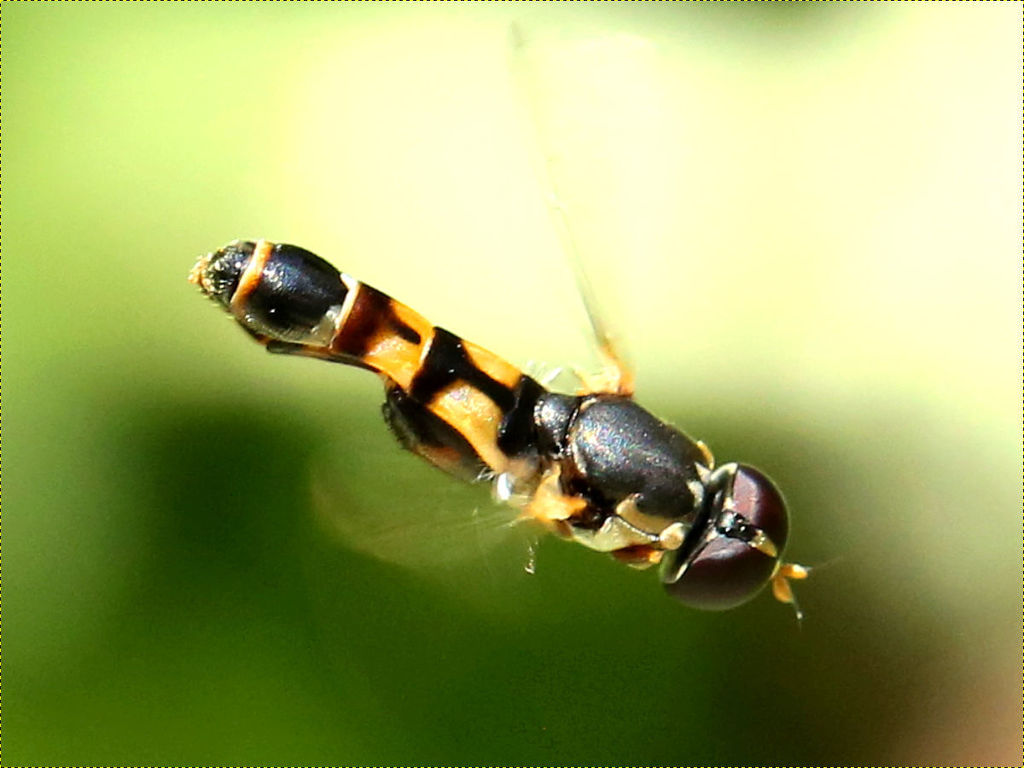
(c) Peter Chen 2.0, some rights reserved (CC BY) · licence
Family: Syrphidae · Class: Insecta · Order: Diptera
Syritta pipiens (Thick-legged Hover Fly) is a California animal in the Syrphidae family.
The thick-legged hover fly is a small to medium-sized syrphid fly belonging to the family Syrphidae. Adults typically measure 8-12 mm in length and are characterized by their distinctive enlarged hind femora, which gives the species its common name. The body exhibits a black and yellow coloration pattern typical of many hover flies, with yellow markings on the thorax and abdomen that may serve as wasp mimicry. The wings are clear with darkened veins, and the compound eyes are large and prominent, facilitating their hovering flight behavior. Syritta pipiens has a broad distribution across North America, including California, where it occurs throughout much of the state. The species is also found across temperate regions of Europe and Asia, indicating a Holarctic distribution pattern. In North America, it ranges from coast to coast and from southern Canada to northern Mexico. Within California, the species has been documented from sea level to moderate elevations in various habitat types. This hover fly inhabits a wide range of environments, showing particular affinity for areas with abundant flowering plants. It commonly occurs in gardens, agricultural areas, meadows, forest edges, and riparian zones. The species demonstrates considerable habitat flexibility, adapting to both natural and human-modified landscapes. Adults are frequently observed in association with composite flowers and other open-faced blooms that provide accessible nectar and pollen resources. Adult thick-legged hover flies are active pollinators, feeding on nectar and pollen from a diverse array of flowering plants. They exhibit the characteristic hovering flight behavior of syrphids, remaining suspended in mid-air before darting to flowers or potential mates. Like other flower flies, adults have relatively short tongues and therefore favor open flowers such as members of the daisy family, roses, and similar accessible blooms. The larval stage is saprophagous, developing in decaying organic matter including rotting vegetation, compost, and manure. Females deposit eggs in suitable organic substrates where larvae feed on decomposing material and associated microorganisms. The species is multivoltine in warmer regions, producing multiple generations per year, with adults active from spring through fall depending on local climate conditions. Syritta pipiens currently holds no special conservation status at federal or state levels. The species appears to be relatively common and stable across its range, benefiting from its habitat flexibility and association with human-modified environments. However, like many beneficial insects, populations may face pressures from habitat loss, pesticide use, and climate change. The species' role as a pollinator makes it ecologically valuable, contributing to both wild plant reproduction and agricultural crop pollination. Its larvae also provide ecosystem services through decomposition processes. While not of immediate conservation concern, the species exemplifies the important but often overlooked ecological contributions of non-bee pollinators in both natural and agricultural systems.
Classification
Class: Insecta · Order: Diptera · Family: Syrphidae
Frequently asked questions
How is Syritta pipiens classified?
Syritta pipiens belongs to class Insecta, order Diptera, family Syrphidae.
What family does Syritta pipiens belong to?
Syritta pipiens is in the Syrphidae family.
What is Syritta pipiens?
The thick-legged hover fly is a small to medium-sized syrphid fly belonging to the family Syrphidae.
Is Syritta pipiens found in California?
Yes. Syritta pipiens is recorded in California in The California Species Project's catalogue.
Related species
Other California species in the same genus, family, or bioregion.
Data from The California Species Project — 14,000+ California species with verified data from CNPS, CDFW, USFWS, and more.