Tachycineta bicolor
Tree Swallow
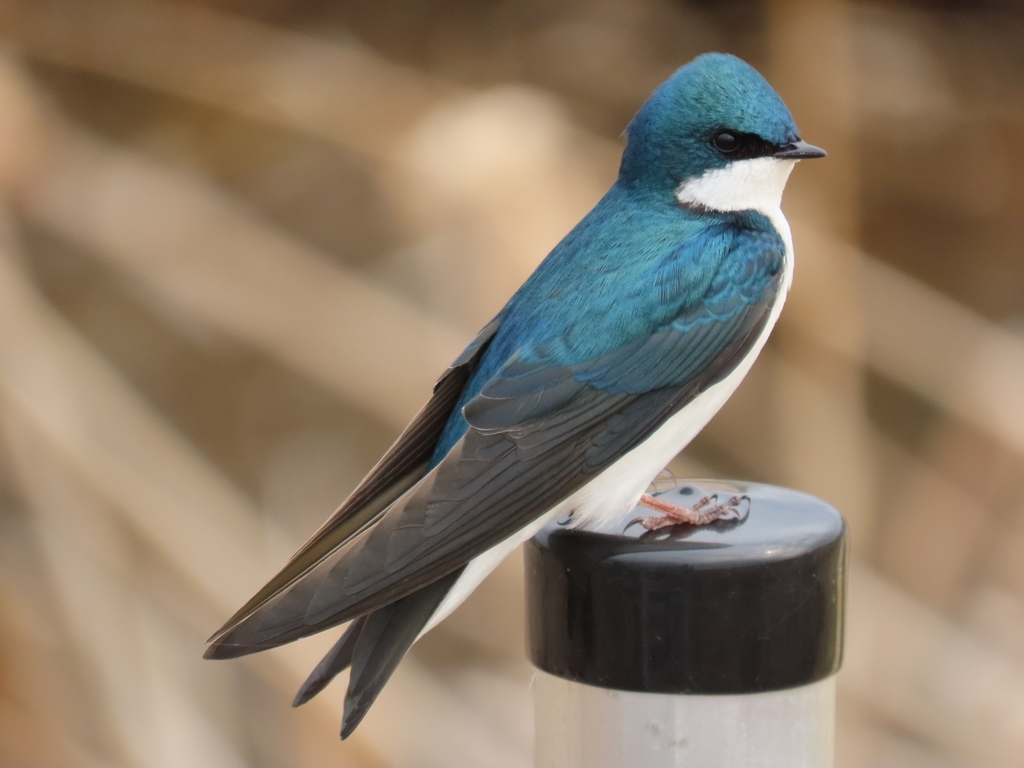
no rights reserved · CC0
Family: Hirundinidae · Class: Aves · Order: Passeriformes
Tachycineta bicolor (Tree Swallow) is a California animal in the Hirundinidae family.
The Tree Swallow is a small aerial insectivore measuring 12 to 14 cm (4.7 to 5.5 inches) in length with a wingspan of 30 to 35 cm (12 to 14 inches). Adults weigh 17 to 25 grams. Males display iridescent blue-green upperparts that appear metallic in sunlight, contrasting sharply with bright white underparts. Females are typically duller with less iridescent coloring, while juveniles show brownish upperparts before acquiring adult plumage. The species has a slightly notched tail, long pointed wings adapted for aerial foraging, and a small, wide bill suited for catching insects in flight. Tree Swallows breed across most of North America, from Alaska and northern Canada south to California, the southwestern United States, and parts of the southeastern coastal plain. In California, breeding populations occur primarily in the northern two-thirds of the state, including the Central Valley, Sierra Nevada foothills, and coastal regions north of Monterey County. The species is less common in southern California, with scattered breeding records in suitable habitat. During migration and winter, Tree Swallows concentrate along the Pacific Coast and in the Central Valley before continuing to wintering grounds in Mexico, Central America, and the Caribbean. Breeding habitat consists of open areas near water bodies, including wetlands, ponds, lakes, streams, and agricultural fields with scattered trees or nest boxes. Tree Swallows require cavity nesting sites, utilizing old woodpecker holes, natural tree cavities, or artificial nest boxes. They prefer sites 1.5 to 6 meters above ground in dead trees, fence posts, or specially designed nest box programs. Wintering and migratory habitat includes coastal marshes, agricultural areas, and open water where insects are abundant. Tree Swallows are exclusively insectivorous during breeding season, capturing flies, beetles, flying ants, and other small insects entirely on the wing. They are among the most aerial of swallows, spending most daylight hours in flight. Breeding occurs from May through July, with females laying 4 to 6 white eggs in grass-lined nests. Incubation lasts 14 to 15 days, and young fledge after 20 to 24 days. Adults often produce single broods annually, though second broods may occur in favorable conditions. The species is highly social during migration, forming large flocks that can number in the thousands. Tree Swallows are not federally or state listed and maintain stable populations across most of their range. According to the North American Breeding Bird Survey, populations increased by approximately 0.8% annually between 1966 and 2019. However, local declines have been documented in some regions due to habitat loss, pesticide use reducing insect prey, and competition for nest sites. Climate change may affect migration timing and insect availability. Conservation efforts focus on maintaining wetland habitats and providing nest box programs, particularly in agricultural areas where natural cavities are scarce.
Classification
Class: Aves · Order: Passeriformes · Family: Hirundinidae
Frequently asked questions
How is Tachycineta bicolor classified?
Tachycineta bicolor belongs to class Aves, order Passeriformes, family Hirundinidae.
What family does Tachycineta bicolor belong to?
Tachycineta bicolor is in the Hirundinidae family.
What is Tachycineta bicolor?
The Tree Swallow is a small aerial insectivore measuring 12 to 14 cm (4.7 to 5.5 inches) in length with a wingspan of 30 to 35 cm (12 to 14 inches).
Is Tachycineta bicolor found in California?
Yes. Tachycineta bicolor is recorded in California in The California Species Project's catalogue.
Related species
Other California species in the same genus, family, or bioregion.
Data from The California Species Project — 14,000+ California species with verified data from CNPS, CDFW, USFWS, and more.