Tachycineta thalassina
Violet-green Swallow
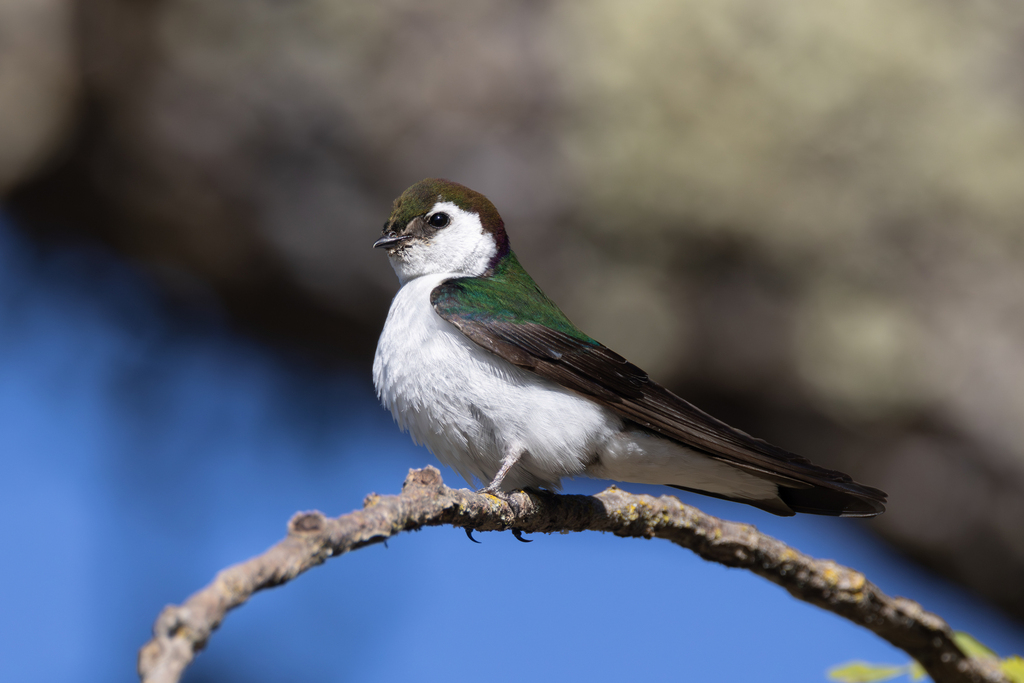
(c) Ryan F. Mandelbaum, some rights reserved (CC BY) · licence
Family: Hirundinidae · Class: Aves · Order: Passeriformes
Tachycineta thalassina (Violet-green Swallow) is a California animal in the Hirundinidae family.
The Violet-green Swallow is a small, streamlined aerial insectivore measuring 12 to 14 cm (4.7 to 5.5 inches) in length with a wingspan of 27 to 30 cm (10.6 to 11.8 inches). Adults weigh 13 to 18 grams. Males display iridescent violet-green upperparts that appear blue-green in certain lighting conditions, with the violet coloration most prominent on the crown and nape. The rump shows distinct white patches that extend onto the sides, visible during flight. Underparts are bright white, extending higher on the flanks than in similar swallow species. Females are slightly duller with less pronounced iridescence. Juveniles show brownish-gray upperparts with reduced iridescence and may have faint breast bands. Violet-green Swallows breed across western North America from British Columbia south to Mexico. In California, they occur throughout most of the state except the Central Valley floor and low desert regions. The species ranges from sea level along the coast to elevations exceeding 3,400 meters (11,150 feet) in the Sierra Nevada. Populations are migratory, with California breeders wintering from Mexico south to Costa Rica. Some coastal populations may remain year-round in mild areas. Breeding habitat includes open woodlands, forest edges, riparian zones, and areas with scattered trees or snags for nesting. The species favors coniferous and mixed forests, particularly ponderosa pine, Douglas-fir, and oak woodlands. Violet-green Swallows require open airspace for foraging and access to water sources. They utilize natural tree cavities, old woodpecker holes, and nest boxes, typically selecting sites 1.5 to 15 meters (5 to 49 feet) above ground. Urban and suburban environments with suitable nest sites and open areas are increasingly utilized. Violet-green Swallows are exclusively aerial insectivores, capturing prey during sustained flight. Their diet consists primarily of flying ants, beetles, flies, aphids, leafhoppers, and flying termites. Foraging occurs from dawn to dusk at various heights, from just above ground level to over 150 meters high. Breeding season extends from April through July, varying by elevation and latitude. Females lay 4 to 6 glossy white eggs in cup nests constructed of grass, feathers, and other soft materials within cavities. Incubation lasts 13 to 15 days, performed solely by females. Both parents feed nestlings, which fledge after 18 to 24 days. Pairs typically raise one brood per season, though double brooding may occur in favorable conditions. The Violet-green Swallow is not federally or state listed and maintains stable populations across most of its range. According to the North American Breeding Bird Survey, populations have remained relatively stable since 1966, with some regional variations. Primary conservation concerns include habitat loss from logging, development, and fire suppression that reduces snag availability. Climate change may affect insect prey abundance and alter migration timing. Nest box programs and retention of snags during forest management benefit this cavity-dependent species.
Classification
Class: Aves · Order: Passeriformes · Family: Hirundinidae
Frequently asked questions
How is Tachycineta thalassina classified?
Tachycineta thalassina belongs to class Aves, order Passeriformes, family Hirundinidae.
What family does Tachycineta thalassina belong to?
Tachycineta thalassina is in the Hirundinidae family.
What is Tachycineta thalassina?
The Violet-green Swallow is a small, streamlined aerial insectivore measuring 12 to 14 cm (4.7 to 5.5 inches) in length with a wingspan of 27 to 30 cm (10.6 to 11.8 inches).
Is Tachycineta thalassina found in California?
Yes. Tachycineta thalassina is recorded in California in The California Species Project's catalogue.
Related species
Other California species in the same genus, family, or bioregion.
Data from The California Species Project — 14,000+ California species with verified data from CNPS, CDFW, USFWS, and more.