Tachypompilus unicolor
Western Red-tailed Spider Wasp
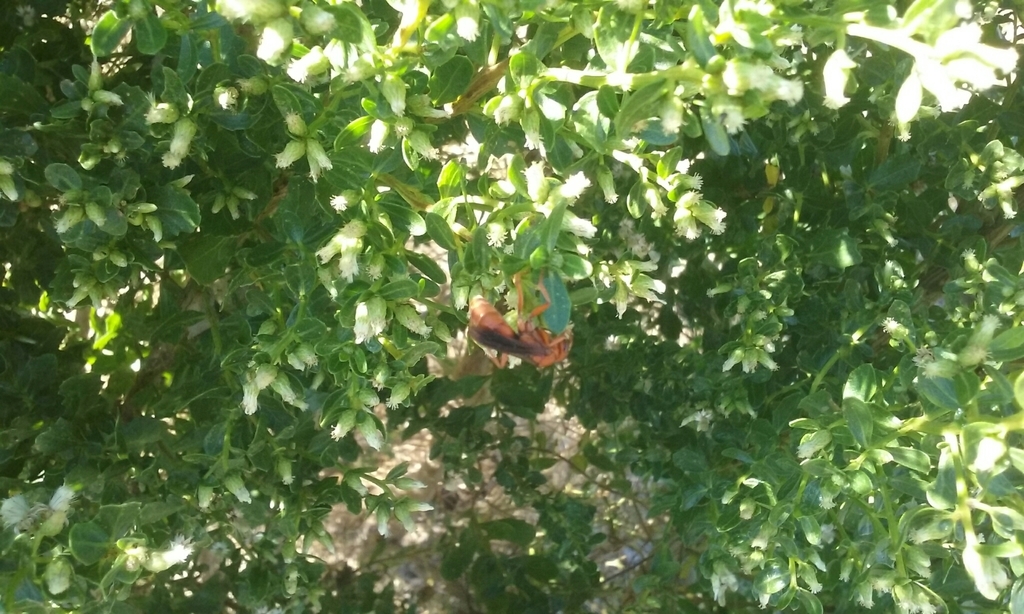
no rights reserved · CC0
Family: Pompilidae · Class: Insecta · Order: Hymenoptera
Tachypompilus unicolor (Western Red-tailed Spider Wasp) is a California animal in the Pompilidae family.
The Western Red-tailed Spider Wasp (Tachypompilus unicolor) is a solitary hunting wasp in the family Pompilidae. Adults are characterized by their ferruginous (rust-colored) integument with distinctive black markings, distinguishing them from other Tachypompilus species which may be entirely black or have different color patterns (BugGuide 2025). The body exhibits the typical wasp morphology with a narrow waist connecting the thorax and abdomen, membranous wings with fore and hind wings connected by small hooks, and thread-like antennae. This species is restricted to the western United States, differentiating it from other transcontinental Tachypompilus species (BugGuide 2025). The wasp occurs across various western states, with documented records from California, including Solano County where specimens have been photographed and collected. The Western Red-tailed Spider Wasp inhabits varied terrain but shows a strong preference for open habitats (BugGuide 2025). These environments provide suitable conditions for both adult foraging activities and the ground-nesting behavior essential to their reproductive cycle. The species appears to favor areas with accessible soil for nest construction and abundant flower resources for adult nutrition. Adult Western Red-tailed Spider Wasps are active primarily from June through September in northern regions, with potentially extended seasons in warmer southern areas (BugGuide 2025). Adults frequently visit flowers for nectar, particularly those of wild carrot (Daucus), wild parsnip (Pastinaca), and sea holly (Eryngium) species. Female wasps are fossorial or semi-fossorial, meaning they excavate nests in soil or utilize existing cavities. They commonly construct brood cells within rock piles or near building foundations, taking advantage of natural or artificial structures that provide protection for developing offspring. The species exhibits typical spider wasp hunting behavior, with females specializing in capturing lycosid spiders (wolf spiders) to provision their nests (BugGuide 2025). After paralyzing prey with their sting, females transport spiders to prepared nest cells where a single egg is deposited on each spider. The developing larva feeds on the paralyzed but living spider, ensuring fresh protein throughout its development. This hunting specialization on lycosids reflects an evolutionary adaptation to exploit a specific prey resource effectively. Like other members of the Pompilidae family, females possess a powerful sting used for subduing prey rather than defense. The species undergoes complete metamorphosis, with eggs developing into larvae within the provisioned nest cells, followed by pupation and eventual emergence as adults. Currently, Tachypompilus unicolor appears to have stable populations across its western range, with no apparent conservation concerns. The species has been documented in various state wildlife surveys and continues to be regularly observed by entomologists and naturalists. Its adaptation to diverse open habitats and ability to utilize both natural and human-modified environments for nesting likely contribute to its persistence across the western landscape.
Classification
Class: Insecta · Order: Hymenoptera · Family: Pompilidae
Frequently asked questions
How is Tachypompilus unicolor classified?
Tachypompilus unicolor belongs to class Insecta, order Hymenoptera, family Pompilidae.
What family does Tachypompilus unicolor belong to?
Tachypompilus unicolor is in the Pompilidae family.
What is Tachypompilus unicolor?
The Western Red-tailed Spider Wasp (Tachypompilus unicolor) is a solitary hunting wasp in the family Pompilidae.
Is Tachypompilus unicolor found in California?
Yes. Tachypompilus unicolor is recorded in California in The California Species Project's catalogue.
Related species
Other California species in the same genus, family, or bioregion.
Data from The California Species Project — 14,000+ California species with verified data from CNPS, CDFW, USFWS, and more.