Tachystola hemisema
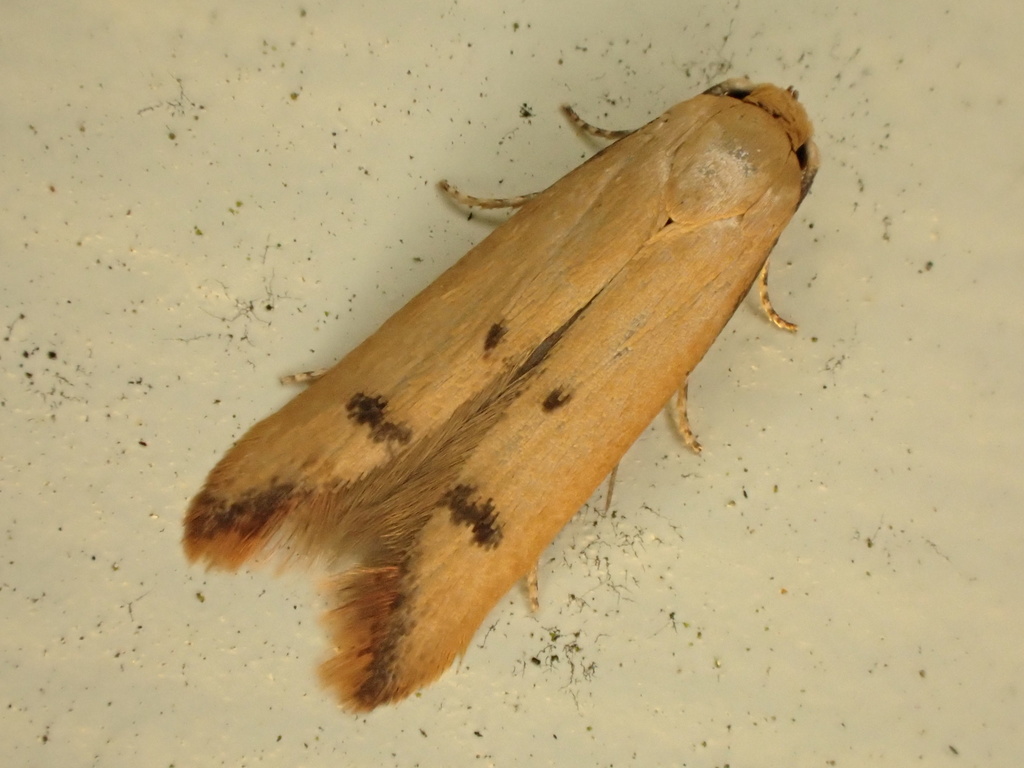
(c) Saryu Mae 前 朝琉, some rights reserved (CC BY) · licence
Family: Stenomatidae · Class: Insecta · Order: Lepidoptera
Tachystola hemisema is a California animal in the Stenomatidae family.
Tachystola hemisema is a small moth species in the family Stenomatidae, known from limited collections in California. This species belongs to a genus of concealer moths that typically measure 8 to 12 mm in wingspan when adults. Like other members of the Stenomatidae family, T. hemisema likely displays muted coloration patterns with earth tones that provide camouflage against bark and leaf litter substrates. The known range of Tachystola hemisema appears to be restricted to California, though specific distribution records are limited in available literature. The species has been documented from scattered locations, but comprehensive range mapping requires additional survey work. Many oecophorid moths have narrow distributions tied to specific host plants or microhabitats, suggesting T. hemisema may have similarly restricted occurrence patterns. Habitat preferences for this species remain poorly documented, though related Tachystola species typically inhabit areas with woody vegetation where larvae can develop in plant material. Oecophorid moths generally favor environments with adequate shelter and organic matter accumulation, including forest edges, chaparral, and riparian zones. The specific elevation range and vegetation associations for T. hemisema require further field investigation. The life history and ecological requirements of Tachystola hemisema are not well-established in current literature. Most oecophorid moths undergo complete metamorphosis with larvae that feed as concealed borers or scavengers in plant material, including dead wood, leaf litter, or fungal matter. Adult flight periods typically coincide with favorable weather conditions, often during spring or fall months when temperatures are moderate and humidity levels support activity. Mating behaviors likely involve pheromone communication, as is common among nocturnal moth species. Reproductive ecology for T. hemisema has not been specifically documented, but related species typically lay eggs on or near larval host substrates. Development time from egg to adult emergence varies with temperature and food availability, with some species requiring one to two years to complete their life cycle. Adults are presumably nocturnal and attracted to artificial light sources during peak activity periods. The conservation status of Tachystola hemisema is not formally assessed by federal or state agencies as of December 2025. The apparent rarity of collection records suggests either limited distribution, cryptic habits, or insufficient survey effort in appropriate habitats. Many small moth species face threats from habitat loss, urban development, and changes in vegetation structure that affect host plant availability. Climate change may also impact species with narrow environmental tolerances or restricted ranges. Further taxonomic research and field surveys are needed to determine population status, habitat requirements, and potential conservation needs for this species. The lack of comprehensive biological information highlights the need for additional study of California's diverse but poorly known moth fauna.
Classification
Class: Insecta · Order: Lepidoptera · Family: Stenomatidae
Frequently asked questions
How is Tachystola hemisema classified?
Tachystola hemisema belongs to class Insecta, order Lepidoptera, family Stenomatidae.
What family does Tachystola hemisema belong to?
Tachystola hemisema is in the Stenomatidae family.
What is Tachystola hemisema?
Tachystola hemisema is a small moth species in the family Stenomatidae, known from limited collections in California.
Is Tachystola hemisema found in California?
Yes. Tachystola hemisema is recorded in California in The California Species Project's catalogue.
Related species
Other California species in the same genus, family, or bioregion.
Data from The California Species Project — 14,000+ California species with verified data from CNPS, CDFW, USFWS, and more.