Tamias minimus
Least Chipmunk
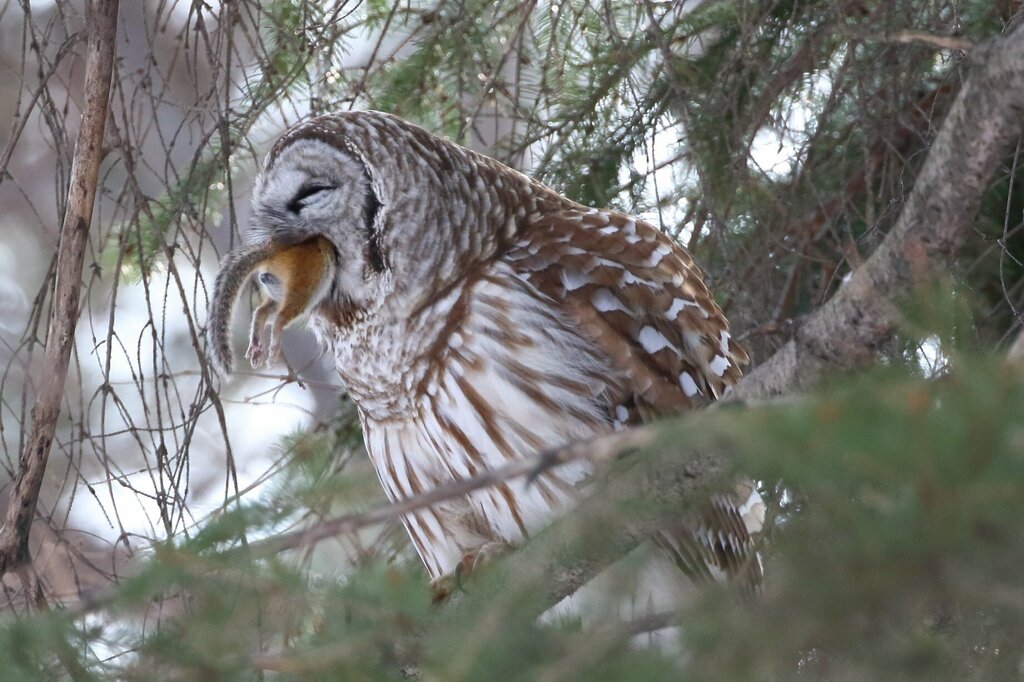
no rights reserved · CC0
Family: Sciuridae · Class: Mammalia · Order: Rodentia
Tamias minimus (Least Chipmunk) is a California animal in the Sciuridae family.
The least chipmunk is the smallest and most widely distributed chipmunk species in North America. Adults typically measure 185 to 216 millimeters (7.3 to 8.5 inches) in total length, with tails comprising approximately half this length at 90 to 110 millimeters (3.5 to 4.3 inches). Body weight ranges from 32 to 50 grams (1.1 to 1.8 ounces), making it noticeably smaller than other western chipmunk species. The species displays characteristic chipmunk coloration with five dark dorsal stripes alternating with four lighter stripes running from head to tail. The central dark stripe extends to the base of the tail, while facial stripes include a dark stripe through each eye and lighter stripes above and below. The underside is typically whitish to pale gray, and the tail shows dark and light banding with buff-colored edges. In California, the least chipmunk occurs primarily in the eastern Sierra Nevada, Cascade Range, and northeastern portions of the state. The species ranges from Mono County north through the Modoc Plateau and into Siskiyou County. Elevational distribution extends from approximately 1,200 meters (4,000 feet) in sagebrush valleys to over 3,400 meters (11,200 feet) near treeline. This represents the western edge of the species' continental range, which extends eastward across much of the western United States and into Canada. Least chipmunks occupy diverse habitats including sagebrush steppe, pinyon-juniper woodland, montane coniferous forests, and alpine areas near treeline. The species shows particular affinity for edge habitats and forest openings where shrub cover provides protective shelter. In lower elevations, they frequent sagebrush communities with scattered trees or rocky outcrops. At higher elevations, they utilize whitebark pine, limber pine, and subalpine fir forests, often associated with fallen logs and rocky talus slopes. This species exhibits typical chipmunk behavior patterns with diurnal activity peaks in morning and late afternoon. Least chipmunks are omnivorous, consuming seeds, nuts, berries, green vegetation, fungi, and occasionally insects and bird eggs. They cache food extensively in underground burrows and tree caches to survive winter hibernation. The species constructs complex burrow systems with multiple entrances, nesting chambers, and food storage areas. Breeding occurs once annually following emergence from hibernation, typically from April to June depending on elevation. Females produce litters of 2 to 7 young after a gestation period of approximately 30 days. Young become independent at 6 to 8 weeks of age. The least chipmunk maintains stable populations throughout most of its California range and currently holds no special conservation status at state or federal levels. The species demonstrates adaptability to various habitat conditions and elevation gradients, contributing to its persistence across diverse environments. Climate change may affect high-elevation populations through altered snow patterns and vegetation shifts, but overall population trends appear stable. Habitat fragmentation from development and fire management practices represent localized threats in some areas, though the species' wide habitat tolerance generally provides population resilience.
Classification
Class: Mammalia · Order: Rodentia · Family: Sciuridae
Frequently asked questions
How is Tamias minimus classified?
Tamias minimus belongs to class Mammalia, order Rodentia, family Sciuridae.
What family does Tamias minimus belong to?
Tamias minimus is in the Sciuridae family.
What is Tamias minimus?
The least chipmunk is the smallest and most widely distributed chipmunk species in North America.
Is Tamias minimus found in California?
Yes. Tamias minimus is recorded in California in The California Species Project's catalogue.
Related species
Other California species in the same genus, family, or bioregion.
Data from The California Species Project — 14,000+ California species with verified data from CNPS, CDFW, USFWS, and more.