Tamias quadrimaculatus
Long-eared Chipmunk
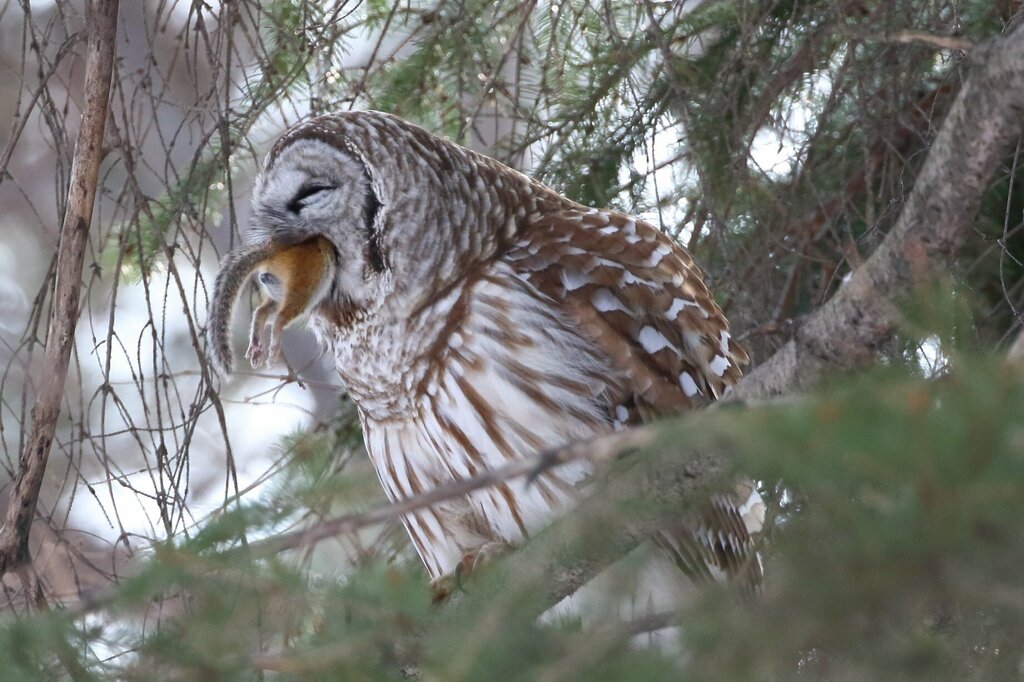
no rights reserved · CC0
Family: Sciuridae · Class: Mammalia · Order: Rodentia
Tamias quadrimaculatus (Long-eared Chipmunk) is a California animal in the Sciuridae family.
The Long-eared Chipmunk is a medium-sized sciurid rodent distinguished by its notably large ears relative to other chipmunk species. Adults measure 85 to 95 mm (3.3 to 3.7 inches) in head-body length, with tails adding an additional 75 to 95 mm (3.0 to 3.7 inches). Total length ranges from 160 to 190 mm (6.3 to 7.5 inches), and adults typically weigh 30 to 50 grams (1.1 to 1.8 ounces). The species exhibits the classic chipmunk coloration pattern with five dark dorsal stripes alternating with four light stripes. The outer dark stripes extend from the ears to the rump, while the central dark stripe runs along the spine. The ears are proportionally larger than those of sympatric chipmunk species, measuring 15 to 20 mm in length. The tail is bushy and well-haired with alternating dark and light bands. Long-eared Chipmunks occur in the montane and subalpine regions of the Sierra Nevada and southern Cascade Range in California. The species' range extends from Plumas County southward through the Sierra Nevada to Tulare County. Elevational distribution typically spans from 1,200 to 3,200 meters (4,000 to 10,500 feet), though the species is most commonly encountered between 1,800 and 2,700 meters (5,900 to 8,900 feet). Small populations also occur in the Warner Mountains of Modoc County and isolated mountain ranges in the eastern Sierra Nevada. The species inhabits mixed coniferous forests dominated by ponderosa pine, Douglas fir, white fir, and red fir. At higher elevations, Long-eared Chipmunks occur in lodgepole pine forests and mixed stands with mountain hemlock. The species shows a preference for areas with moderate to dense canopy cover and abundant fallen logs, rock outcrops, and brush piles that provide shelter and foraging opportunities. Optimal habitat includes forest edges, clearings with scattered trees, and areas with diverse understory vegetation. Long-eared Chipmunks are primarily granivorous, feeding extensively on conifer seeds, particularly those of pine, fir, and Douglas fir. The diet is supplemented with nuts, berries, fungi, green vegetation, and occasionally insects. Breeding occurs from April through June, with females producing a single litter of 3 to 5 young after a gestation period of approximately 30 days. The species is semi-fossorial, constructing burrow systems up to 1.5 meters deep with multiple chambers for food storage, nesting, and winter torpor. Unlike some chipmunk species, Long-eared Chipmunks enter extended periods of winter dormancy but may emerge during warm spells to feed from cached food stores. The Long-eared Chipmunk has no federal or state conservation listing and is considered stable throughout most of its range. Population densities vary with habitat quality and food availability, typically ranging from 0.5 to 8 individuals per hectare. Climate change represents a potential long-term threat as warming temperatures may force upslope habitat shifts, potentially reducing available habitat at the species' upper elevational limits. Forest management practices that maintain structural diversity and snag retention benefit the species by preserving essential microhabitat features.
Classification
Class: Mammalia · Order: Rodentia · Family: Sciuridae
Frequently asked questions
How is Tamias quadrimaculatus classified?
Tamias quadrimaculatus belongs to class Mammalia, order Rodentia, family Sciuridae.
What family does Tamias quadrimaculatus belong to?
Tamias quadrimaculatus is in the Sciuridae family.
What is Tamias quadrimaculatus?
The Long-eared Chipmunk is a medium-sized sciurid rodent distinguished by its notably large ears relative to other chipmunk species.
Is Tamias quadrimaculatus found in California?
Yes. Tamias quadrimaculatus is recorded in California in The California Species Project's catalogue.
Related species
Other California species in the same genus, family, or bioregion.
Data from The California Species Project — 14,000+ California species with verified data from CNPS, CDFW, USFWS, and more.