Tamiasciurus douglasii
Douglas' Squirrel
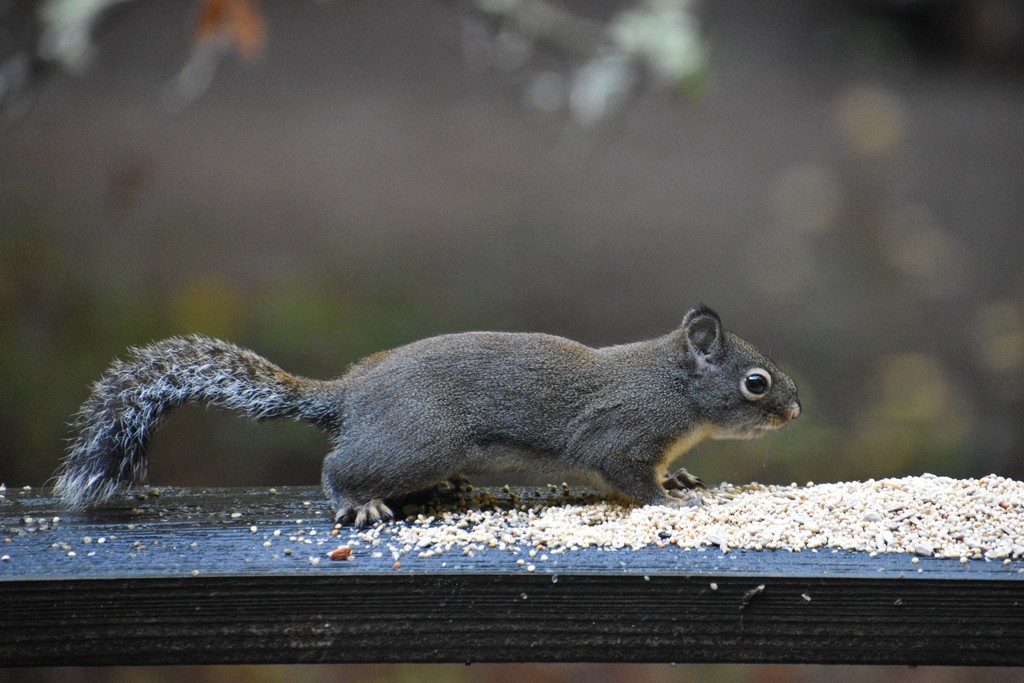
no rights reserved · CC0
Family: Sciuridae · Class: Mammalia · Order: Rodentia
Tamiasciurus douglasii (Douglas' Squirrel) is a California animal in the Sciuridae family.
Douglas' squirrel (Tamiasciurus douglasii), also known as the chickaree, is a small tree squirrel native to the coniferous forests of western North America. Adults measure 25-35 cm (10-14 inches) in total body length, with a bushy tail adding another 10-14 cm (4-5.5 inches). Body weight ranges from 150-300 grams (5.3-10.6 ounces). The dorsal pelage is olive-brown to rusty-brown, while the ventral surface is white to pale yellow. A distinct black lateral line separates the dorsal and ventral coloration during summer months. The tail is flattened with alternating bands of black and rusty-brown. In California, Douglas' squirrel occurs primarily in the Sierra Nevada range from Plumas County south to Tulare County, typically at elevations between 900-2,400 meters (2,950-7,870 feet). The species also inhabits coastal ranges from Del Norte County south to Santa Cruz County. Historically, populations extended further south in the Sierra Nevada, but current distribution has contracted northward. Small isolated populations persist in some southern California mountain ranges, including the San Bernardino and San Jacinto Mountains. Douglas' squirrel is strongly associated with mature coniferous forests, particularly those dominated by Douglas-fir, true firs (Abies spp.), and pines. The species requires forests with dense canopy cover that allows for continuous arboreal movement. Preferred habitats include mixed-conifer forests, red fir forests, and Douglas-fir forests with understories of shrubs and fallen logs. Territory size averages 0.4-0.8 hectares (1-2 acres) per individual, with boundaries marked by scent and defended vocally. This species is diurnal and highly arboreal, spending most of its time in the forest canopy. Diet consists primarily of conifer seeds, with Douglas-fir and pine seeds comprising the majority of food intake. Individuals create extensive caches of seeds and cones, storing them in tree cavities, underground burrows, and beneath logs. Breeding occurs once annually, typically from April through June. After a gestation period of 35-40 days, females produce litters of 3-6 young in tree cavities or stick nests. Juveniles remain dependent on their mothers for 10-12 weeks. Douglas' squirrels are known for their loud, territorial calls and aggressive defense of feeding territories. Currently, Douglas' squirrel holds no special conservation status at federal or state levels and is considered stable throughout most of its range. However, populations in southern California face pressure from habitat fragmentation due to urban development and altered fire regimes. Climate change poses potential long-term threats through shifts in forest composition and elevation of suitable habitat. The species serves as an important seed disperser in coniferous forest ecosystems and is a primary prey species for various predators including martens, weasels, and raptors.
Classification
Class: Mammalia · Order: Rodentia · Family: Sciuridae
Frequently asked questions
How is Tamiasciurus douglasii classified?
Tamiasciurus douglasii belongs to class Mammalia, order Rodentia, family Sciuridae.
What family does Tamiasciurus douglasii belong to?
Tamiasciurus douglasii is in the Sciuridae family.
What is Tamiasciurus douglasii?
Douglas' squirrel (Tamiasciurus douglasii), also known as the chickaree, is a small tree squirrel native to the coniferous forests of western North America.
Is Tamiasciurus douglasii found in California?
Yes. Tamiasciurus douglasii is recorded in California in The California Species Project's catalogue.
Related species
Other California species in the same genus, family, or bioregion.
Data from The California Species Project — 14,000+ California species with verified data from CNPS, CDFW, USFWS, and more.