Tamiasciurus fremonti grahamensis
Mount Graham red squirrel
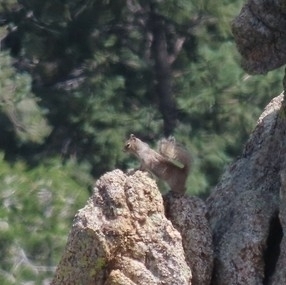
(c) Alina Martin, some rights reserved (CC BY) · licence
Family: Sciuridae · Class: Mammalia · Order: Rodentia
Conservation status: Endangered
Tamiasciurus fremonti grahamensis (Mount Graham red squirrel) is a California animal in the Sciuridae family.
The Mount Graham red squirrel is a small tree squirrel subspecies endemic to the Pinaleño Mountains of southeastern Arizona. Adults weigh approximately 224 grams (8 ounces) and measure about 20 centimeters (8 inches) in body length, with a fluffy tail extending an additional 15 centimeters (6 inches) (USFWS 2025). The species exhibits grayish-brown coloration with rusty and yellowish markings along the back. Unlike many squirrel species, Mount Graham red squirrels lack white-fringed tails. Males and females appear similar, with white underfur marked by a dark line during summer months. Historically distributed throughout the Pinaleño Mountains, the Mount Graham red squirrel now occupies a severely restricted range. The subspecies was once common above 2,590 meters (8,500 feet) elevation but is currently seldom found below 2,804 meters (9,200 feet) (USFWS Recovery Plan 1993). Most suitable habitat and remaining populations occur in the central eastern portion of the mountains at the highest elevations. The species was once present in western portions of the range but has experienced significant range contraction. Mount Graham red squirrels inhabit upper elevation mature to old-growth mixed conifer and spruce-fir forest associations above approximately 2,425 meters (8,000 feet). They may also occupy drainage bottoms where mixed conifer associations extend to lower elevations. The subspecies depends on a relatively small land base within this single isolated mountain range, making it inherently vulnerable to habitat changes and environmental threats. As members of the genus Tamiasciurus, these squirrels exhibit typical red squirrel behaviors including territorial defense of cone caches and year-round activity patterns. They feed primarily on conifer seeds, particularly from spruce and fir trees, creating large middens where they store cone caches for winter survival. The species' reproductive ecology and detailed behavioral patterns in this unique sky island environment require further scientific documentation. The Mount Graham red squirrel was listed as federally endangered in 1987, with current population estimates indicating fewer than 250 individuals remaining (USFWS 2025). The subspecies faces multiple conservation challenges including habitat loss from wildfires, drought, climate change effects, and the inherent vulnerability associated with its extremely limited range and small population size. Recent taxonomic updates have changed the scientific name from Tamiasciurus hudsonicus grahamensis to Tamiasciurus fremonti grahamensis, though this revision does not affect the endangered status or critical habitat designation (Federal Register 2021). Climate change poses a particularly severe long-term threat, as global warming may cause further retreat of suitable forest habitat up the mountain, potentially eliminating critical habitat areas. The U.S. Fish and Wildlife Service, Arizona Game and Fish Department, Forest Service, and partner organizations including Phoenix and San Diego Zoos have dedicated resources to monitoring, management, and recovery efforts for this critically imperiled subspecies.
Classification
Class: Mammalia · Order: Rodentia · Family: Sciuridae
Conservation status
Endangered
Frequently asked questions
How is Tamiasciurus fremonti grahamensis classified?
Tamiasciurus fremonti grahamensis belongs to class Mammalia, order Rodentia, family Sciuridae.
What family does Tamiasciurus fremonti grahamensis belong to?
Tamiasciurus fremonti grahamensis is in the Sciuridae family.
Is Tamiasciurus fremonti grahamensis protected or of conservation concern?
Tamiasciurus fremonti grahamensis carries the following status: Endangered.
What is Tamiasciurus fremonti grahamensis?
The Mount Graham red squirrel is a small tree squirrel subspecies endemic to the Pinaleño Mountains of southeastern Arizona.
Is Tamiasciurus fremonti grahamensis found in California?
Yes. Tamiasciurus fremonti grahamensis is recorded in California in The California Species Project's catalogue.
Related species
Other California species in the same genus, family, or bioregion.
Data from The California Species Project — 14,000+ California species with verified data from CNPS, CDFW, USFWS, and more.