Tantilla hobartsmithi
Smith's Black-Headed Snake
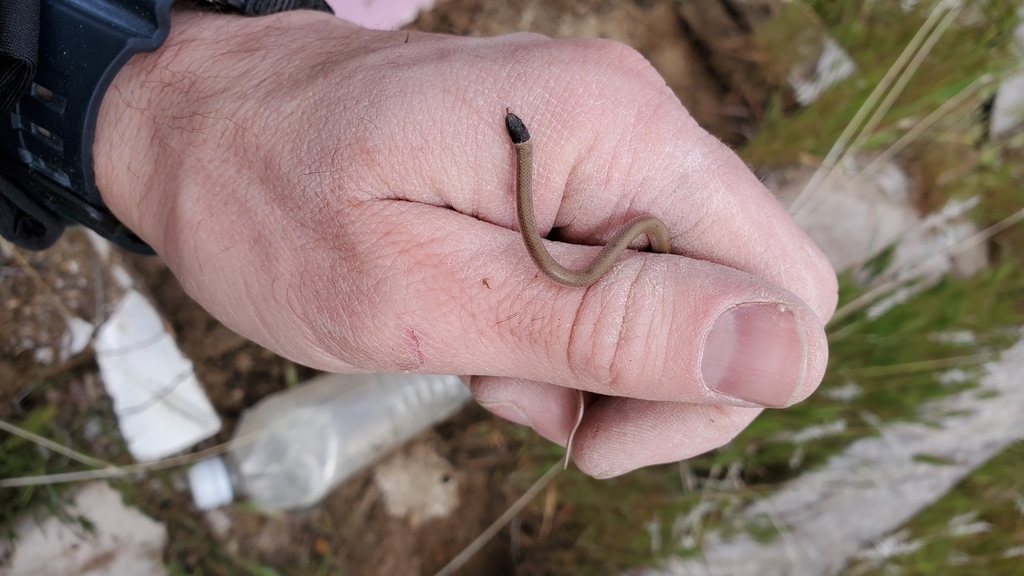
(c) B. P. White, some rights reserved (CC BY-SA) · licence
Family: Colubridae · Class: Reptilia · Order: Squamata
Tantilla hobartsmithi (Smith's Black-Headed Snake) is a California animal in the Colubridae family.
Smith's black-headed snake is a small, secretive colubrid snake endemic to the southwestern United States. Adults typically measure 200 to 380 mm (7.9 to 15.0 inches) in total length, with females generally larger than males. The dorsal surface is tan to light brown, while the ventral surface is cream to white. The species is characterized by a distinctive black cap extending from the snout to approximately the third or fourth scale row behind the head, contrasting sharply with the lighter body coloration. The black cap is bordered posteriorly by a white or cream-colored collar that extends 1-3 scale rows behind the head. Scales are smooth, arranged in 15 dorsal scale rows at midbody, with 120-140 ventral scales and 35-50 subcaudal scales. Smith's black-headed snake occurs across the southwestern United States, including Arizona, New Mexico, Utah, Colorado, and Nevada. In California, the species has limited distribution primarily in the southeastern desert regions. The species extends southward into northwestern Mexico in the states of Sonora and Chihuahua. Historical records indicate a broader distribution, though current populations appear more fragmented than previously documented. This species inhabits arid and semi-arid environments, typically in desert scrubland, grassland, and woodland communities. Smith's black-headed snake shows a strong association with riparian corridors and areas near intermittent streams, particularly in Utah where it is considered rare. The species occurs from approximately 760 to 2,130 meters (2,500 to 7,000 feet) in elevation. Preferred microhabitats include areas with loose soil, rock crevices, and debris piles where the snake can burrow and seek shelter. Vegetation communities include creosote bush scrub, desert grassland, pinyon-juniper woodland, and oak woodland. Smith's black-headed snake is fossorial and secretive, spending most daylight hours underground or beneath surface cover. The species is primarily active during twilight and nighttime hours, particularly following precipitation events. Diet consists almost exclusively of invertebrates, particularly centipedes, beetle larvae, and spider eggs, with centipedes comprising the majority of documented prey items. Reproduction occurs through oviposition, with females laying 2-4 elongated eggs during summer months, typically in loose soil or under rocks. Eggs measure approximately 15-20 mm in length and have an incubation period of 45-60 days. Smith's black-headed snake is not federally listed under the Endangered Species Act, though it is considered a Species of Greatest Conservation Need in Utah due to its rarity within the state. Primary threats include habitat fragmentation from urban development, agricultural conversion, and water diversions that affect riparian corridors. Climate change may impact the species through altered precipitation patterns and increased temperatures in already arid habitats. The secretive nature and limited detectability of this species make population monitoring challenging, and current population trends remain largely unknown. Conservation efforts focus on habitat protection within existing protected areas and maintaining connectivity between fragmented populations.
Classification
Class: Reptilia · Order: Squamata · Family: Colubridae
Frequently asked questions
How is Tantilla hobartsmithi classified?
Tantilla hobartsmithi belongs to class Reptilia, order Squamata, family Colubridae.
What family does Tantilla hobartsmithi belong to?
Tantilla hobartsmithi is in the Colubridae family.
What is Tantilla hobartsmithi?
Smith's black-headed snake is a small, secretive colubrid snake endemic to the southwestern United States.
Is Tantilla hobartsmithi found in California?
Yes. Tantilla hobartsmithi is recorded in California in The California Species Project's catalogue.
Related species
Other California species in the same genus, family, or bioregion.
Data from The California Species Project — 14,000+ California species with verified data from CNPS, CDFW, USFWS, and more.