Tantilla planiceps
Western Black-Headed Snake
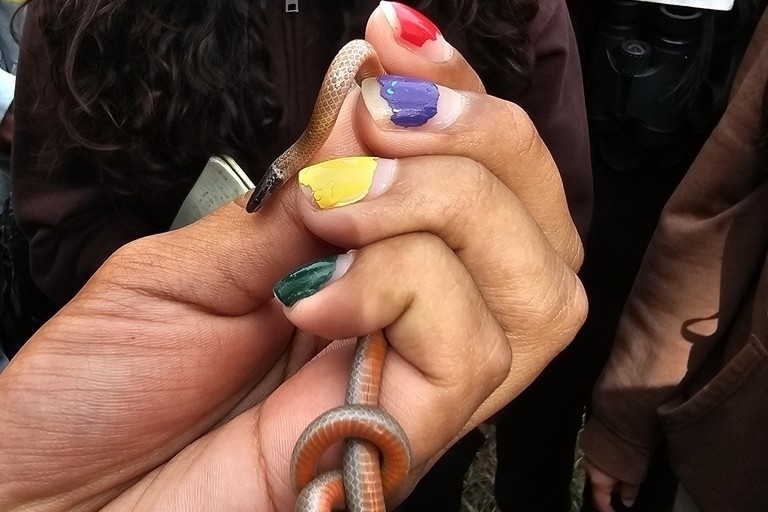
no rights reserved · CC0
Family: Colubridae · Class: Reptilia · Order: Squamata
Tantilla planiceps (Western Black-Headed Snake) is a California animal in the Colubridae family.
The Western Black-headed Snake (Tantilla planiceps) is a small, secretive serpent belonging to the family Colubridae. Adults typically measure 18 to 38 centimeters (7 to 15 inches) in total length, with a maximum recorded length of approximately 46 centimeters (18 inches). The species is characterized by a distinctive black or dark brown cap extending from the snout to just behind the eyes, contrasting sharply with the pale tan to gray body coloration. The dark cap is bordered posteriorly by a white or cream-colored collar that extends across the neck. The ventral surface is uniformly white or cream-colored, and the species lacks the red coloration found in some related species. The body is cylindrical with smooth scales arranged in 15 rows at midbody. The Western Black-headed Snake occurs in disjunct populations across California, from near sea level to elevations of approximately 1,219 meters (4,000 feet). The species is found in scattered locations including coastal areas of Southern California, the San Francisco Bay region extending just south of San Jose, areas east of Mount Diablo, east of Livermore, and documented populations in the Caliente Mountains of San Luis Obispo County as of 2014. The range extends southward into Baja California, Mexico, reaching the cape region. Within California, documented locations include refuges such as Pixley National Wildlife Refuge in the Central Valley and Hopper Mountain National Wildlife Refuge in Ventura County. This species inhabits diverse habitat types including semi-arid grasslands, chaparral, coastal sage scrub, oak woodlands, and mixed shrublands. Western Black-headed Snakes prefer areas with loose soil or leaf litter where they can burrow and find cover. They are commonly found under rocks, logs, debris, and in areas with dense ground cover. The species appears to favor habitats near permanent water sources with associated riparian vegetation in some portions of its range. Western Black-headed Snakes are primarily fossorial and crepuscular, spending most daylight hours underground or beneath surface cover. They emerge primarily during evening and nighttime hours to forage. The diet consists predominantly of small invertebrates, particularly centipedes, millipedes, beetle larvae, and other soft-bodied arthropods. Reproductive behavior includes egg-laying, with females depositing small clutches of eggs during summer months. The species exhibits secretive behavior and is infrequently encountered due to its fossorial lifestyle and small size. The Western Black-headed Snake is not federally listed under the Endangered Species Act and lacks special conservation status designations in California as of December 2025. However, like many small reptile species, populations may face localized threats from habitat loss due to urban development, agricultural conversion, and fragmentation of suitable habitat. The species' secretive nature makes population monitoring challenging, and its conservation status may be underassessed due to limited survey data.
Classification
Class: Reptilia · Order: Squamata · Family: Colubridae
Frequently asked questions
How is Tantilla planiceps classified?
Tantilla planiceps belongs to class Reptilia, order Squamata, family Colubridae.
What family does Tantilla planiceps belong to?
Tantilla planiceps is in the Colubridae family.
What is Tantilla planiceps?
The Western Black-headed Snake (Tantilla planiceps) is a small, secretive serpent belonging to the family Colubridae.
Is Tantilla planiceps found in California?
Yes. Tantilla planiceps is recorded in California in The California Species Project's catalogue.
Related species
Other California species in the same genus, family, or bioregion.
Data from The California Species Project — 14,000+ California species with verified data from CNPS, CDFW, USFWS, and more.