Tarentola annularis
Ringed Wall Gecko
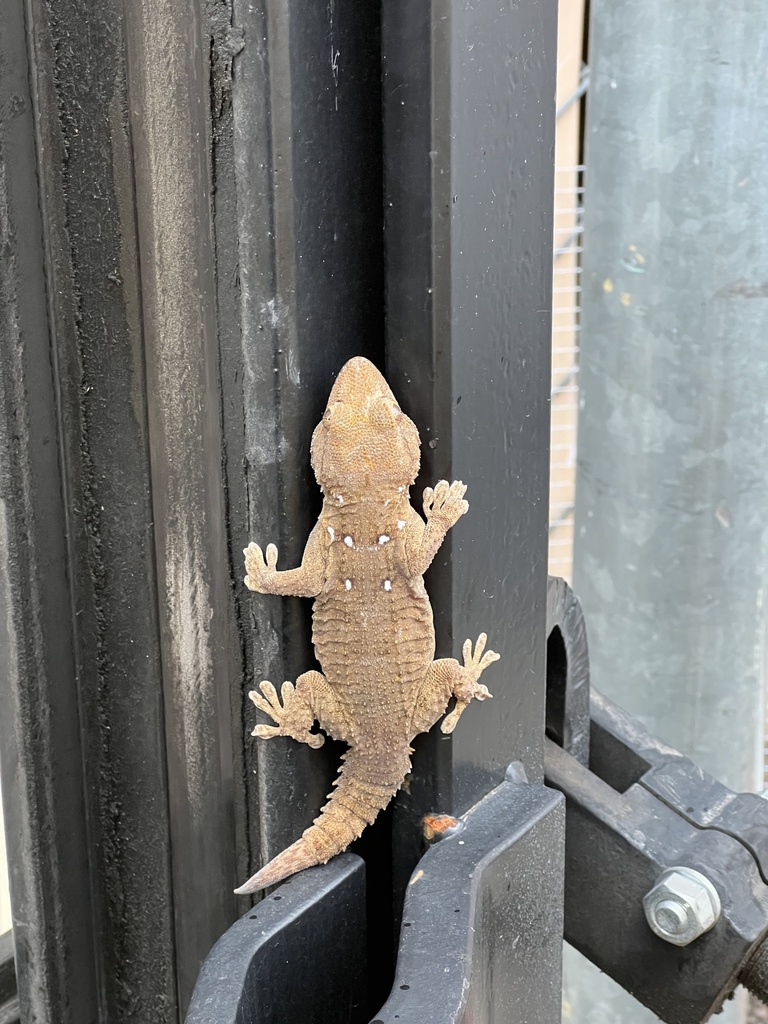
no rights reserved · CC0
Family: Phyllodactylidae · Class: Reptilia · Order: Squamata
Tarentola annularis (Ringed Wall Gecko) is a California animal in the Phyllodactylidae family.
The Ringed Wall Gecko, also known as the White-spotted Wall Gecko, is a medium-sized gecko native to northern Africa that has established small populations in California. Adults typically measure 100-120 mm (4-5 inches) in total length, making them larger than most other introduced gecko species in the state. The body is covered in granular scales with scattered enlarged tubercles, giving the skin a less wrinkled appearance compared to similar species. The dorsal coloration ranges from reddish-brown to gray or olive, marked with small black flecks and spots across the back and sides. Dark bands pattern the legs, while distinctive white spots on the shoulders serve as a key identifying feature. The underside of the rear legs displays characteristic red coloring. In California, the Ringed Wall Gecko has been documented only in Redlands, San Bernardino County, where a population was first reported in 2006. The Natural History Museum of Los Angeles County published the first scientific documentation of the species in California in 2014. According to local reports, the population appears to be thriving in the downtown Redlands area, with neonates observed up to 3 miles from the suspected original introduction site. The species has a much broader distribution in Arizona, particularly around the Phoenix metropolitan area, and is also established in Florida. Its native range encompasses northern Africa and western Asia, including Algeria, Egypt, Israel, Jordan, Lebanon, and parts of the Arabian Peninsula. This gecko occupies urban habitats in California, primarily inhabiting buildings and urban alleys. The species demonstrates strong climbing abilities and is commonly found on vertical surfaces. In its native range, it typically occurs at elevations below 400 meters (1,300 feet) but can be found as high as 1,400 meters (4,600 feet). Ringed Wall Geckos are nocturnal and exhibit territorial behavior, readily biting when handled and producing audible squeaking sounds when threatened or engaging in territorial disputes. They are opportunistic predators, feeding on invertebrates and occasionally small lizards. The species is known to forage actively under artificial light sources, taking advantage of insects attracted to urban lighting. In their native habitat of northern Africa, females produce multiple clutches per breeding season, typically laying two eggs per clutch. The Ringed Wall Gecko lacks formal conservation status listings and is not considered threatened. However, the California population represents an introduced, non-native species with unknown ecological impacts. The most likely origin of the California population involves escaped or released pets, similar to establishment patterns documented in Arizona where intentional releases by homeowners seeking natural scorpion control have been reported. The limited distribution in California suggests either recent establishment or environmental constraints limiting population expansion beyond the current range in San Bernardino County.
Classification
Class: Reptilia · Order: Squamata · Family: Phyllodactylidae
Frequently asked questions
How is Tarentola annularis classified?
Tarentola annularis belongs to class Reptilia, order Squamata, family Phyllodactylidae.
What family does Tarentola annularis belong to?
Tarentola annularis is in the Phyllodactylidae family.
What is Tarentola annularis?
The Ringed Wall Gecko, also known as the White-spotted Wall Gecko, is a medium-sized gecko native to northern Africa that has established small populations in California.
Is Tarentola annularis found in California?
Yes. Tarentola annularis is recorded in California in The California Species Project's catalogue.
Related species
Other California species in the same genus, family, or bioregion.
Data from The California Species Project — 14,000+ California species with verified data from CNPS, CDFW, USFWS, and more.