Tarentola mauritanica
Moorish Wall Gecko
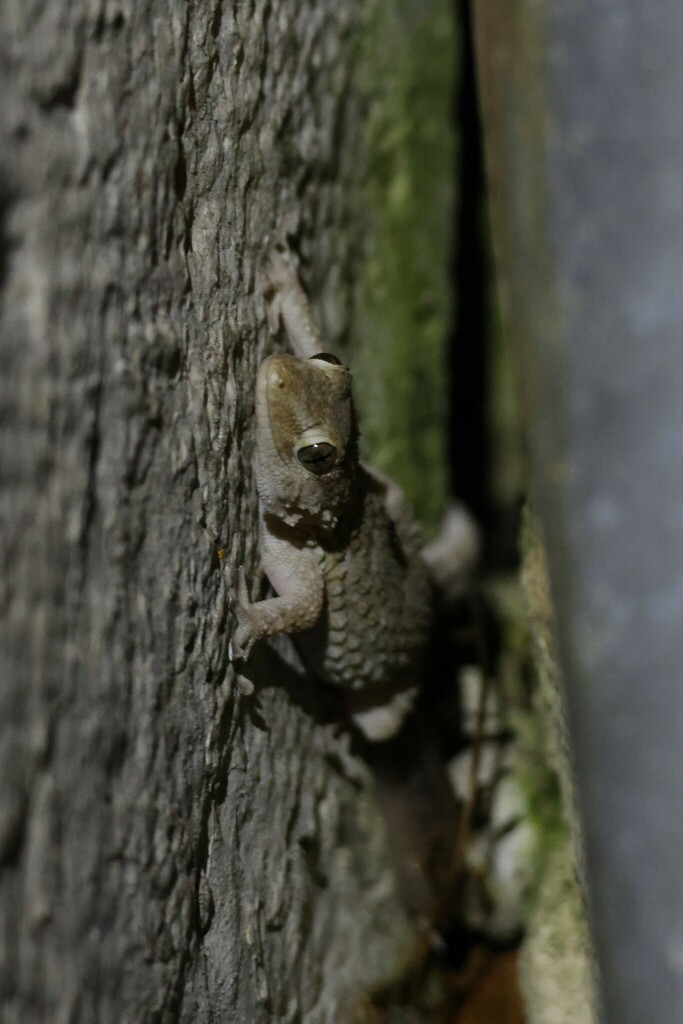
(c) Diego González Dopico, some rights reserved (CC BY) · licence
Family: Phyllodactylidae · Class: Reptilia · Order: Squamata
Tarentola mauritanica (Moorish Wall Gecko) is a California animal in the Phyllodactylidae family.
The Moorish Wall Gecko is a medium-sized gecko measuring up to 15 cm (6 inches) in total length, with adults typically reaching 8 cm (3.2 inches) from snout to vent. The body is covered in wrinkled skin with prominent tubercles, giving it a distinctly textured appearance. Coloration is variable, ranging from brownish to grey or sandy with dark and light markings. The species exhibits color-changing ability, appearing darker during daylight hours and lighter at night. The underside is white to yellow. Juveniles display distinct dark banding patterns that become less pronounced with age. The tail is easily autotomized and will regenerate, though regenerated tails lack the tubercles of the original. Adhesive toe pads enable vertical locomotion on smooth surfaces. The Moorish Wall Gecko is not native to California and represents an introduced species with limited established populations. According to California Herps, isolated populations have been documented in San Diego County, with establishment first reported by Mahrdt in 1998. Additional populations may exist in other urban areas of southern California. The native range extends across Mediterranean regions of northern Africa and western Asia, including Algeria, Egypt, Israel, Jordan, Lebanon, and Syria. In California, established populations are associated with urban and suburban environments. The species primarily inhabits buildings, walls, and urban structures rather than natural habitats. In its native range, Moorish Wall Geckos occupy stone walls, boulder outcrops, and wood piles in warm, dry, lowland coastal areas. The California populations demonstrate adaptation to artificial substrates including cinderblock fences and building exteriors. Moorish Wall Geckos are primarily nocturnal but have been observed basking during daylight hours, sometimes alongside native Western Fence Lizards. The species is territorial and produces audible squeaking sounds when threatened or during territorial disputes. Diet consists of invertebrates and small lizards. Reproduction involves multiple clutches per breeding season, with females typically laying two eggs per clutch. Eggs are deposited between April and June in the species' native range. Sexual maturity is reached after several years of development. As a non-native species in California, the Moorish Wall Gecko is not afforded protection under state or federal endangered species legislation. The species lacks formal conservation status within California, and its long-term establishment success remains uncertain. The limited distribution and apparent restriction to urban environments suggest minimal impact on native ecosystems, though comprehensive assessment of ecological interactions has not been conducted. Population trends and expansion potential in California remain poorly documented. The species' establishment likely results from escaped or released pet trade animals rather than natural colonization.
Classification
Class: Reptilia · Order: Squamata · Family: Phyllodactylidae
Frequently asked questions
How is Tarentola mauritanica classified?
Tarentola mauritanica belongs to class Reptilia, order Squamata, family Phyllodactylidae.
What family does Tarentola mauritanica belong to?
Tarentola mauritanica is in the Phyllodactylidae family.
What is Tarentola mauritanica?
The Moorish Wall Gecko is a medium-sized gecko measuring up to 15 cm (6 inches) in total length, with adults typically reaching 8 cm (3.2 inches) from snout to vent.
Is Tarentola mauritanica found in California?
Yes. Tarentola mauritanica is recorded in California in The California Species Project's catalogue.
Related species
Other California species in the same genus, family, or bioregion.
Data from The California Species Project — 14,000+ California species with verified data from CNPS, CDFW, USFWS, and more.