Taricha granulosa
Rough-Skinned Newt
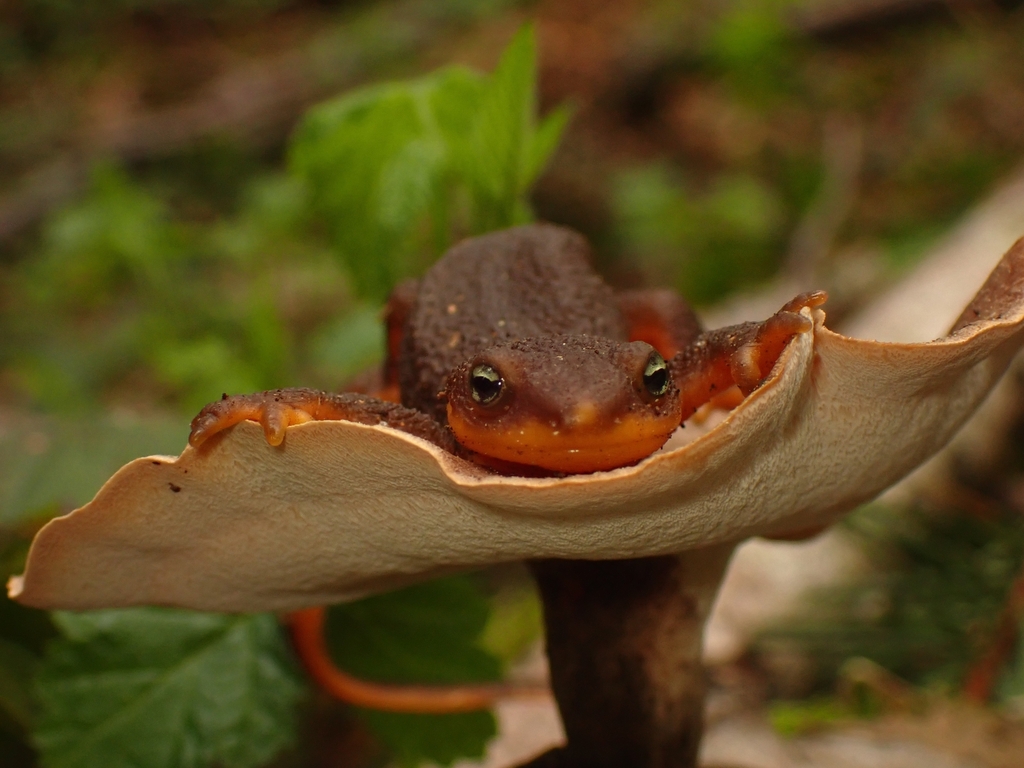
(c) Rand Workman, some rights reserved (CC BY-SA) · licence
Family: Salamandridae · Class: Amphibia · Order: Caudata
Taricha granulosa (Rough-Skinned Newt) is a California animal in the Salamandridae family.
The rough-skinned newt is a medium-sized salamander endemic to the Pacific Coast of North America. Adults typically measure 14 to 22 cm (5.5 to 8.7 inches) in total length, with females generally larger than males. The species exhibits distinct dorsal and ventral coloration: the upper surface ranges from olive-brown to dark brown or nearly black, while the ventral surface is bright yellow to orange-red. The skin texture is notably granular and dry-appearing, giving the species its common name. During the aquatic breeding phase, males develop smooth skin, a laterally compressed tail with a distinct fin, and enlarged hind limbs. Rough-skinned newts occur along the Pacific Coast from southeastern Alaska south to central California. In California, the species is found primarily in the Coast Ranges and the western slopes of the Sierra Nevada, extending from sea level to approximately 2,800 meters (9,200 feet) in elevation. The distribution includes coastal counties from Humboldt south to Santa Barbara County, with populations extending inland through the Central Valley foothills and into the Sierra Nevada. This species inhabits a variety of forest and woodland environments, including coastal redwood forests, mixed coniferous forests, oak woodlands, and chaparral. Adults require access to permanent or semi-permanent water sources for breeding, including ponds, lakes, slow-moving streams, and reservoirs. Terrestrial habitats must provide adequate moisture and cover, with newts commonly found under logs, rocks, bark, and leaf litter. The species shows preference for areas with dense canopy cover that maintains soil moisture. Rough-skinned newts are primarily nocturnal and exhibit both aquatic and terrestrial life stages. Adults migrate to breeding waters in late fall through early spring, depending on local conditions and elevation. Females deposit 7 to 30 eggs individually on aquatic vegetation or debris. Larvae develop over several months, transforming into terrestrial juveniles by late summer or early fall. The species is notable for producing tetrodotoxin, a potent neurotoxin concentrated in the skin glands that provides protection from predators. This toxin is the same compound found in pufferfish and can be lethal to predators and humans. Diet consists primarily of small invertebrates including insects, worms, slugs, and spiders. Currently, the rough-skinned newt has no federal or state conservation listing status and is considered stable across most of its range. However, localized populations face threats from habitat loss due to urban development, timber harvest practices, and water diversions that affect breeding sites. Climate change poses potential risks through altered precipitation patterns and increased wildfire frequency. Road mortality during breeding migrations represents a significant threat in some areas. Water pollution and the introduction of non-native predatory fish in breeding habitats have caused declines in specific locations. The species' relatively stable status reflects its adaptability to various habitat conditions and broad distribution across the Pacific Northwest.
Classification
Class: Amphibia · Order: Caudata · Family: Salamandridae
Frequently asked questions
How is Taricha granulosa classified?
Taricha granulosa belongs to class Amphibia, order Caudata, family Salamandridae.
What family does Taricha granulosa belong to?
Taricha granulosa is in the Salamandridae family.
What is Taricha granulosa?
The rough-skinned newt is a medium-sized salamander endemic to the Pacific Coast of North America.
Is Taricha granulosa found in California?
Yes. Taricha granulosa is recorded in California in The California Species Project's catalogue.
Related species
Other California species in the same genus, family, or bioregion.
Data from The California Species Project — 14,000+ California species with verified data from CNPS, CDFW, USFWS, and more.