Taricha rivularis
Red-bellied Newt
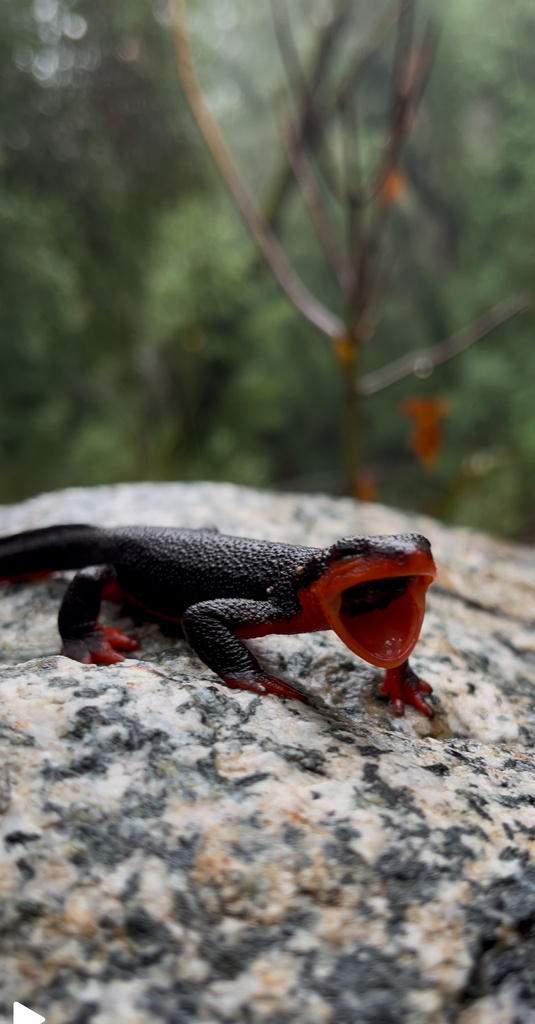
(c) Parsa Fard, some rights reserved (CC BY) · licence
Family: Salamandridae · Class: Amphibia · Order: Caudata
Conservation status: G2 S2
Taricha rivularis (Red-bellied Newt) is a California animal in the Salamandridae family.
The red-bellied newt (Taricha rivularis) is a medium-sized terrestrial salamander endemic to the coastal ranges of northern California. Adults typically measure 140 to 190 mm (5.5 to 7.5 inches) in total length, with females generally larger than males. The species is distinguished by its dark brown to black dorsal coloration and bright red to orange-red ventral surface, which extends from the chin to the underside of the tail. The skin has a granular texture during terrestrial phases, becoming smoother during aquatic breeding periods. Eyes are small and dark, positioned on the sides of the relatively broad head. Red-bellied newts have the most restricted range of any North American Taricha species, occurring only in coastal Sonoma and Mendocino counties in California. Historical records indicate the species was once more widespread throughout the Russian River drainage system. Current populations are fragmented and limited to forested watersheds within approximately 50 kilometers of the Pacific Ocean. The species occurs in elevations ranging from sea level to approximately 760 meters (2,500 feet). This species inhabits mixed coniferous and deciduous forests dominated by coast redwood (Sequoia sempervirens), Douglas fir (Pseudotsuga menziesii), and California bay laurel (Umbellularia californica). Adults require cool, moist microhabitats including talus slopes, rocky crevices, and areas beneath fallen logs and leaf litter. During dry periods, individuals may burrow up to one meter underground or retreat to deep rock crevices. Breeding occurs in permanent and semi-permanent streams, springs, and occasionally ponds with cool, clear water and moderate flow rates. Red-bellied newts exhibit a complex life cycle with distinct terrestrial and aquatic phases. Adults migrate to breeding sites during winter rains, typically between December and March. Females deposit 7 to 16 eggs individually on the undersides of rocks or logs in flowing water. Eggs hatch after 6 to 10 weeks, and larvae remain aquatic for 4 to 7 months before metamorphosing. Adults are primarily nocturnal predators, feeding on insects, spiders, worms, and other small invertebrates. Like other Taricha species, red-bellied newts produce tetrodotoxin, a potent neurotoxin that deters predation. The red-bellied newt holds a Global rank of G2 (imperiled) and a California State rank of S2 (imperiled), indicating high vulnerability to extinction. Population declines have been documented throughout much of the species' range due to habitat loss from logging, urban development, and water diversions. Stream sedimentation from timber harvesting and road construction degrades breeding habitat quality. Climate change poses additional threats through altered precipitation patterns and increased wildfire frequency. Invasive species, including bullfrogs and non-native fish, prey on larvae and compete for aquatic resources. Conservation efforts focus on protecting remaining old-growth forest habitat and maintaining water quality in breeding streams through improved land management practices.
Classification
Class: Amphibia · Order: Caudata · Family: Salamandridae
Conservation status
G2 S2
Frequently asked questions
How is Taricha rivularis classified?
Taricha rivularis belongs to class Amphibia, order Caudata, family Salamandridae.
What family does Taricha rivularis belong to?
Taricha rivularis is in the Salamandridae family.
Is Taricha rivularis protected or of conservation concern?
Taricha rivularis carries the following status: G2 S2.
What is Taricha rivularis?
The red-bellied newt (Taricha rivularis) is a medium-sized terrestrial salamander endemic to the coastal ranges of northern California.
Is Taricha rivularis found in California?
Yes. Taricha rivularis is recorded in California in The California Species Project's catalogue.
Related species
Other California species in the same genus, family, or bioregion.
Data from The California Species Project — 14,000+ California species with verified data from CNPS, CDFW, USFWS, and more.