Taricha sierrae
Sierra Newt
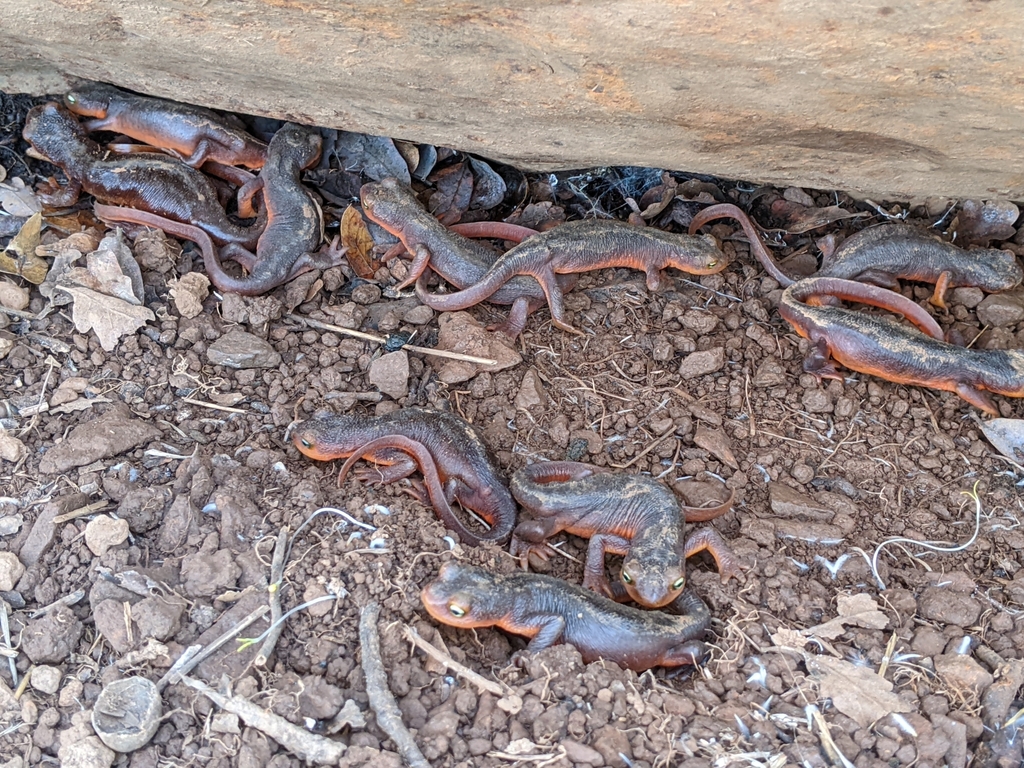
(c) Ken-ichi Ueda, some rights reserved (CC BY) · licence
Family: Salamandridae · Class: Amphibia · Order: Caudata
Taricha sierrae (Sierra Newt) is a California animal in the Salamandridae family.
The Sierra newt (Taricha sierrae) is a medium-sized terrestrial salamander endemic to the Sierra Nevada mountain range of California. Adults typically measure 75 to 130 mm (3.0 to 5.1 inches) in total length, with females generally larger than males. The dorsal surface is dark brown to black, while the ventral surface displays bright yellow to orange coloration with irregular dark markings. During the aquatic breeding phase, males develop a laterally compressed tail and smooth skin texture, while terrestrial adults maintain rougher, more granular skin. The Sierra newt occurs along the western slopes of the Sierra Nevada from approximately Butte County south to Tulare County, at elevations ranging from 450 to 2,200 meters (1,475 to 7,220 feet). Populations are documented in foothill oak woodlands, mixed coniferous forests, and montane chaparral communities. The species shows a patchy distribution pattern, with populations often separated by unsuitable habitat or geographic barriers. Historical records indicate the range may have been more continuous prior to habitat fragmentation. Sierra newts inhabit mixed oak-pine woodlands, ponderosa pine forests, and areas with dense understory vegetation. Terrestrial adults require moist microhabitats such as fallen logs, rock crevices, and leaf litter during the dry season. Breeding occurs in slow-moving streams, ponds, and seasonal pools with permanent or semi-permanent water. Adults migrate to aquatic breeding sites following winter rains, typically between December and April depending on elevation and local conditions. The species exhibits a complex life cycle with distinct terrestrial and aquatic phases. Adults are carnivorous, feeding on insects, worms, small arthropods, and other invertebrates found in leaf litter and soil. Breeding occurs annually, with females depositing 15 to 30 eggs individually on submerged vegetation or rocks. Eggs develop over 2 to 4 weeks, hatching into aquatic larvae that undergo metamorphosis after 3 to 6 months. Larvae feed on small aquatic invertebrates and algae. Adults can live 10 to 20 years in the wild and exhibit strong site fidelity to both terrestrial home ranges and breeding locations. Like other members of the genus Taricha, Sierra newts produce potent neurotoxins in their skin as defense against predators. The bright ventral coloration serves as warning coloration to potential predators. Adults are primarily active during cool, moist conditions and may estivate underground during hot, dry periods. Currently, the Sierra newt lacks federal listing status under the Endangered Species Act and does not appear on California's list of threatened or endangered species. However, populations face increasing pressure from habitat loss due to development, logging, and fire management practices. Climate change poses additional threats through altered precipitation patterns and increased wildfire frequency. Water diversions and habitat fragmentation in foothill areas may isolate breeding populations and reduce genetic connectivity between metapopulations.
Classification
Class: Amphibia · Order: Caudata · Family: Salamandridae
Frequently asked questions
How is Taricha sierrae classified?
Taricha sierrae belongs to class Amphibia, order Caudata, family Salamandridae.
What family does Taricha sierrae belong to?
Taricha sierrae is in the Salamandridae family.
What is Taricha sierrae?
The Sierra newt (Taricha sierrae) is a medium-sized terrestrial salamander endemic to the Sierra Nevada mountain range of California.
Is Taricha sierrae found in California?
Yes. Taricha sierrae is recorded in California in The California Species Project's catalogue.
Related species
Other California species in the same genus, family, or bioregion.
Data from The California Species Project — 14,000+ California species with verified data from CNPS, CDFW, USFWS, and more.