Taricha torosa
California Newt
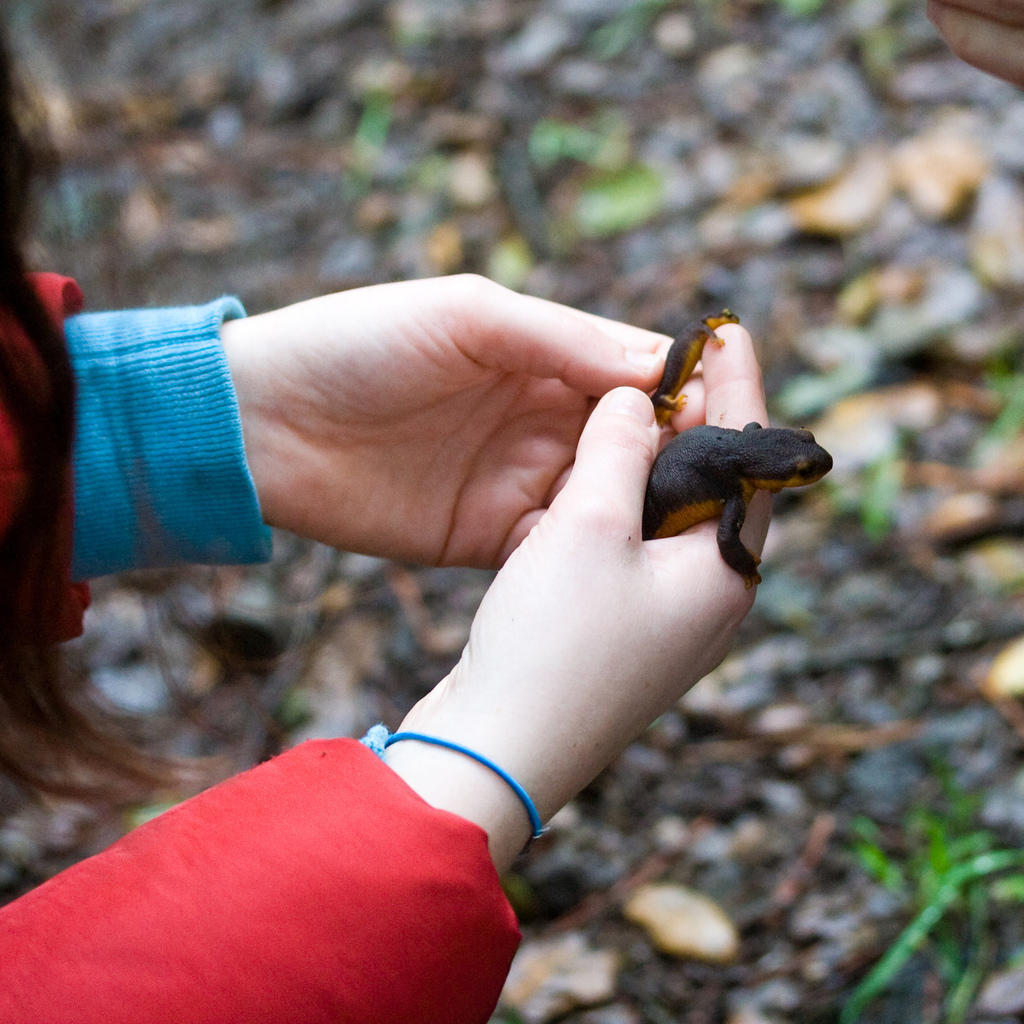
(c) Ken-ichi Ueda, some rights reserved (CC BY) · licence
Family: Salamandridae · Class: Amphibia · Order: Caudata
Conservation status: G4 S4
Taricha torosa (California Newt) is a California animal in the Salamandridae family.
The California newt (Taricha torosa), also known as the Coast Range newt, is a medium-sized salamander endemic to California and Baja California, Mexico. Adults typically measure 76 to 102 mm (3.0 to 4.0 inches) in total length, with females generally larger than males. The dorsal surface is olive-brown to tan, while the ventral surface displays bright orange to yellow coloration. During the breeding season, males develop smooth, dark skin and a laterally compressed tail with a pronounced fin-like crest. The skin contains potent neurotoxins, including tetrodotoxin, which serves as a defense mechanism against predators. California newts occur along the Pacific Coast from Mendocino County south to San Diego County, with populations extending into Baja California, Mexico. The species inhabits the Coast Ranges, Sierra Nevada foothills, and southern California mountains at elevations from sea level to approximately 2,134 meters (7,000 feet). Historical range reduction has occurred in some urbanized areas, particularly in southern California. The species occupies oak woodlands, chaparral, and coniferous forests, requiring both terrestrial and aquatic habitats for reproduction. Adults spend most of the year in upland areas under logs, rocks, or leaf litter within 1.6 km (1 mile) of breeding sites. Breeding occurs in slow-moving streams, ponds, reservoirs, and stock tanks with permanent or semi-permanent water. Optimal breeding habitat includes areas with emergent vegetation, moderate depths of 0.3 to 1.5 meters (1 to 5 feet), and minimal flow velocity. California newts exhibit a complex life cycle involving aquatic larvae and terrestrial adults. Breeding typically occurs from December through May, depending on precipitation patterns and temperature. Males migrate to aquatic sites first, developing secondary sexual characteristics including enlarged cloaca and smooth skin. Females deposit 7 to 47 eggs individually on submerged vegetation or rocks. Larval development requires 10 to 20 weeks, with metamorphosis occurring from July through October. Adults are opportunistic predators, consuming insects, worms, snails, and other invertebrates. The species demonstrates strong site fidelity, with individuals returning to natal ponds for breeding. The California newt is ranked G4 S4, indicating the species is apparently secure globally and within California. However, localized populations face threats from habitat fragmentation, urban development, water diversions, and introduced predators such as mosquitofish and bullfrogs. Climate change poses additional risks through altered precipitation patterns and increased drought frequency. Road mortality during breeding migrations represents a significant threat in developed areas. Disease, particularly chytrid fungus infections, has been documented in some populations. While not listed under state or federal endangered species acts, the species is protected under California Fish and Game Code Section 5050, which prohibits take without appropriate permits.
Classification
Class: Amphibia · Order: Caudata · Family: Salamandridae
Conservation status
G4 S4
Frequently asked questions
How is Taricha torosa classified?
Taricha torosa belongs to class Amphibia, order Caudata, family Salamandridae.
What family does Taricha torosa belong to?
Taricha torosa is in the Salamandridae family.
Is Taricha torosa protected or of conservation concern?
Taricha torosa carries the following status: G4 S4.
What is Taricha torosa?
The California newt (Taricha torosa), also known as the Coast Range newt, is a medium-sized salamander endemic to California and Baja California, Mexico.
Is Taricha torosa found in California?
Yes. Taricha torosa is recorded in California in The California Species Project's catalogue.
Related species
Other California species in the same genus, family, or bioregion.
Data from The California Species Project — 14,000+ California species with verified data from CNPS, CDFW, USFWS, and more.