Tarsiger cyanurus
Red-flanked Bluetail
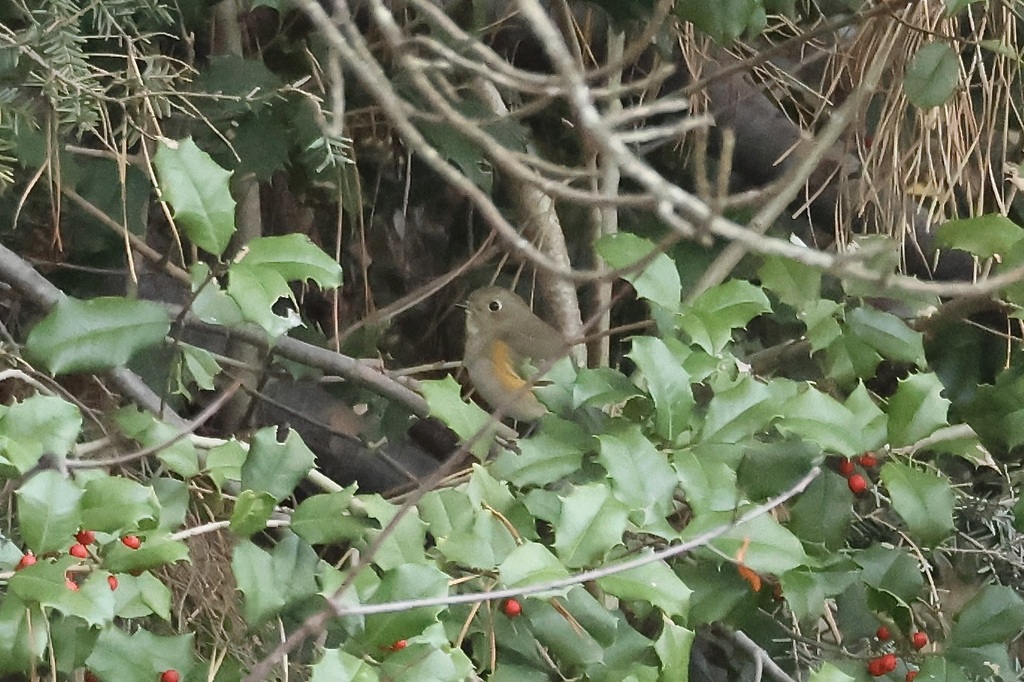
(c) er-birds, some rights reserved (CC BY) · licence
Family: Muscicapidae · Class: Aves · Order: Passeriformes
Tarsiger cyanurus (Red-flanked Bluetail) is a California animal in the Muscicapidae family.
The Red-flanked Bluetail is a small passerine bird in the family Muscicapidae, measuring approximately 14 cm (5.5 inches) in length with a wingspan of 20-22 cm (7.9-8.7 inches). Adult males display distinctive plumage with bright blue upperparts extending from the crown to the tail, contrasting with white underparts and prominent orange-red flanks that give the species its common name. The throat is white with a black border. Females and juveniles are more subdued, showing brownish-olive upperparts with a blue tail and rump, and pale underparts with less pronounced orange flanking. Both sexes exhibit the characteristic bright blue tail that is frequently flicked and spread during foraging and territorial displays. The Red-flanked Bluetail breeds across the boreal forests of northern Eurasia, from Scandinavia eastward through Siberia to northeastern China, Korea, and Japan. During winter, the species migrates to southern and southeastern Asia, including parts of China, Southeast Asia, and the Indian subcontinent. In North America, the Red-flanked Bluetail is considered an extremely rare vagrant, with documented occurrences primarily in Alaska's western Aleutian Islands and Bering Sea islands. California records are exceptionally rare, with fewer than five documented sightings in the state's history, typically occurring during fall migration periods along the coast. This species inhabits dense coniferous and mixed forests, particularly favoring areas with spruce, fir, and birch trees. During the breeding season, Red-flanked Bluetails occupy mature forests with thick understory vegetation, often near water sources such as streams or forest clearings. They typically forage in the lower canopy and understory levels, rarely venturing into completely open areas. Elevation preferences range from sea level to approximately 2,000 meters (6,600 feet) in montane forests. Red-flanked Bluetails are primarily insectivorous, feeding on beetles, flies, caterpillars, spiders, and other small arthropods captured through gleaning and occasional aerial sallies. During autumn and winter, they supplement their diet with small berries and seeds. The species is generally solitary outside the breeding season. Breeding occurs from May through July, with females constructing cup-shaped nests in tree cavities, rock crevices, or dense vegetation close to the ground. Clutch size typically ranges from 4-7 pale blue eggs with fine reddish-brown spotting. Incubation lasts approximately 13-15 days, and nestlings fledge after 12-14 days. The Red-flanked Bluetail is not federally listed in the United States and has no special conservation status in California due to its rarity as a vagrant species. Globally, the species is classified as Least Concern by the International Union for Conservation of Nature, with stable populations across its breeding range. In its native habitat, primary threats include habitat loss due to logging and forest fragmentation, though overall population trends remain stable. Climate change may affect migration patterns and breeding success in northern populations. For California birders, any Red-flanked Bluetail sighting represents a significant vagrant occurrence requiring careful documentation and verification by ornithological authorities.
Classification
Class: Aves · Order: Passeriformes · Family: Muscicapidae
Frequently asked questions
How is Tarsiger cyanurus classified?
Tarsiger cyanurus belongs to class Aves, order Passeriformes, family Muscicapidae.
What family does Tarsiger cyanurus belong to?
Tarsiger cyanurus is in the Muscicapidae family.
What is Tarsiger cyanurus?
The Red-flanked Bluetail is a small passerine bird in the family Muscicapidae, measuring approximately 14 cm (5.5 inches) in length with a wingspan of 20-22 cm (7.9-8.7 inches).
Is Tarsiger cyanurus found in California?
Yes. Tarsiger cyanurus is recorded in California in The California Species Project's catalogue.
Related species
Other California species in the same genus, family, or bioregion.
Data from The California Species Project — 14,000+ California species with verified data from CNPS, CDFW, USFWS, and more.