Tegenaria domestica
Barn Funnel Weaver
(c) Анатолий Озерной /Anatoly Ozernoy, some rights reserved (CC BY-SA) · licence
Family: Agelenidae · Class: Arachnida · Order: Araneae
Tegenaria domestica (Barn Funnel Weaver) is a California animal in the Agelenidae family.
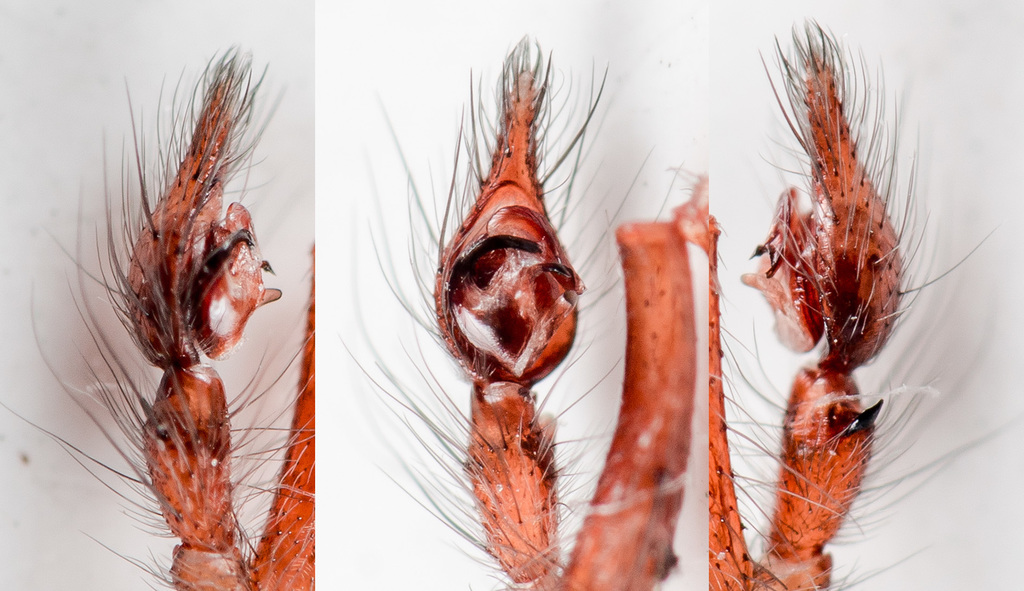
The barn funnel weaver is a medium-sized spider in the family Agelenidae, measuring 10-16 mm in body length. Females are typically larger than males, with leg spans reaching 40-50 mm. The spider displays brownish coloration with darker markings on the cephalothorax and abdomen. Two parallel dark stripes run along the carapace, while the abdomen bears chevron-shaped patterns. The legs are relatively long and robust, adapted for rapid movement across their sheet webs. Tegenaria domestica has a cosmopolitan distribution and is found nearly worldwide, having been inadvertently transported by human activities (BugGuide). In North America, the species occurs throughout the continental United States and Canada, including California. It is suspected that this spider arrived with the earliest European settlers in the 1600s (BugGuide). The species is also known by alternate common names including common house spider in the Pacific Northwest and barn funnel weaving spider. This spider inhabits human-modified environments, particularly barns, sheds, basements, and other structures that provide dark, undisturbed spaces. The species shows a strong preference for corners and crevices where it can construct its characteristic funnel webs. These webs consist of a flat sheet with a funnel-shaped retreat at one end, typically spanning 15-30 cm in diameter. Unlike orb weavers, barn funnel weavers do not rebuild their webs daily but maintain and repair them over extended periods. Barn funnel weavers are primarily nocturnal hunters that rely on vibrations transmitted through their sheet webs to detect prey. When an insect becomes entangled in the web, the spider rapidly emerges from its funnel retreat to subdue the prey. Their diet consists mainly of flies, moths, beetles, and other small arthropods. Mating typically occurs in late summer, with males approaching females' webs and performing courtship rituals involving web vibrations. Females produce egg sacs containing 50-100 eggs, which are deposited in protected locations within the funnel retreat. Spiderlings emerge the following spring and undergo several molts before reaching sexual maturity. Tegenaria domestica is not listed under any federal or state conservation programs and maintains stable populations throughout its range. As a synanthropic species that benefits from human habitation, it faces no significant conservation threats. The species may actually provide beneficial pest control services by consuming flying insects in agricultural and residential settings. While sometimes confused with the hobo spider (Eratigena agrestis), the barn funnel weaver poses no threat to humans and rarely bites. This species represents a successful example of a European introduction that has established itself across North America without causing ecological harm to native spider communities.
Classification
Class: Arachnida · Order: Araneae · Family: Agelenidae
Frequently asked questions
How is Tegenaria domestica classified?
Tegenaria domestica belongs to class Arachnida, order Araneae, family Agelenidae.
What family does Tegenaria domestica belong to?
Tegenaria domestica is in the Agelenidae family.
What is Tegenaria domestica?
The barn funnel weaver is a medium-sized spider in the family Agelenidae, measuring 10-16 mm in body length.
Is Tegenaria domestica found in California?
Yes. Tegenaria domestica is recorded in California in The California Species Project's catalogue.
Related species
Other California species in the same genus, family, or bioregion.
Data from The California Species Project — 14,000+ California species with verified data from CNPS, CDFW, USFWS, and more.