Temnoscheila chlorodia
Pine Trogossitid Beetle
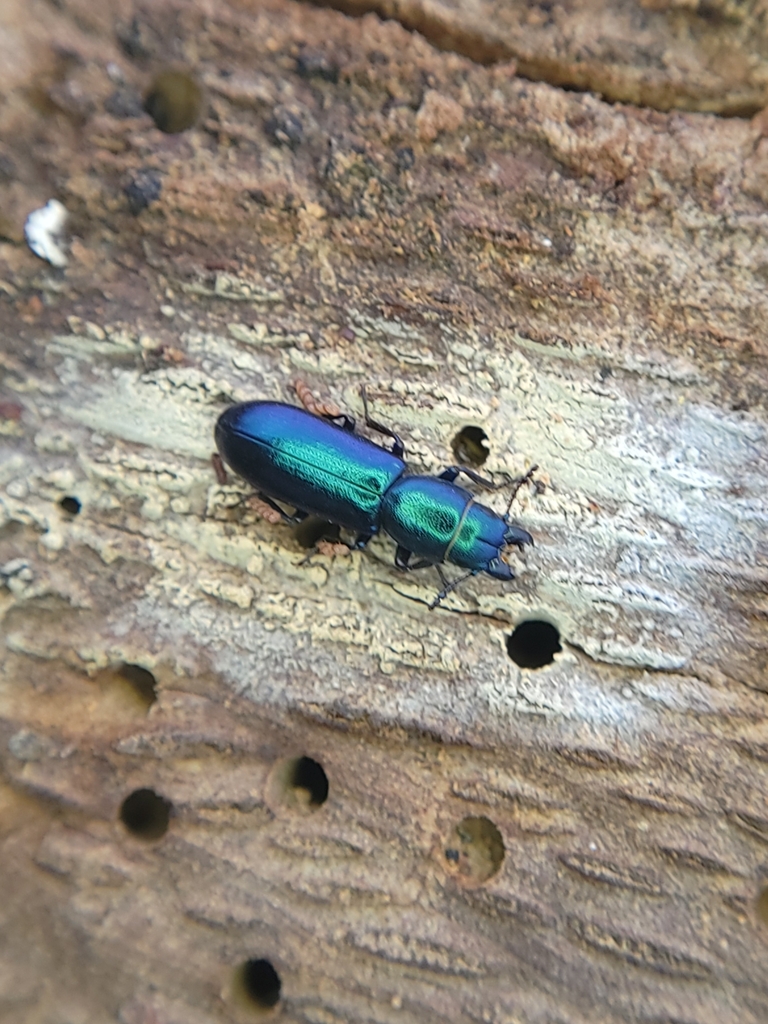
no rights reserved · CC0
Family: Trogossitidae · Class: Insecta · Order: Coleoptera
Temnoscheila chlorodia (Pine Trogossitid Beetle) is a California animal in the Trogossitidae family.
The Pine Trogossitid Beetle (Temnoscheila chlorodia) is a predatory bark beetle in the family Trogossitidae, also known as the Green Bark Beetle. Adults measure 8.4 to 19.8 mm (0.33 to 0.78 inches) in length, making them relatively large among bark beetles (Barron 1971). The species exhibits a distinctive metallic green coloration that gives rise to its alternative common name. This species occurs throughout western North America, ranging from British Columbia south to California and east to the Northwest Territories, South Dakota, and Texas, extending into Mexico (Barron 1971). In California, the Pine Trogossitid Beetle is distributed across mountainous regions where suitable coniferous host trees are present. The species' range encompasses diverse elevational zones from valleys to montane forests. The Pine Trogossitid Beetle inhabits mountains, deserts, and valleys, with populations closely associated with coniferous trees (Evans & Hogue 2006). Adults and larvae are found primarily on pine species and other conifers, where they occupy the bark and subcortical regions of both living and dead trees. The species demonstrates adaptation to various coniferous forest types across its extensive range, from coastal forests to interior mountain ranges. As a member of the Trogossitidae family, commonly known as bark-gnawing beetles, T. chlorodia functions as both predator and scavenger within forest ecosystems. Adults are predaceous, actively hunting other insects that inhabit bark crevices and galleries created by bark beetles and wood-boring insects. The species plays an ecological role in controlling populations of pest insects that attack coniferous trees. Larvae develop within the bark of conifers, where they feed on other insect larvae and organic matter. The species' life cycle is closely synchronized with the activity patterns of its prey species, particularly bark beetles that create the subcortical habitat where T. chlorodia completes development. Adults are active during warmer months when prey insects are most abundant. The species exhibits strong flight capabilities, allowing dispersal between suitable host trees across the landscape. Both adults and larvae possess robust mandibles adapted for their predatory lifestyle, enabling them to capture and consume a variety of prey items found within bark habitats. No specific conservation concerns have been documented for the Pine Trogossitid Beetle. The species appears to maintain stable populations across its range, likely benefiting from the widespread distribution of coniferous forests throughout western North America. As a predatory species that helps regulate forest pest populations, T. chlorodia contributes to forest ecosystem health. However, large-scale forest disturbances such as wildfire, logging, and climate-induced changes to coniferous forest composition could potentially affect local populations by altering habitat availability and prey abundance. The species' broad geographic range and habitat flexibility suggest resilience to moderate environmental changes, though specific population monitoring data are not available.
Classification
Class: Insecta · Order: Coleoptera · Family: Trogossitidae
Frequently asked questions
How is Temnoscheila chlorodia classified?
Temnoscheila chlorodia belongs to class Insecta, order Coleoptera, family Trogossitidae.
What family does Temnoscheila chlorodia belong to?
Temnoscheila chlorodia is in the Trogossitidae family.
What is Temnoscheila chlorodia?
The Pine Trogossitid Beetle (Temnoscheila chlorodia) is a predatory bark beetle in the family Trogossitidae, also known as the Green Bark Beetle.
Is Temnoscheila chlorodia found in California?
Yes. Temnoscheila chlorodia is recorded in California in The California Species Project's catalogue.
More California species
This species has no close relatives in our California data — here are other species to explore.
Data from The California Species Project — 14,000+ California species with verified data from CNPS, CDFW, USFWS, and more.