Tethya californiana
Orange puffball sponge
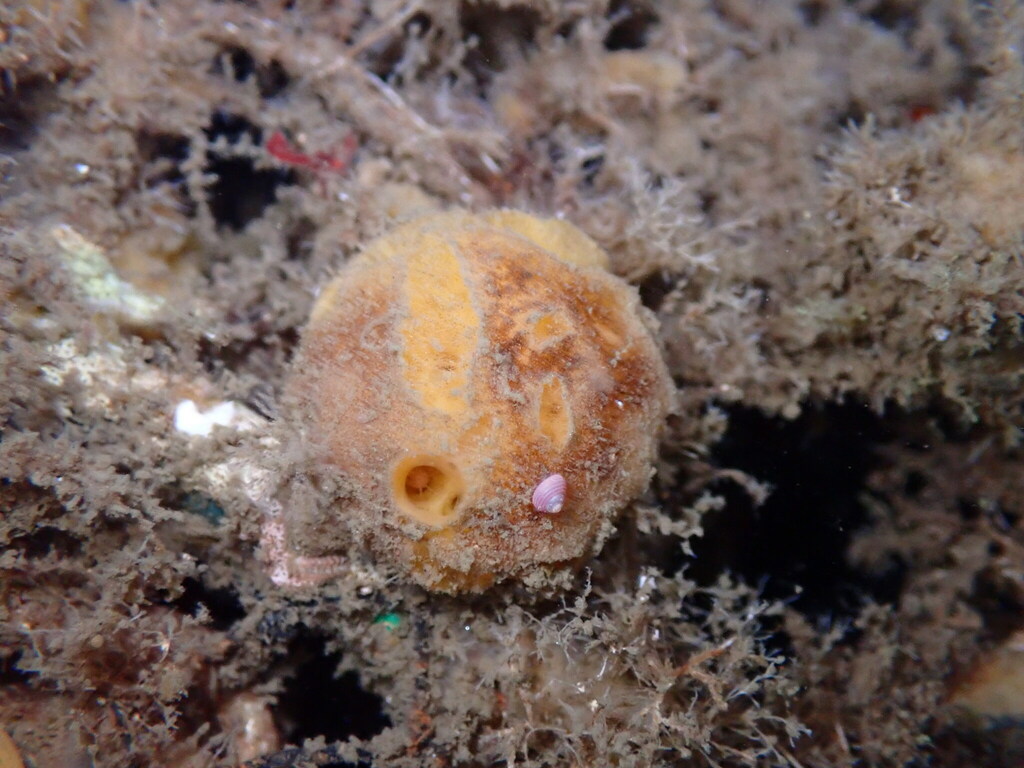
(c) Cricket Raspet, some rights reserved (CC BY) · licence
Family: Tethyidae · Class: Demospongiae · Order: Hadromerida
Tethya californiana (Orange puffball sponge) is a California animal in the Tethyidae family.
The orange puffball sponge is a marine invertebrate characterized by its distinctive spherical to oval morphology and bright orange coloration. This demosponge typically measures 5 to 15 centimeters (2 to 6 inches) in diameter, with a firm, somewhat compressible texture. The surface is covered with numerous small pores (ostia) and scattered larger openings (oscula) that facilitate water filtration. The species exhibits the typical sponge body plan with a complex internal canal system lined with choanocytes that create water currents for feeding and gas exchange. Tethya californiana is endemic to the northeastern Pacific Ocean, with its range extending along the California coast from Mendocino County south to Baja California, Mexico. The species occurs in both nearshore and offshore waters, with documented populations at locations including the Farallon Islands and Saunders Reef State Marine Conservation Area off the central California coast. Distribution appears patchy, likely reflecting specific habitat requirements and substrate availability. This sponge inhabits rocky subtidal environments from the low intertidal zone to depths exceeding 30 meters (98 feet). Orange puffball sponges attach to hard substrates including bedrock, large boulders, and occasionally artificial structures. They show preference for areas with moderate to strong water movement that facilitates feeding and prevents sediment accumulation. The species is commonly found in kelp forest ecosystems and rocky reef communities where it contributes to the diverse invertebrate assemblage. As a suspension feeder, Tethya californiana filters seawater through its body cavity, capturing bacteria, phytoplankton, dissolved organic matter, and other microscopic particles. Water enters through the numerous small pores and exits through larger oscula, with choanocytes creating the necessary water flow while simultaneously capturing food particles. Reproduction occurs through both sexual and asexual means. Sexual reproduction involves the release of sperm into the water column for external fertilization, followed by development of free-swimming larvae that eventually settle and metamorphose into adult sponges. Asexual reproduction can occur through budding or fragmentation, allowing for local population expansion. Currently, Tethya californiana lacks formal conservation status designations at federal or state levels. However, like many marine invertebrates along the California coast, populations may face pressures from habitat degradation, pollution, and climate change effects including ocean acidification and warming water temperatures. The species' presence in marine protected areas such as Saunders Reef State Marine Conservation Area provides some level of habitat protection. The patchwork distribution and specific habitat requirements suggest that maintaining healthy rocky reef ecosystems is crucial for population persistence. Long-term monitoring data for this species remains limited, making population trend assessments difficult to determine as of December 2025.
Classification
Class: Demospongiae · Order: Hadromerida · Family: Tethyidae
Frequently asked questions
How is Tethya californiana classified?
Tethya californiana belongs to class Demospongiae, order Hadromerida, family Tethyidae.
What family does Tethya californiana belong to?
Tethya californiana is in the Tethyidae family.
What is Tethya californiana?
The orange puffball sponge is a marine invertebrate characterized by its distinctive spherical to oval morphology and bright orange coloration.
Is Tethya californiana found in California?
Yes. Tethya californiana is recorded in California in The California Species Project's catalogue.
More California species
This species has no close relatives in our California data — here are other species to explore.
Data from The California Species Project — 14,000+ California species with verified data from CNPS, CDFW, USFWS, and more.