Tetracis pallulata
Pale Tetracis
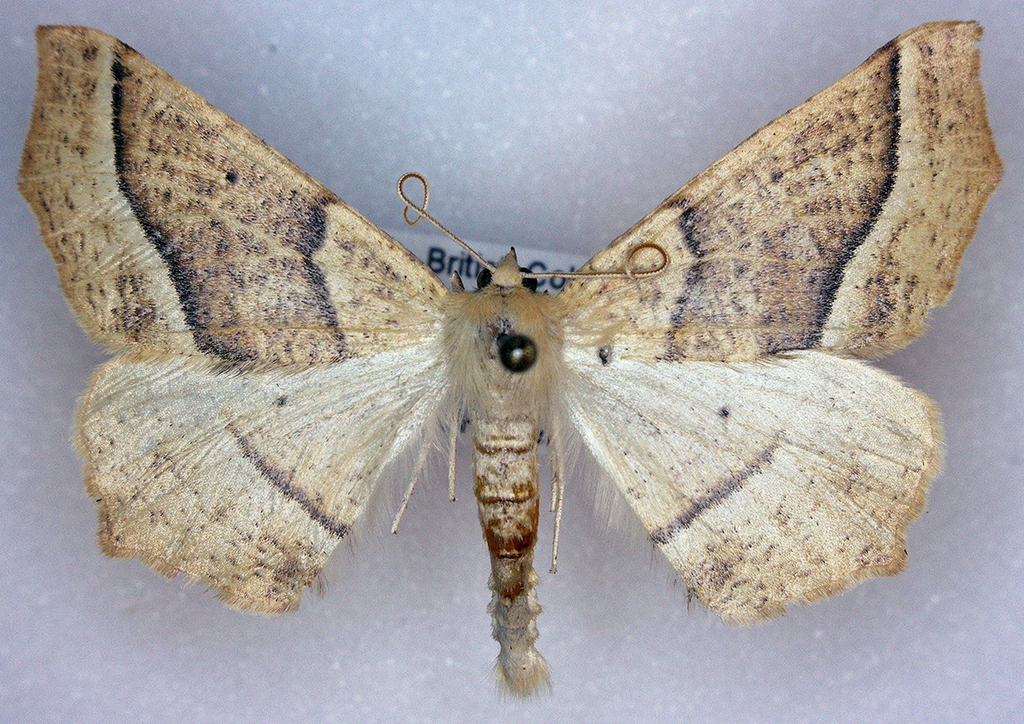
(c) Dave, some rights reserved (CC BY) · licence
Family: Geometridae · Class: Insecta · Order: Lepidoptera
Tetracis pallulata (Pale Tetracis) is a California animal in the Geometridae family.
Tetracis pallulata is a geometrid moth in the subfamily Ennominae, tribe Ourapterygini. Adults have a forewing length of approximately 17-26 mm, with forewings displaying variable coloration from pale yellowish-cream to brownish-gray or reddish-brown (BugGuide). The species exhibits sexual dimorphism, with females typically darker than males and lacking the pale shading beyond the postmedial line that distinguishes it from the closely related T. jubararia (Moth Photographers Group). This species ranges from southern California north to British Columbia, extending eastward to Idaho (Clearwater County) and western Montana (Lewis and Clark County) (BugGuide). The distribution spans elevations from near sea level to 7,200 feet (2,200 meters), representing one of the broadest elevational ranges among North American Tetracis species. Tetracis pallulata inhabits coniferous forests in western mountains, distinguishing it from most other Tetracis species that typically occur in deciduous or mixed forests (BugGuide). This habitat preference aligns with its larval host plant requirements, as the species feeds exclusively on coniferous trees rather than the broad-leaved trees utilized by most congeners (BugGuide). Larvae are twig mimics when at rest, displaying cryptic coloration that matches their host plants. The caterpillars have light brown heads with dark markings and body coloration variable from yellowish-cream to brownish-gray to reddish-brown (BugGuide). Notable morphological features include a swollen second thoracic segment dorsally and paired tubercles near the posterior margin of the fourth, fifth, and eighth abdominal segments (BugGuide). Adults are nocturnal and attracted to artificial lights. The genus Tetracis typically produces one generation per year, overwintering as eggs, though specific life cycle details for T. pallulata remain poorly documented. The species belongs to a taxonomically complex group. Recent systematic work by Ferris and Schmidt (2010) synonymized the genus Synaxis with Tetracis, affecting the classification of several related species. Tetracis pallulata can be distinguished from the similar T. jubararia by the absence of pale shading beyond the postmedial line and different wing pattern characteristics (Moth Photographers Group). No federal or state conservation status has been assigned to Tetracis pallulata. The species appears to maintain stable populations throughout its range, likely due to its association with widespread coniferous forest habitats across western North America. However, like many forest-dependent lepidoptera, potential threats could include habitat fragmentation, fire management practices, and climate-induced changes to montane forest composition. Detailed ecological studies of this species remain limited. The information presented here synthesizes available sources including BugGuide and Moth Photographers Group databases. Research gaps exist regarding specific host plant relationships, detailed life cycle timing, population dynamics, and conservation needs. Additional field studies and systematic surveys would enhance understanding of this species' biology and ecological requirements across its extensive geographic and elevational range.
Classification
Class: Insecta · Order: Lepidoptera · Family: Geometridae
Frequently asked questions
How is Tetracis pallulata classified?
Tetracis pallulata belongs to class Insecta, order Lepidoptera, family Geometridae.
What family does Tetracis pallulata belong to?
Tetracis pallulata is in the Geometridae family.
What is Tetracis pallulata?
Tetracis pallulata is a geometrid moth in the subfamily Ennominae, tribe Ourapterygini.
Is Tetracis pallulata found in California?
Yes. Tetracis pallulata is recorded in California in The California Species Project's catalogue.
Related species
Other California species in the same genus, family, or bioregion.
Data from The California Species Project — 14,000+ California species with verified data from CNPS, CDFW, USFWS, and more.