Tetraclita rubescens
Pink Volcano Barnacle
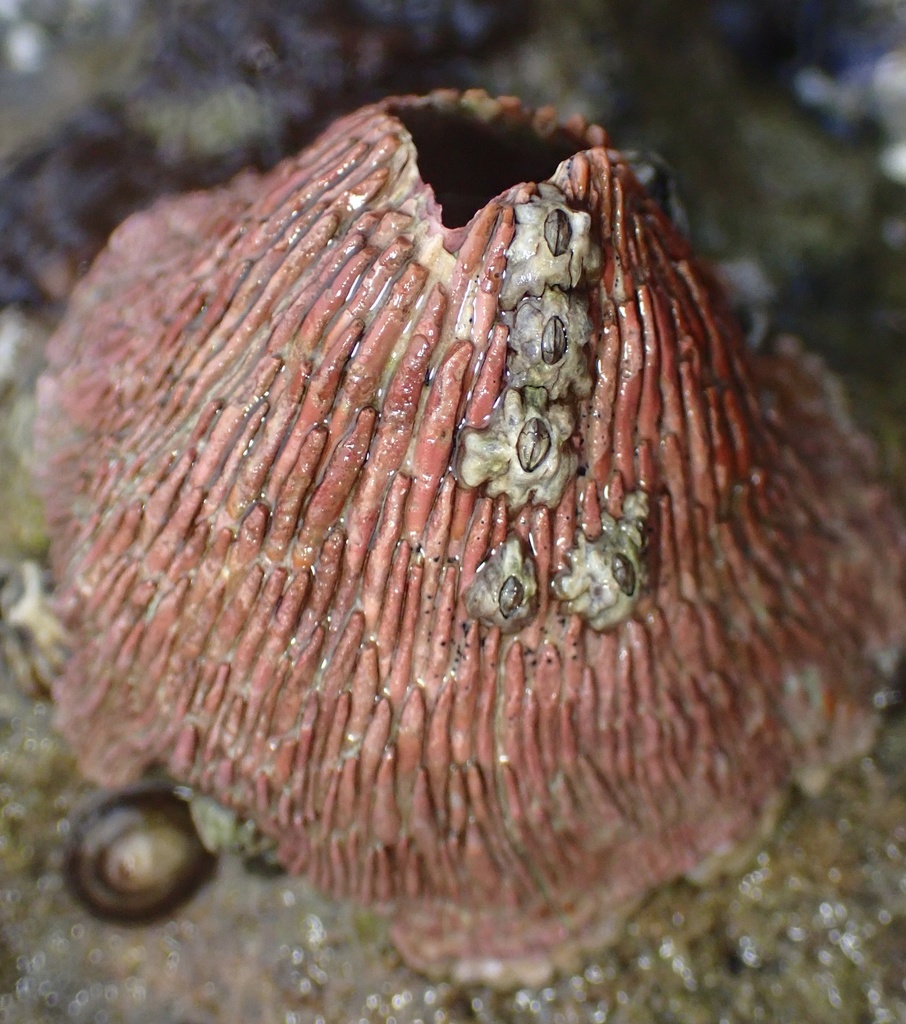
(c) Cricket Raspet, some rights reserved (CC BY) · licence
Family: Tetraclitidae · Class: Thecostraca · Order: Balanomorpha
Tetraclita rubescens (Pink Volcano Barnacle) is a California animal in the Tetraclitidae family.
The pink volcano barnacle (Tetraclita rubescens) is a sessile marine crustacean in the family Tetraclitidae. This species exhibits the characteristic cone-shaped shell structure typical of acorn barnacles, with a robust, thick-walled test composed of six primary plates. The common name derives from the pinkish coloration often displayed on the shell plates, though coloration can vary from pale pink to reddish-brown depending on environmental conditions and age. Tetraclita rubescens occurs along the Pacific coast from Alaska south to Santa Barbara, California (Hawaii Biological Survey 1998). The species demonstrates a broad latitudinal range extending through temperate and subtropical marine environments. In California, populations are documented from rocky intertidal and subtidal zones throughout much of the state's coastline, with observations recorded as far south as the Santa Barbara region. This barnacle inhabits rocky intertidal zones, typically attaching to hard substrates including natural rock surfaces, pier pilings, and other artificial structures. The species shows a preference for areas with moderate to high wave exposure, where water circulation provides adequate food delivery and prevents sediment accumulation. Pink volcano barnacles are commonly found in the mid to low intertidal zones, where they can withstand both aerial exposure during low tides and submersion during high tides. As a filter-feeding organism, T. rubescens captures planktonic organisms and organic particles from the water column using specialized feeding appendages called cirri. These feathery structures are extended from the shell opening to sweep through the water, collecting microscopic prey including copepods, diatoms, and other small planktonic organisms. The species exhibits typical barnacle reproductive behavior, functioning as simultaneous hermaphrodites. Cross-fertilization occurs between neighboring individuals through the extension of long penis-like structures. Fertilized eggs develop within the parental shell cavity before being released as free-swimming nauplii larvae, which eventually settle and metamorphose into juvenile barnacles. The conservation status of the pink volcano barnacle has not been formally evaluated by state or federal agencies, and the species does not appear on threatened or endangered species lists. Population trends and specific threats to this species have not been comprehensively documented in the scientific literature. Like many intertidal species, T. rubescens may face challenges from coastal development, pollution, ocean acidification, and climate change impacts including sea level rise and changing ocean temperatures. The species' broad geographic range may provide some resilience against localized threats, though specific population assessments would be needed to determine conservation priorities. Research gaps exist regarding detailed population dynamics, specific habitat requirements, and potential impacts from environmental stressors on this Pacific coast barnacle species.
Classification
Class: Thecostraca · Order: Balanomorpha · Family: Tetraclitidae
Frequently asked questions
How is Tetraclita rubescens classified?
Tetraclita rubescens belongs to class Thecostraca, order Balanomorpha, family Tetraclitidae.
What family does Tetraclita rubescens belong to?
Tetraclita rubescens is in the Tetraclitidae family.
What is Tetraclita rubescens?
The pink volcano barnacle (Tetraclita rubescens) is a sessile marine crustacean in the family Tetraclitidae.
Is Tetraclita rubescens found in California?
Yes. Tetraclita rubescens is recorded in California in The California Species Project's catalogue.
More California species
This species has no close relatives in our California data — here are other species to explore.
Data from The California Species Project — 14,000+ California species with verified data from CNPS, CDFW, USFWS, and more.