Texella deserticola
Whitewater Canyon Harvestman
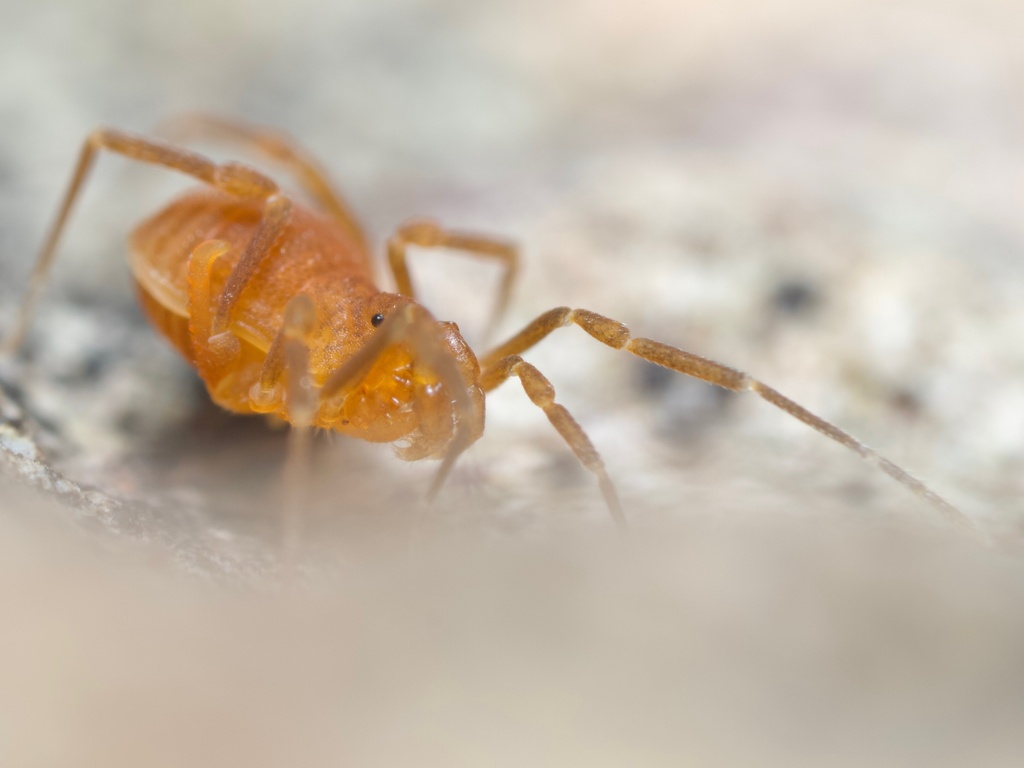
(c) Turner Brockman, some rights reserved (CC BY-SA) · licence
Family: Phalangodidae · Class: Arachnida · Order: Opiliones
Conservation status: G1 S1
Texella deserticola (Whitewater Canyon Harvestman) is a California animal in the Phalangodidae family.
The Whitewater Canyon harvestman (Texella deserticola) is a small arachnid endemic to a highly restricted range in southern California. This species belongs to the family Phalangodidae, a group of harvestmen typically associated with cave and karst environments. Like other members of the genus Texella, this harvestman likely exhibits the characteristic elongated legs and compact body typical of cave-adapted opilionids, though detailed morphological descriptions remain limited in the scientific literature. Texella deserticola has an extremely restricted range, known only from Whitewater Canyon in Riverside County, California (NatureServe Explorer). The species' range extent is less than 100 square kilometers, making it one of the most geographically limited arachnids in North America. This narrow distribution places the species entirely within the Colorado Desert region of the Sonoran Desert ecosystem. The species inhabits specialized cave and karst environments within Whitewater Canyon. As a member of the Phalangodidae family, T. deserticola likely occupies deep cave zones or other subterranean habitats that provide stable temperature and humidity conditions. These karst landscapes, formed by the dissolution of soluble bedrock, create the specialized underground ecosystems that support endemic cave-adapted fauna. The specific microhabitat requirements and substrate preferences of this species have not been well documented in the available literature. Detailed information about the behavior and ecology of T. deserticola remains limited. Like other cave-adapted harvestmen, this species likely exhibits troglomorphic adaptations such as reduced pigmentation and enhanced sensory structures. Cave harvestmen typically function as predators or scavengers, feeding on small invertebrates, organic detritus, and microbial films within the cave environment. Reproductive biology, seasonal activity patterns, and specific dietary preferences for this species require further scientific investigation. Texella deserticola is assigned a conservation status of G1 S1, indicating it is critically imperiled both globally and within California due to its extreme rarity and restricted range. While not currently listed under the Endangered Species Act, the species' highly limited distribution makes it vulnerable to habitat disturbance, groundwater depletion, and human activities that could alter the delicate cave ecosystem. The specialized nature of karst habitats means that even minor environmental changes can have significant impacts on endemic cave fauna. Conservation of this species depends on protecting the integrity of the Whitewater Canyon cave system and maintaining the hydrological processes that sustain these underground habitats. The restricted range of T. deserticola exemplifies the conservation challenges facing California's endemic cave fauna, where entire species may be confined to single cave systems or small clusters of caves within limited geographic areas. Scientific documentation for this species remains limited. Additional research is needed to better understand the ecology, distribution, and conservation needs of this rare harvestman.
Classification
Class: Arachnida · Order: Opiliones · Family: Phalangodidae
Conservation status
G1 S1
Frequently asked questions
How is Texella deserticola classified?
Texella deserticola belongs to class Arachnida, order Opiliones, family Phalangodidae.
What family does Texella deserticola belong to?
Texella deserticola is in the Phalangodidae family.
Is Texella deserticola protected or of conservation concern?
Texella deserticola carries the following status: G1 S1.
What is Texella deserticola?
The Whitewater Canyon harvestman (Texella deserticola) is a small arachnid endemic to a highly restricted range in southern California.
Is Texella deserticola found in California?
Yes. Texella deserticola is recorded in California in The California Species Project's catalogue.
Related species
Other California species in the same genus, family, or bioregion.
Data from The California Species Project — 14,000+ California species with verified data from CNPS, CDFW, USFWS, and more.