Thalasseus elegans
Elegant Tern
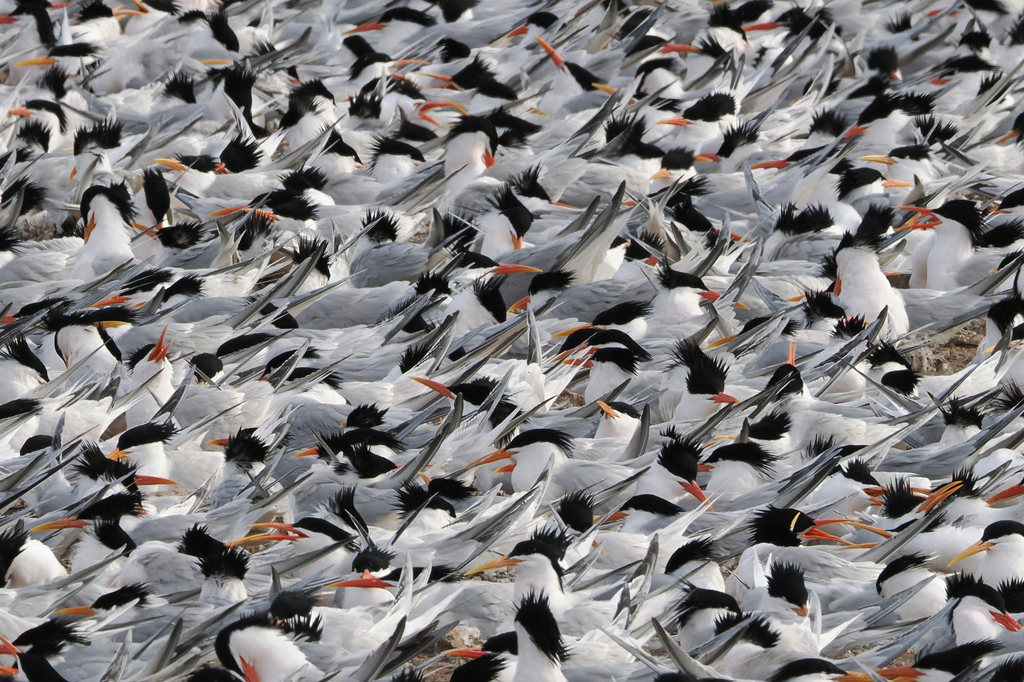
no rights reserved · CC0
Family: Laridae · Class: Aves · Order: Charadriiformes
Conservation status: WL · G4 S3
Thalasseus elegans (Elegant Tern) is a California animal in the Laridae family.
The Elegant Tern is a medium-sized seabird measuring 40 to 43 cm (16 to 17 inches) in length with a wingspan of 86 to 92 cm (34 to 36 inches). Adults weigh approximately 200 to 280 grams. During breeding season, the species displays a distinctive black crest that extends from the forehead to the nape, contrasting sharply with white underparts and pale gray upperparts. The bill is long, slender, and orange-yellow with a black tip. Non-breeding adults show a white forehead with black streaking behind the eye, and the crest becomes less pronounced. Juveniles exhibit brown mottling on the back and wings with a shorter, duller bill. The Elegant Tern breeds primarily along the Pacific coast from central California to western Mexico, with the largest breeding colony located on Isla Rasa in the Gulf of California. In California, breeding occurs at scattered coastal sites including the Salton Sea, where the species has established an inland colony. The species winters along the Pacific coast from central California south to Peru and Chile. Post-breeding dispersal extends northward to Oregon and Washington, with occasional sightings in British Columbia. Elegant Terns nest colonially on sandy beaches, salt ponds, and islands, typically selecting sites with minimal vegetation and protection from mammalian predators. At the Salton Sea, the species nests on artificial islands constructed specifically for colonial waterbirds. Nesting areas are characterized by flat, open terrain with sparse ground cover. The species requires nearby productive marine or inland waters for foraging. Elegant Terns are piscivorous, feeding primarily on small schooling fish including anchovies, sardines, and silversides. They employ plunge-diving techniques, diving from heights of 3 to 15 meters into the water to capture prey. At the Salton Sea, the diet consists largely of tilapia and other introduced fish species. Breeding occurs from April through August, with peak nesting in May and June. Females typically lay a single egg, occasionally two, in a shallow scrape lined with shells and debris. Incubation lasts 20 to 24 days, and chicks fledge after 28 to 35 days. The species exhibits high site fidelity to successful breeding colonies. The Elegant Tern is designated as a Watch List species by the California Department of Fish and Wildlife, reflecting concerns about population stability and habitat vulnerability. The species is ranked G4 globally, indicating apparent security, but S3 in California, suggesting vulnerability at the state level. Primary threats include habitat loss from coastal development, human disturbance at breeding sites, pollution, and climate change effects on marine food webs. The Salton Sea colony faces additional challenges from fluctuating water levels and increasing salinity. El Niño events significantly impact breeding success by reducing prey availability. Conservation efforts focus on protecting breeding sites, managing human access during nesting seasons, and maintaining suitable water levels at inland colonies.
Classification
Class: Aves · Order: Charadriiformes · Family: Laridae
Conservation status
WL · G4 S3
Frequently asked questions
How is Thalasseus elegans classified?
Thalasseus elegans belongs to class Aves, order Charadriiformes, family Laridae.
What family does Thalasseus elegans belong to?
Thalasseus elegans is in the Laridae family.
Is Thalasseus elegans protected or of conservation concern?
Thalasseus elegans carries the following status: WL · G4 S3.
What is Thalasseus elegans?
The Elegant Tern is a medium-sized seabird measuring 40 to 43 cm (16 to 17 inches) in length with a wingspan of 86 to 92 cm (34 to 36 inches).
Is Thalasseus elegans found in California?
Yes. Thalasseus elegans is recorded in California in The California Species Project's catalogue.
Related species
Other California species in the same genus, family, or bioregion.
Data from The California Species Project — 14,000+ California species with verified data from CNPS, CDFW, USFWS, and more.