Thalasseus maximus
Royal Tern
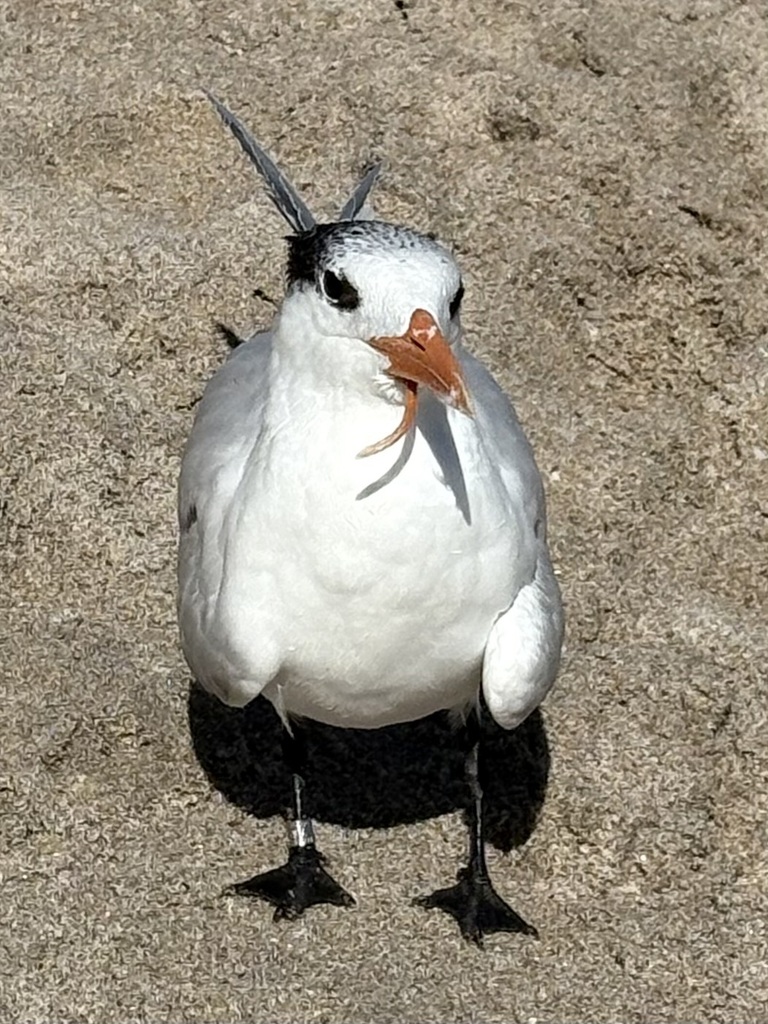
(c) ecovore, some rights reserved (CC BY) · licence
Family: Laridae · Class: Aves · Order: Charadriiformes
Thalasseus maximus (Royal Tern) is a California animal in the Laridae family.
The Royal Tern is a large seabird measuring 45 to 50 cm (18 to 20 inches) in length with a wingspan of 130 to 145 cm (51 to 57 inches). Adults weigh between 350 to 450 grams. During breeding season, adults display a distinctive black crest that extends from the forehead to the nape, bright orange-red bills, and orange legs. The upperparts are pale gray while the underparts are white. In non-breeding plumage, the black cap is reduced to a partial crown with white forehead and streaking on the nape. Juveniles show darker markings on the back and wings with a yellowish bill. Historically, Royal Terns bred at scattered locations along the California coast from San Francisco Bay south to San Diego County. The species has experienced significant range contraction in California, with breeding currently limited to a few sites. Small numbers still nest on islands in San Francisco Bay, including artificial structures, and occasionally at coastal locations in southern California. The species is more common as a non-breeding visitor, occurring along beaches, bays, and estuaries throughout the state's coastline. Royal Terns inhabit marine and estuarine environments, preferring sandy beaches, mudflats, shallow bays, and coastal lagoons. Breeding colonies are typically established on isolated sandy islands, shell beaches, or dredge spoil sites that provide protection from terrestrial predators. Nesting sites are characterized by minimal vegetation and proximity to productive marine waters. Outside the breeding season, the species forages in nearshore waters and rests on beaches, jetties, and offshore islands. Royal Terns are highly social, often forming mixed flocks with other tern species and gulls. They are specialized piscivores, diving from heights of 3 to 10 meters to capture small fish such as anchovies, sardines, and smelt. Breeding occurs in dense colonies from April through August, with peak activity in May and June. Females typically lay one to two eggs in shallow scrapes lined with shells or debris. Incubation lasts 25 to 30 days, and chicks fledge after 28 to 35 days. Parents continue feeding juveniles for several weeks after fledging. According to eBird data, Royal Terns are uncommon to rare breeders in California, with the breeding population estimated at fewer than 100 pairs as of 2024. The species faces threats from human disturbance at nesting sites, habitat loss due to coastal development, predation by introduced mammals, and climate change effects on prey availability. Sea level rise poses long-term risks to low-lying nesting islands. Conservation efforts focus on protecting existing colony sites and managing human access during breeding seasons.
Classification
Class: Aves · Order: Charadriiformes · Family: Laridae
Frequently asked questions
How is Thalasseus maximus classified?
Thalasseus maximus belongs to class Aves, order Charadriiformes, family Laridae.
What family does Thalasseus maximus belong to?
Thalasseus maximus is in the Laridae family.
What is Thalasseus maximus?
The Royal Tern is a large seabird measuring 45 to 50 cm (18 to 20 inches) in length with a wingspan of 130 to 145 cm (51 to 57 inches).
Is Thalasseus maximus found in California?
Yes. Thalasseus maximus is recorded in California in The California Species Project's catalogue.
Related species
Other California species in the same genus, family, or bioregion.
Data from The California Species Project — 14,000+ California species with verified data from CNPS, CDFW, USFWS, and more.