Thamnophis atratus
Aquatic Garter Snake
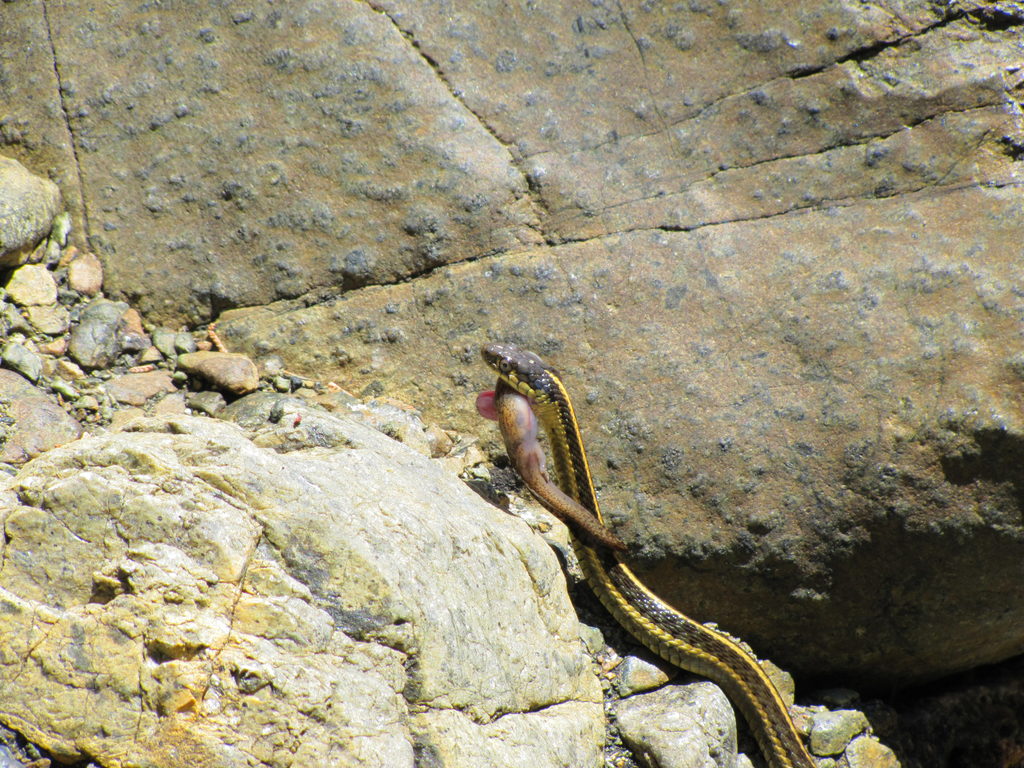
(c) Roger Raiche, some rights reserved (CC BY) · licence
Family: Colubridae · Class: Reptilia · Order: Squamata
Thamnophis atratus (Aquatic Garter Snake) is a California animal in the Colubridae family.
The Aquatic Garter Snake is a semi-aquatic serpent measuring 46 to 91 cm (18 to 36 inches) in total length, with females typically larger than males. The dorsal surface displays a dark olive-brown to black coloration with pale yellow or cream stripes running longitudinally along the body. The ventral surface is pale yellow or cream with dark checkered patterns. Adults possess keeled scales and a relatively slender build adapted for aquatic locomotion. The head is distinctly wider than the neck, with prominent eyes positioned for surface-level hunting. This species occurs along the Pacific Coast from southwestern Oregon through California to Baja California, Mexico. In California, populations are documented from sea level to approximately 2,400 meters (7,900 feet) elevation in the Sierra Nevada, Cascade Range, Coast Ranges, and Transverse Ranges. The subspecies T. a. hydrophilus is found in northwestern California, while T. a. atratus occurs throughout the remainder of the state's range. Aquatic Garter Snakes inhabit permanent and semi-permanent freshwater environments including streams, ponds, lakes, marshes, and wet meadows. They demonstrate strong fidelity to aquatic habitats, rarely venturing more than a few meters from water sources. According to California Department of Fish and Wildlife research at Echo Lake Basin, these snakes show a distinct preference for habitats containing fish populations. Optimal habitat features include rocky substrates for basking, emergent vegetation for cover, and clear water supporting prey visibility. This species is primarily piscivorous, specializing in small fish including sculpins, dace, and juvenile trout. Dietary studies reveal that fish comprise 70-90% of adult prey items, supplemented by amphibians, aquatic invertebrates, and occasionally small mammals. Aquatic Garter Snakes are opportunistic predators that hunt both actively and by ambush, often pursuing prey underwater. Mating occurs in spring following emergence from winter dormancy, with females giving birth to 8-25 live young in late summer. Neonates measure 15-20 cm at birth and reach sexual maturity in their second or third year. Population studies in northwestern California by Lind et al. (2005) documented linear densities of 58-131 individuals per kilometer of suitable stream habitat. Research has shown that these snakes respond positively to fish introductions in previously fishless systems, with California Department of Fish and Wildlife noting their expansion into high-elevation lakes following trout stocking. Welsh et al. (2010) reported approximately equal adult sex ratios in Del Norte County populations. While not federally listed, habitat degradation through water diversions, pollution, and introduced predators poses localized threats. Climate change may impact prey availability and alter hydrological patterns critical to breeding success. The species' dependence on aquatic ecosystems makes it vulnerable to drought conditions and water management practices that reduce stream flows or alter natural hydrological cycles.
Classification
Class: Reptilia · Order: Squamata · Family: Colubridae
Frequently asked questions
How is Thamnophis atratus classified?
Thamnophis atratus belongs to class Reptilia, order Squamata, family Colubridae.
What family does Thamnophis atratus belong to?
Thamnophis atratus is in the Colubridae family.
What is Thamnophis atratus?
The Aquatic Garter Snake is a semi-aquatic serpent measuring 46 to 91 cm (18 to 36 inches) in total length, with females typically larger than males.
Is Thamnophis atratus found in California?
Yes. Thamnophis atratus is recorded in California in The California Species Project's catalogue.
Related species
Other California species in the same genus, family, or bioregion.
Data from The California Species Project — 14,000+ California species with verified data from CNPS, CDFW, USFWS, and more.