Thamnophis elegans
Western Terrestrial Garter Snake
no rights reserved · CC0
Family: Colubridae · Class: Reptilia · Order: Squamata
Thamnophis elegans (Western Terrestrial Garter Snake) is a California animal in the Colubridae family.
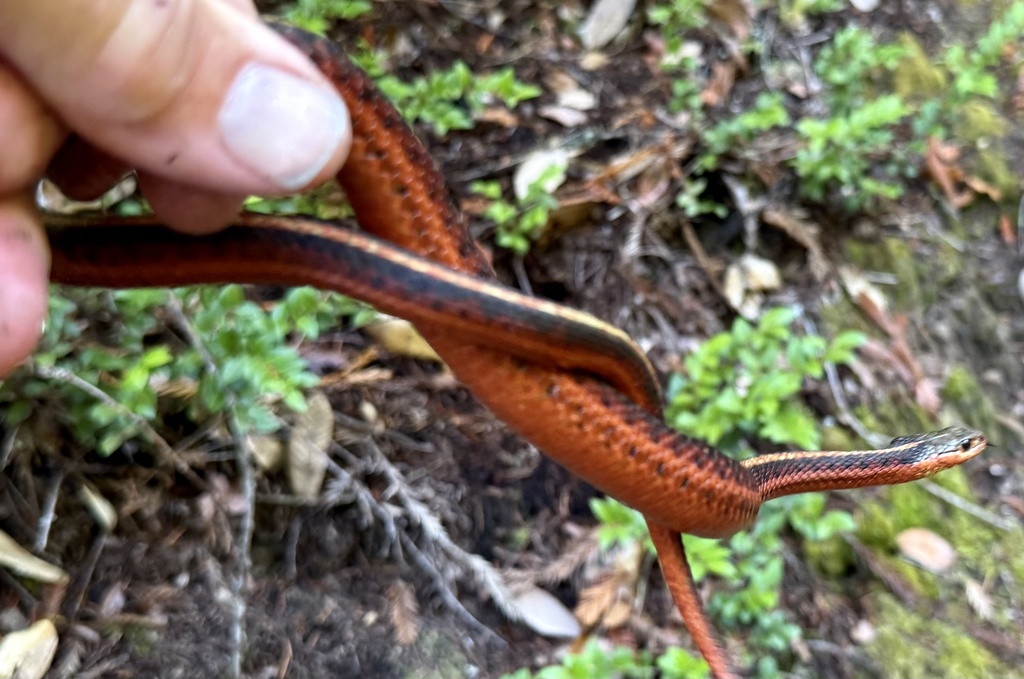
The western terrestrial garter snake is a medium-sized snake reaching lengths of 18 to 43 inches (46 to 109 cm), with females typically larger than males. The body is moderately robust with keeled scales and a distinct head wider than the neck. Coloration varies considerably across subspecies and populations, typically featuring a tan, gray, or olive-brown base color with three longitudinal stripes. The dorsal stripe ranges from yellow to orange or red, while lateral stripes are usually yellow or white. Dark spots or checkered patterns often appear between the stripes, becoming less distinct toward the tail. The belly is typically pale yellow or greenish with dark markings. This species has one of the broadest distributions among North American garter snakes, ranging from sea level to elevations exceeding 10,000 feet (3,048 meters). In California, western terrestrial garter snakes occur throughout most of the state except the southeastern desert regions. The range extends from coastal areas north through the Central Valley, Sierra Nevada, Cascade Range, and northern California mountains. Multiple subspecies are recognized, including the mountain garter snake (T. e. elegans) in the Sierra Nevada and northern California mountains, and the coast garter snake (T. e. terrestris) along the Pacific coast. Western terrestrial garter snakes occupy diverse habitats from sea level coastal areas to high mountain meadows. They are found in grasslands, oak woodlands, chaparral, coniferous forests, riparian zones, and alpine meadows. Unlike many garter snake species, they are less dependent on aquatic habitats, though they are often found near water sources including streams, ponds, lakes, and seasonal wetlands. They utilize rocky outcrops, fallen logs, and dense vegetation for shelter and thermoregulation. This species exhibits both terrestrial and semi-aquatic behavior, feeding on a diverse diet including amphibians, fish, earthworms, slugs, leeches, and small mammals. Frogs, toads, and salamanders comprise a significant portion of their diet, though they readily consume fish when available. Western terrestrial garter snakes are ovoviviparous, giving birth to live young typically from July through September. Litter sizes range from 4 to 36 offspring, with larger females producing more young. Neonates measure 6 to 8 inches (15 to 20 cm) at birth. These snakes are active during daylight hours but may become crepuscular in hot weather. They hibernate in rock crevices, mammal burrows, or other protected sites during winter months. The western terrestrial garter snake is not federally listed and maintains stable populations throughout most of its range. NatureServe ranks the species as G5 (globally secure) as of 2016. However, some local populations face threats from habitat loss due to urban development, agricultural conversion, and water diversions. Introduced predatory fish and bullfrogs may impact prey availability in aquatic habitats. Climate change could affect high-elevation populations through altered precipitation patterns and temperature regimes.
Classification
Class: Reptilia · Order: Squamata · Family: Colubridae
Frequently asked questions
How is Thamnophis elegans classified?
Thamnophis elegans belongs to class Reptilia, order Squamata, family Colubridae.
What family does Thamnophis elegans belong to?
Thamnophis elegans is in the Colubridae family.
What is Thamnophis elegans?
The western terrestrial garter snake is a medium-sized snake reaching lengths of 18 to 43 inches (46 to 109 cm), with females typically larger than males.
Is Thamnophis elegans found in California?
Yes. Thamnophis elegans is recorded in California in The California Species Project's catalogue.
Related species
Other California species in the same genus, family, or bioregion.
Data from The California Species Project — 14,000+ California species with verified data from CNPS, CDFW, USFWS, and more.