Thamnophis gigas
Giant Garter Snake
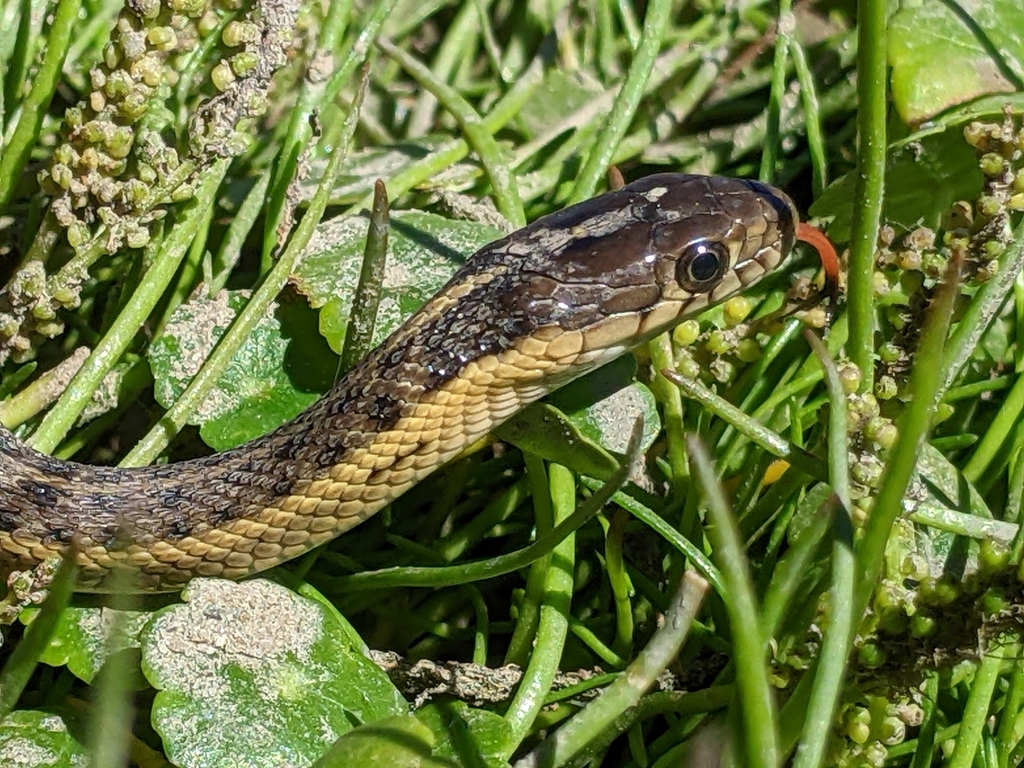
(c) Ken-ichi Ueda, some rights reserved (CC BY) · licence
Family: Colubridae · Class: Reptilia · Order: Squamata
Conservation status: ST · Threatened · G2 S2
Thamnophis gigas (Giant Garter Snake) is a California animal in the Colubridae family.
The giant garter snake is one of the largest garter snakes in North America, reaching lengths of up to 162 centimeters (63.7 inches). Adults display olive to brown coloration with a distinctive cream, yellow, or orange stripe running along the dorsal surface and two light-colored stripes positioned along each side. The body is robust and elongated, with a relatively small head compared to body size. Scales are keeled, giving the snake a rough texture, and the underside is typically pale yellow or cream-colored. The giant garter snake is endemic to California's Central Valley, where it historically occurred in wetlands, sloughs, and slow-moving waterways from Butte County south to Kern County. The species now occupies a significantly reduced range, primarily in the Sacramento Valley and northern San Joaquin Valley. Current populations are fragmented and largely restricted to managed wetlands, agricultural drainage systems, and constructed habitat in counties including Butte, Colusa, Glenn, Fresno, Merced, Sacramento, San Joaquin, Solano, Stanislaus, Sutter, and Yolo. This semi-aquatic species inhabits freshwater marshes, irrigation canals, drainage ditches, and low-gradient streams with emergent vegetation. Giant garter snakes require aquatic habitat with substantial vegetation such as cattails, bulrushes, and sedges for foraging and escape cover. During winter months, they seek terrestrial refugia in small mammal burrows, rock crevices, or other underground sites above the high-water line. Water depths of 0.3 to 1.5 meters (1 to 5 feet) with adjacent upland areas for basking and overwintering are essential habitat components. Giant garter snakes are primarily piscivorous, feeding on small fish, tadpoles, and frogs, though they also consume earthworms, leeches, and occasionally small mammals. Adults are active from March through October, with peak activity during warmer months. Mating occurs in spring following emergence from winter dormancy, with females giving birth to 10 to 46 live young in late summer. Young measure approximately 20 centimeters (8 inches) at birth and reach sexual maturity at 2 to 3 years of age. The species exhibits high site fidelity and limited dispersal capability. The U.S. Fish and Wildlife Service listed the giant garter snake as threatened on October 20, 1993. According to CDFW, the species was historically listed by the State of California as Thamnophis couchi gigas but is now recognized as a distinct species. Primary threats include habitat loss and fragmentation due to urban development, agricultural conversion, and water management practices. Introduced predators such as largemouth bass and bullfrogs impact prey availability and directly predate on snakes. Climate change poses additional challenges through altered precipitation patterns and increased temperatures. Recovery efforts focus on habitat restoration and protection, with recent projects including a 9-acre wetland restoration near Oakley designed specifically for giant garter snake recovery.
Classification
Class: Reptilia · Order: Squamata · Family: Colubridae
Conservation status
ST · Threatened · G2 S2
Frequently asked questions
How is Thamnophis gigas classified?
Thamnophis gigas belongs to class Reptilia, order Squamata, family Colubridae.
What family does Thamnophis gigas belong to?
Thamnophis gigas is in the Colubridae family.
Is Thamnophis gigas protected or of conservation concern?
Thamnophis gigas carries the following status: ST · Threatened · G2 S2.
What is Thamnophis gigas?
The giant garter snake is one of the largest garter snakes in North America, reaching lengths of up to 162 centimeters (63.7 inches).
Is Thamnophis gigas found in California?
Yes. Thamnophis gigas is recorded in California in The California Species Project's catalogue.
Related species
Other California species in the same genus, family, or bioregion.
Data from The California Species Project — 14,000+ California species with verified data from CNPS, CDFW, USFWS, and more.