Thamnophis hammondii pop. 1
Santa Catalina Gartersnake
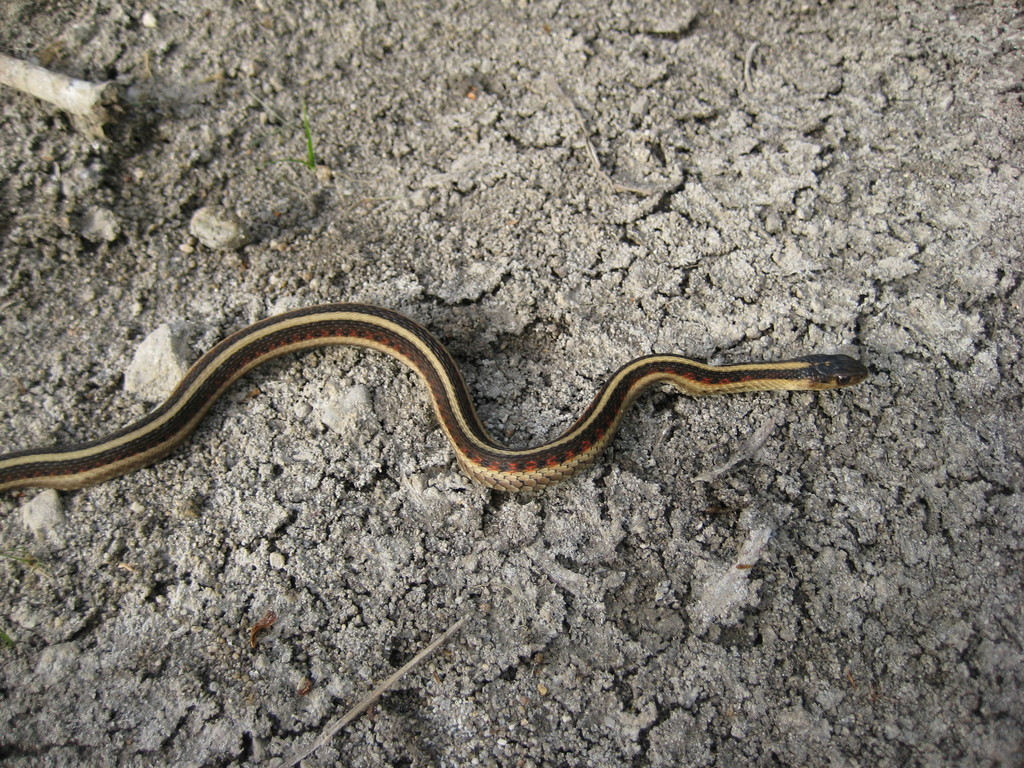
(c) kclarksdnhmorg, some rights reserved (CC BY) · licence
Family: Colubridae · Class: Reptilia · Order: Squamata
Conservation status: G4T1? S1
Thamnophis hammondii pop. 1 (Santa Catalina Gartersnake) is a California animal in the Colubridae family.
The Santa Catalina gartersnake is a distinct population of the two-striped gartersnake (Thamnophis hammondii) endemic to Santa Catalina Island off the coast of southern California. This semi-aquatic snake is distinguished by its characteristic pattern of two prominent lateral stripes running along the length of its body, with a darker dorsal coloration between the stripes. Adults typically measure 0.6 to 1.2 meters (2 to 4 feet) in total length, making them moderately sized among California's gartersnakes. The Santa Catalina gartersnake occurs exclusively on Santa Catalina Island, located approximately 35 kilometers southwest of Los Angeles in the Pacific Ocean. According to Schoenherr (2003), the population is currently known to exist only along a 1.6-kilometer stretch of permanent flow in Cottonwood Canyon that includes a small reservoir. This extremely restricted range makes it one of California's most geographically limited snake populations. The species requires semi-aquatic habitats with permanent or seasonal water sources. On Santa Catalina Island, suitable habitat is severely limited due to the island's naturally arid conditions and lack of extensive freshwater systems. The snake is typically found near streams, springs, and the artificial reservoir in Cottonwood Canyon, where it depends on both aquatic and adjacent terrestrial environments for foraging and shelter. Like other gartersnakes, the Santa Catalina gartersnake is primarily diurnal and semi-aquatic in behavior. Its diet likely consists of amphibians, small fish, aquatic invertebrates, and possibly small mammals and birds. The species exhibits typical gartersnake reproductive behavior, with females giving birth to live young rather than laying eggs. Seasonal activity patterns are probably influenced by water availability and temperature fluctuations on the island. The Santa Catalina gartersnake faces critical conservation challenges due to its extremely small population size and restricted habitat. The species has a Global/State Rank of G4T1? S1, indicating it is critically imperiled in California with very few occurrences or very steep declines. According to californiaherps.com, there is very little appropriate habitat for this semi-aquatic snake on Santa Catalina Island, and it may be on the verge of extirpation. The total population is believed to be extremely small and vulnerable to local extinction. Primary threats include habitat degradation, introduced species impacts, and the inherent vulnerability associated with such a restricted range. The island's ecosystem has been significantly altered by introduced plants and animals, including feral pigs that may impact the snake's prey base and habitat quality. Climate change poses additional risks through potential alterations to the island's limited freshwater resources. Water management and conservation of the remaining riparian habitat in Cottonwood Canyon are essential for this population's survival. The species serves as an example of island endemism and the conservation challenges facing California's most geographically restricted reptile populations.
Classification
Class: Reptilia · Order: Squamata · Family: Colubridae
Conservation status
G4T1? S1
Frequently asked questions
How is Thamnophis hammondii pop. 1 classified?
Thamnophis hammondii pop. 1 belongs to class Reptilia, order Squamata, family Colubridae.
What family does Thamnophis hammondii pop. 1 belong to?
Thamnophis hammondii pop. 1 is in the Colubridae family.
Is Thamnophis hammondii pop. 1 protected or of conservation concern?
Thamnophis hammondii pop. 1 carries the following status: G4T1? S1.
What is Thamnophis hammondii pop. 1?
The Santa Catalina gartersnake is a distinct population of the two-striped gartersnake (Thamnophis hammondii) endemic to Santa Catalina Island off the coast of southern California.
Is Thamnophis hammondii pop. 1 found in California?
Yes. Thamnophis hammondii pop. 1 is recorded in California in The California Species Project's catalogue.
Related species
Other California species in the same genus, family, or bioregion.
Data from The California Species Project — 14,000+ California species with verified data from CNPS, CDFW, USFWS, and more.