Thamnophis sirtalis tetrataenia
San Francisco gartersnake
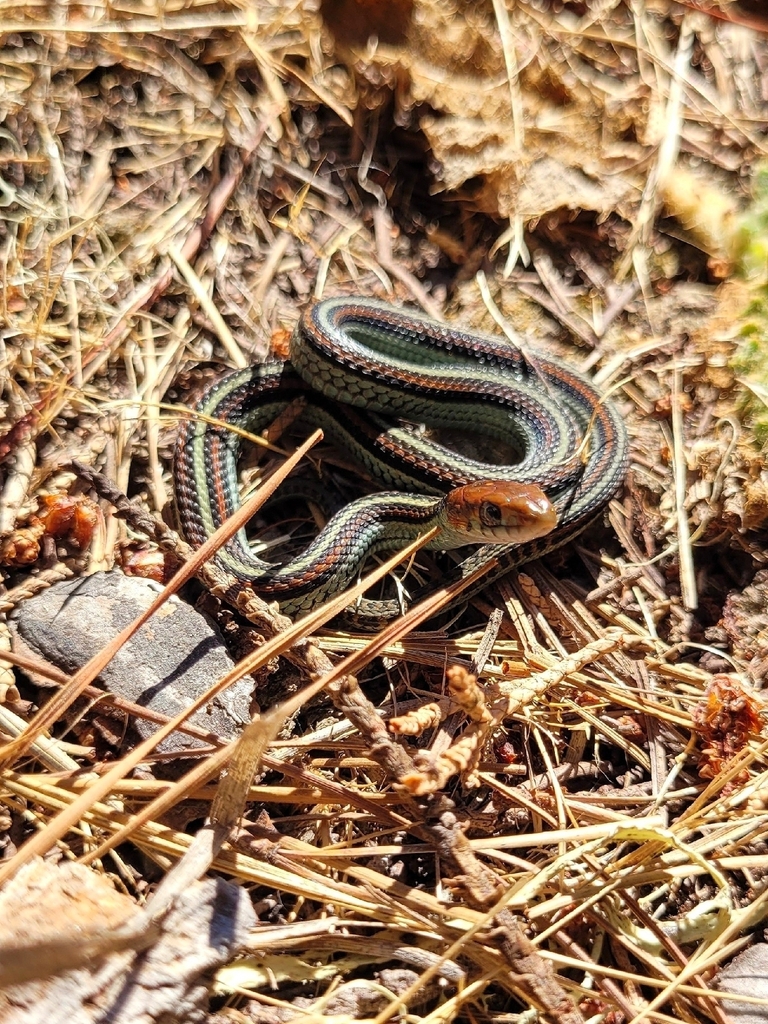
(c) Guillermo Roque, some rights reserved (CC BY) · licence
Family: Colubridae · Class: Reptilia · Order: Squamata
Conservation status: FP · Endangered · G5T2Q S2
Thamnophis sirtalis tetrataenia (San Francisco gartersnake) is a California animal in the Colubridae family.
The San Francisco gartersnake is a slender, colorful subspecies of the common gartersnake distinguished by its distinctive coloration pattern. Adults can reach lengths of 3 feet (0.9 meters) or more, with a burnt orange head and a greenish-yellow dorsal stripe edged in black. This central stripe is bordered by red stripes that may be continuous or broken with black blotches, followed by black lateral stripes. The belly varies from greenish-blue to blue, creating a striking ventral appearance that aids in field identification. This subspecies is endemic to the San Francisco Peninsula, with its current range restricted primarily to San Mateo County, California. Historically, the species occurred more widely throughout the San Francisco Bay area, but habitat loss has significantly reduced its distribution. The largest known populations occur at Pescadero Marsh Natural Preserve in coastal San Mateo County, with smaller populations persisting in fragmented habitats throughout the region. San Francisco gartersnakes require both aquatic and terrestrial habitats for their survival. They are typically found in or adjacent to freshwater aquatic environments, including ponds, creeks, marshes, and seasonal wetlands. The species utilizes upland areas for basking, shelter, and overwintering, often in grasslands, coastal scrub, and woodland edges. This dual habitat requirement makes the species particularly vulnerable to habitat fragmentation, as individuals must move between aquatic breeding areas and terrestrial refugia. As semi-aquatic predators, San Francisco gartersnakes feed primarily on amphibians, particularly frogs and their larvae, as well as fish, earthworms, and occasionally small mammals. The species is closely associated with populations of native amphibians, especially the California red-legged frog, which serves as a primary prey species. Mating typically occurs in spring following emergence from winter dormancy, with females giving birth to live young in late summer. Like other gartersnakes, this subspecies is ovoviviparous, retaining eggs internally until hatching. The San Francisco gartersnake was listed as endangered under the federal Endangered Species Act and is also listed as endangered by the State of California with full protection status. The species faces severe threats from urban development, habitat fragmentation, and wetland destruction throughout the San Francisco Peninsula. According to USFWS documentation, primary threats include residential and commercial development, road construction, golf course development, and agricultural conversion. The species' dependence on both aquatic and upland habitats makes it particularly susceptible to development pressures that fragment these connected ecosystems. Water management practices that alter natural hydrology and the introduction of non-native predators and competitors further threaten remaining populations. Recovery efforts focus on habitat protection, restoration of degraded wetlands, and maintenance of wildlife corridors connecting fragmented habitat patches. The species' limited range and ongoing development pressure in the San Francisco Bay area continue to pose significant challenges to long-term recovery.
Classification
Class: Reptilia · Order: Squamata · Family: Colubridae
Conservation status
FP · Endangered · G5T2Q S2
Frequently asked questions
How is Thamnophis sirtalis tetrataenia classified?
Thamnophis sirtalis tetrataenia belongs to class Reptilia, order Squamata, family Colubridae.
What family does Thamnophis sirtalis tetrataenia belong to?
Thamnophis sirtalis tetrataenia is in the Colubridae family.
Is Thamnophis sirtalis tetrataenia protected or of conservation concern?
Thamnophis sirtalis tetrataenia carries the following status: FP · Endangered · G5T2Q S2.
What is Thamnophis sirtalis tetrataenia?
The San Francisco gartersnake is a slender, colorful subspecies of the common gartersnake distinguished by its distinctive coloration pattern.
Is Thamnophis sirtalis tetrataenia found in California?
Yes. Thamnophis sirtalis tetrataenia is recorded in California in The California Species Project's catalogue.
Related species
Other California species in the same genus, family, or bioregion.
Data from The California Species Project — 14,000+ California species with verified data from CNPS, CDFW, USFWS, and more.