Tharsalea arota
Tailed Copper
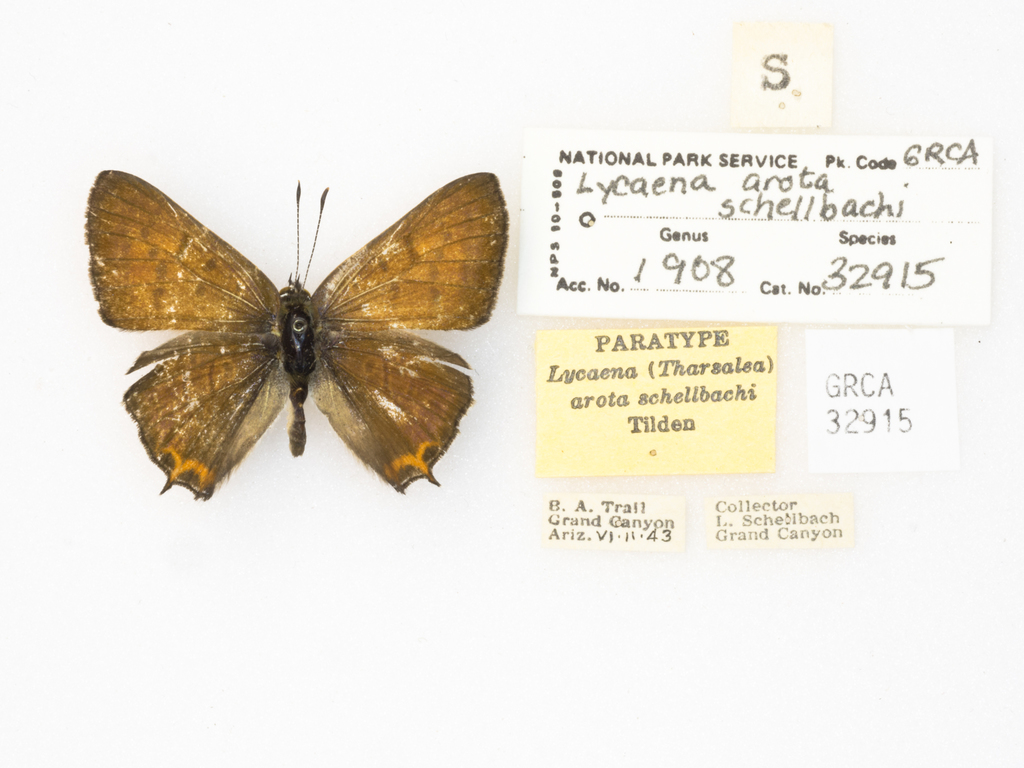
no rights reserved · CC0
Family: Lycaenidae · Class: Insecta · Order: Lepidoptera
Tharsalea arota (Tailed Copper) is a California animal in the Lycaenidae family.
The Tailed Copper is a small butterfly in the hairstreak family Lycaenidae, characterized by its distinctive hindwing tails and copper-orange coloration. Adults have a wingspan of 23 to 29 mm (0.9 to 1.1 inches). Males display bright copper-orange dorsal wing surfaces with narrow dark borders, while females show more subdued orange-brown coloration with broader dark markings. The ventral surfaces are pale gray to whitish with scattered black spots and orange submarginal bands. Both sexes possess short, thread-like tails on the hindwings, though these are more pronounced in males. The species can be distinguished from similar coppers by the combination of its small size, pale gray ventral coloration, and presence of hindwing tails. The Tailed Copper ranges from New Mexico north and west to Oregon, extending south through southern California into Baja California, Mexico. In California, the species occurs primarily in montane regions of the Sierra Nevada, Cascade Range, and higher elevations of the Coast Ranges. Populations are documented from Siskiyou County south to San Diego County, with scattered records from the Transverse and Peninsular Ranges. The species is generally absent from the Central Valley and coastal lowlands. This butterfly inhabits open woodlands, forest clearings, riparian areas, and canyon bottoms where host plants occur. Elevational range extends from approximately 300 to 2,400 meters (1,000 to 7,900 feet), though most populations occur above 1,200 meters. The species requires areas with adequate moisture to support vigorous growth of Ribes shrubs, often found near streams, springs, or in north-facing slopes and canyon bottoms that retain moisture longer than surrounding areas. Tailed Copper larvae feed exclusively on leaves of gooseberry and currant species (Ribes) in the family Grossulariaceae. Females deposit eggs singly on young leaves or flower buds of host plants. The species is univoltine in most of its range, with adults flying from late April through July, depending on elevation and local climate conditions. Peak flight activity typically occurs in May and June. Larvae overwinter in the egg stage, hatching in spring when new Ribes foliage emerges. Adult males establish territories near host plants and engage in aerial encounters with intruding males. Both sexes nectar on various flowers including buckwheat, mint, and composite flowers. The Tailed Copper is not federally or state listed, though local populations may face threats from habitat modification, livestock grazing that damages Ribes shrubs, and altered fire regimes. Urban development and water diversions in riparian areas can eliminate suitable habitat. Climate change may affect the species through shifts in precipitation patterns and increased drought stress on host plants. The butterfly's dependence on specific Ribes species and moisture-dependent habitats makes it potentially vulnerable to habitat fragmentation and degradation of riparian ecosystems.
Classification
Class: Insecta · Order: Lepidoptera · Family: Lycaenidae
Frequently asked questions
How is Tharsalea arota classified?
Tharsalea arota belongs to class Insecta, order Lepidoptera, family Lycaenidae.
What family does Tharsalea arota belong to?
Tharsalea arota is in the Lycaenidae family.
What is Tharsalea arota?
The Tailed Copper is a small butterfly in the hairstreak family Lycaenidae, characterized by its distinctive hindwing tails and copper-orange coloration.
Is Tharsalea arota found in California?
Yes. Tharsalea arota is recorded in California in The California Species Project's catalogue.
Related species
Other California species in the same genus, family, or bioregion.
Data from The California Species Project — 14,000+ California species with verified data from CNPS, CDFW, USFWS, and more.