Tharsalea editha
Edith's Copper
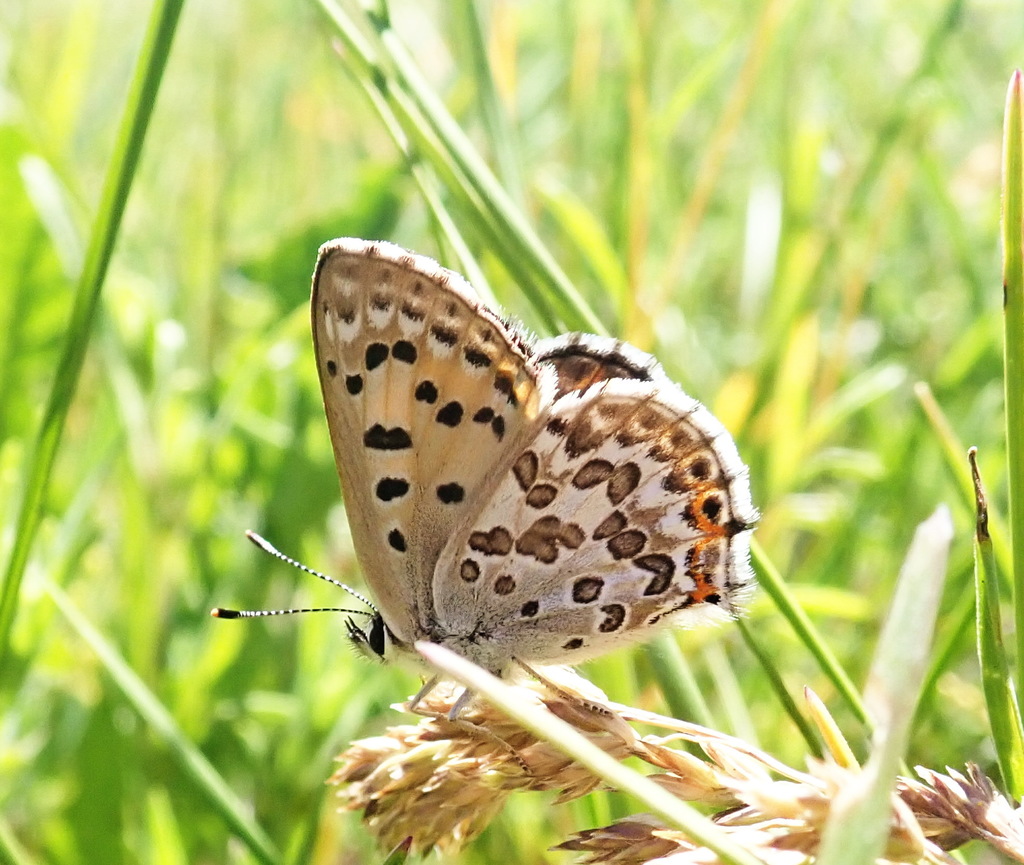
(c) Paul Bedell, some rights reserved (CC BY-SA) · licence
Family: Lycaenidae · Class: Insecta · Order: Lepidoptera
Tharsalea editha (Edith's Copper) is a California animal in the Lycaenidae family.
Edith's Copper (Tharsalea editha) is a small butterfly in the family Lycaenidae, characterized by sexual dimorphism in wing coloration and pattern. Males display bright copper-orange forewings with narrow black borders and scattered black spots, while the hindwings are grayish-brown with orange marginal bands. Females are typically larger and duller, with brownish forewings marked by orange patches and more prominent black spotting. Both sexes have a wingspan ranging from 22 to 28 mm (0.9 to 1.1 inches). The undersides of the wings are pale gray with white-ringed black spots and orange submarginal bands. Edith's Copper has a broad distribution across western North America, ranging from Idaho and western Montana south to California's Sierra Nevada, extending into northern Utah and northern Colorado. Within California, the species occurs primarily in the Sierra Nevada range and associated foothill regions. The species occupies elevations from approximately 1,200 to 3,400 meters (4,000 to 11,200 feet), showing considerable altitudinal tolerance across its range. The species inhabits diverse environments including mountain meadows, riparian zones, forest openings, and disturbed areas where host plants are abundant. Edith's Copper shows a preference for areas with moist soils and partial shade, particularly along stream corridors and in natural clearings. The butterflies are often found in association with willow thickets and aspen groves where their host plants thrive. Edith's Copper is univoltine, producing one generation per year. Adults typically emerge from late June through August, with peak flight activity occurring in July. Mating occurs soon after emergence, and females deposit single eggs on or near the leaves of host plants. The species utilizes various docks (Rumex species) and knotweeds (Polygonum species) as larval food sources. Larvae develop through five instars before pupating, with the pupal stage overwintering. Adults are active during warm daylight hours and exhibit typical lycaenid behavior, including territorial perching by males and nectar feeding on various wildflowers including yarrow, goldenrod, and mint family plants. Currently, Edith's Copper has no federal or state conservation listing status and appears to maintain stable populations across much of its range. The species' broad ecological tolerance and use of common, widespread host plants contribute to its relative stability. However, localized populations may face pressure from habitat modification, particularly in areas subject to development, grazing intensity changes, or water diversions that affect riparian host plant communities. Climate change may influence the species' distribution, particularly at higher elevations where temperature increases could alter suitable habitat zones. The butterfly's dependence on specific host plants makes it vulnerable to changes in plant community composition caused by invasive species or altered disturbance regimes.
Classification
Class: Insecta · Order: Lepidoptera · Family: Lycaenidae
Frequently asked questions
How is Tharsalea editha classified?
Tharsalea editha belongs to class Insecta, order Lepidoptera, family Lycaenidae.
What family does Tharsalea editha belong to?
Tharsalea editha is in the Lycaenidae family.
What is Tharsalea editha?
Edith's Copper (Tharsalea editha) is a small butterfly in the family Lycaenidae, characterized by sexual dimorphism in wing coloration and pattern.
Is Tharsalea editha found in California?
Yes. Tharsalea editha is recorded in California in The California Species Project's catalogue.
Related species
Other California species in the same genus, family, or bioregion.
Data from The California Species Project — 14,000+ California species with verified data from CNPS, CDFW, USFWS, and more.