Tharsalea helloides
Purplish Copper
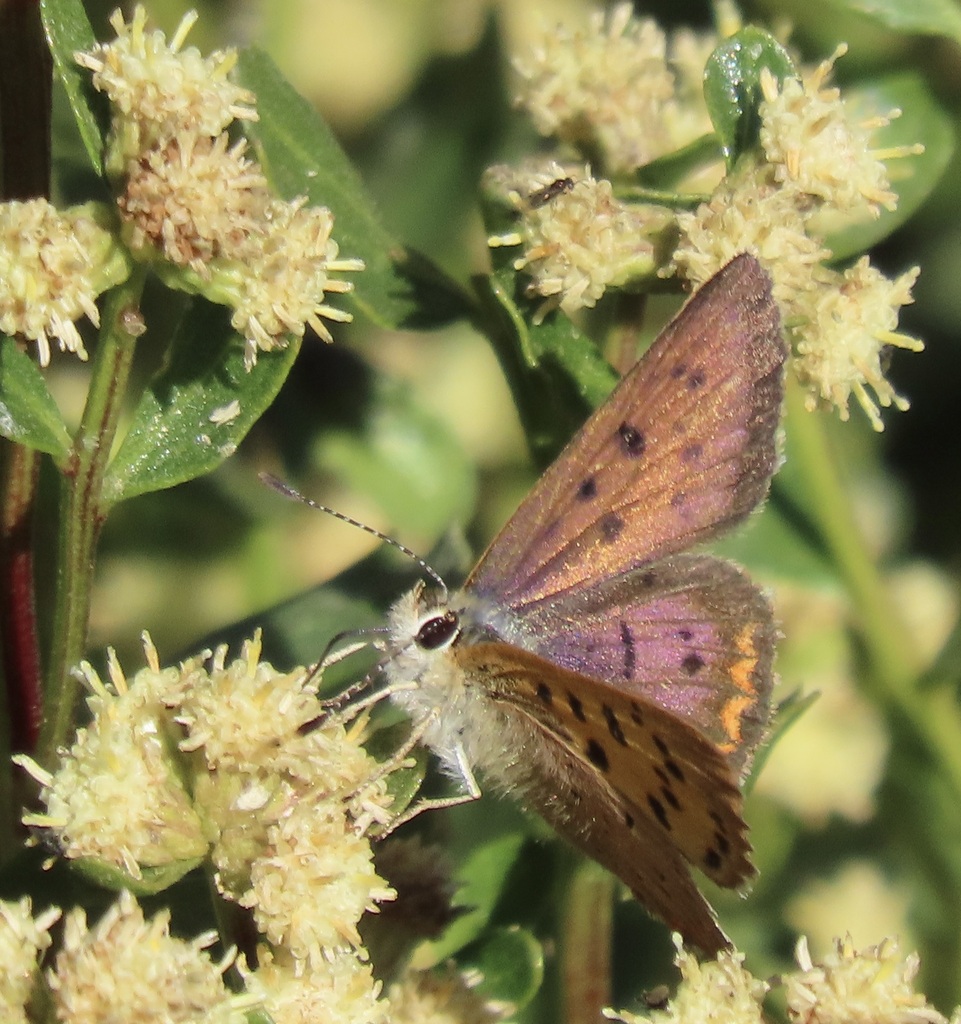
(c) John Hibbard, some rights reserved (CC BY) · licence
Family: Lycaenidae · Class: Insecta · Order: Lepidoptera
Tharsalea helloides (Purplish Copper) is a California animal in the Lycaenidae family.
The Purplish Copper (Tharsalea helloides) is a small butterfly in the family Lycaenidae with a wingspan ranging from 22 to 32 millimeters (0.87 to 1.26 inches). Males display bright orange-copper dorsal wing surfaces with narrow dark borders and small black spots, while females exhibit more subdued orange coloration with broader dark markings. The undersides of both sexes are pale gray to white with black spots and orange submarginal bands. Males possess distinctive purple-blue iridescence on the forewings that gives this species its common name. The hindwings feature small tails and orange crescents along the outer margins. This species ranges from the Great Lakes region through the northern Midwest and northern plains to British Columbia, extending south to Baja California. In California, Purplish Copper populations occur primarily in mountainous regions and foothills of the Sierra Nevada, Cascade Range, and Coast Ranges. The distinction between Purplish Copper and Dorcas Copper becomes unclear in Rocky Mountain populations, where specimens are typically classified under the Purplish Copper designation. Purplish Copper inhabits riparian areas, meadows, marshes, and streamside environments from sea level to approximately 2,400 meters (7,900 feet) elevation. The species requires moist soils and areas with abundant host vegetation. Adults are commonly found in areas with seeps, springs, and seasonal wetlands where larval host plants thrive. They prefer open to semi-open habitats with scattered shrubs and trees rather than dense forest. Larvae feed exclusively on plants in the buckwheat family (Polygonaceae), particularly knotweeds (Polygonum species) and docks (Rumex species), as well as cinquefoils in the rose family (Rosaceae). Adults nectar on various flowering plants including asters, mints, and members of the sunflower family. The species produces two to three broods annually in warmer regions, with flight periods extending from April through October. In cooler northern areas, populations may be univoltine with adults active from June to August. Females deposit eggs singly on host plant leaves or stems. Larvae overwinter in early instars and complete development the following spring. The Purplish Copper is not federally or state listed and appears to maintain stable populations across much of its range. However, localized populations face threats from habitat loss due to agricultural conversion, urban development, and water diversions that alter riparian ecosystems. Livestock grazing and invasive plant species can degrade habitat quality by reducing native host plant abundance. Climate change may affect this species by altering precipitation patterns and snowmelt timing that influence host plant phenology and habitat availability. The species' dependence on moist habitats makes it particularly vulnerable to drought conditions and water management practices that reduce stream flows and lower water tables.
Classification
Class: Insecta · Order: Lepidoptera · Family: Lycaenidae
Frequently asked questions
How is Tharsalea helloides classified?
Tharsalea helloides belongs to class Insecta, order Lepidoptera, family Lycaenidae.
What family does Tharsalea helloides belong to?
Tharsalea helloides is in the Lycaenidae family.
What is Tharsalea helloides?
The Purplish Copper (Tharsalea helloides) is a small butterfly in the family Lycaenidae with a wingspan ranging from 22 to 32 millimeters (0.87 to 1.26 inches).
Is Tharsalea helloides found in California?
Yes. Tharsalea helloides is recorded in California in The California Species Project's catalogue.
Related species
Other California species in the same genus, family, or bioregion.
Data from The California Species Project — 14,000+ California species with verified data from CNPS, CDFW, USFWS, and more.