Tharsalea nivalis
Lilac-bordered Copper
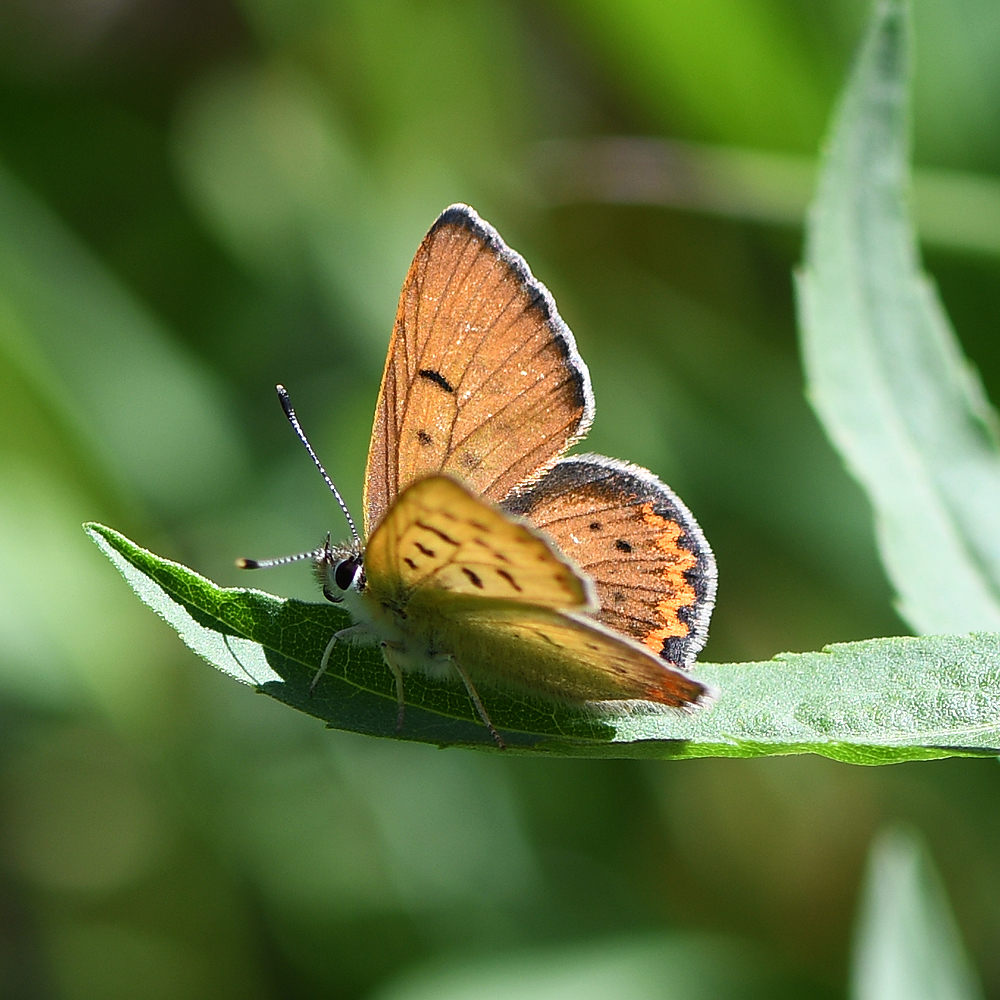
(c) Koji Shiraiwa, some rights reserved (CC BY) · licence
Family: Lycaenidae · Class: Insecta · Order: Lepidoptera
Tharsalea nivalis (Lilac-bordered Copper) is a California animal in the Lycaenidae family.
The lilac-bordered copper (Tharsalea nivalis) is a small butterfly in the family Lycaenidae, distinguished by its distinctive wing coloration and specialized habitat requirements. Males display bright orange-red forewings with black borders and spots, while the hindwings are gray-brown with orange marginal bands bordered by black and white spots that create the characteristic lilac appearance. Females are generally duller, with more subdued orange coloration and heavier black markings. Both sexes have a wingspan of approximately 22 to 30 mm (0.9 to 1.2 inches). The underside of the wings is pale gray with black spots and orange crescents along the margins. The lilac-bordered copper ranges from British Columbia south and east to central California, Wyoming, and Colorado. In California, the species occurs primarily in the Sierra Nevada and Cascade Range, typically at elevations between 1,200 and 3,400 meters (4,000 to 11,200 feet). Historical records indicate the species was once more widespread in montane regions of the western United States, though current distribution appears more fragmented. This butterfly inhabits open areas in coniferous forests, mountain meadows, and alpine zones where its host plant occurs. The species shows a strong association with areas containing Douglas' knotweed (Polygonum douglasii), a low-growing annual herb in the buckwheat family (Polygonaceae). Suitable habitat typically features well-drained soils, moderate to full sun exposure, and the presence of nectar sources for adult butterflies. The species often occurs in areas disturbed by natural processes such as avalanches, rock slides, or forest openings. Lilac-bordered copper larvae are entirely dependent on Douglas' knotweed for development. Females deposit eggs singly on or near the host plant, typically on stems or nearby vegetation. The species is univoltine, producing one generation per year. Adults emerge in mid to late summer, generally from July through September, depending on elevation and local climate conditions. Mating occurs shortly after emergence, with males establishing territories near patches of host plants. Adults feed on nectar from various wildflowers, including buckwheats, asters, and other composite flowers common in montane environments. The lilac-bordered copper is not federally listed, though its specialized habitat requirements and apparent population fragmentation raise conservation concerns. Climate change poses a significant threat, as warming temperatures may shift suitable habitat to higher elevations where host plants may not occur. Forest management practices that eliminate openings and disturbed areas could reduce available habitat. Additionally, the species' dependence on a single host plant makes it vulnerable to factors affecting Douglas' knotweed populations, including drought, invasive species, and habitat modification. Long-term monitoring is needed to assess population trends and habitat stability across the species' range.
Classification
Class: Insecta · Order: Lepidoptera · Family: Lycaenidae
Frequently asked questions
How is Tharsalea nivalis classified?
Tharsalea nivalis belongs to class Insecta, order Lepidoptera, family Lycaenidae.
What family does Tharsalea nivalis belong to?
Tharsalea nivalis is in the Lycaenidae family.
What is Tharsalea nivalis?
The lilac-bordered copper (Tharsalea nivalis) is a small butterfly in the family Lycaenidae, distinguished by its distinctive wing coloration and specialized habitat requirements.
Is Tharsalea nivalis found in California?
Yes. Tharsalea nivalis is recorded in California in The California Species Project's catalogue.
Related species
Other California species in the same genus, family, or bioregion.
Data from The California Species Project — 14,000+ California species with verified data from CNPS, CDFW, USFWS, and more.