Tharsalea xanthoides
Great Copper
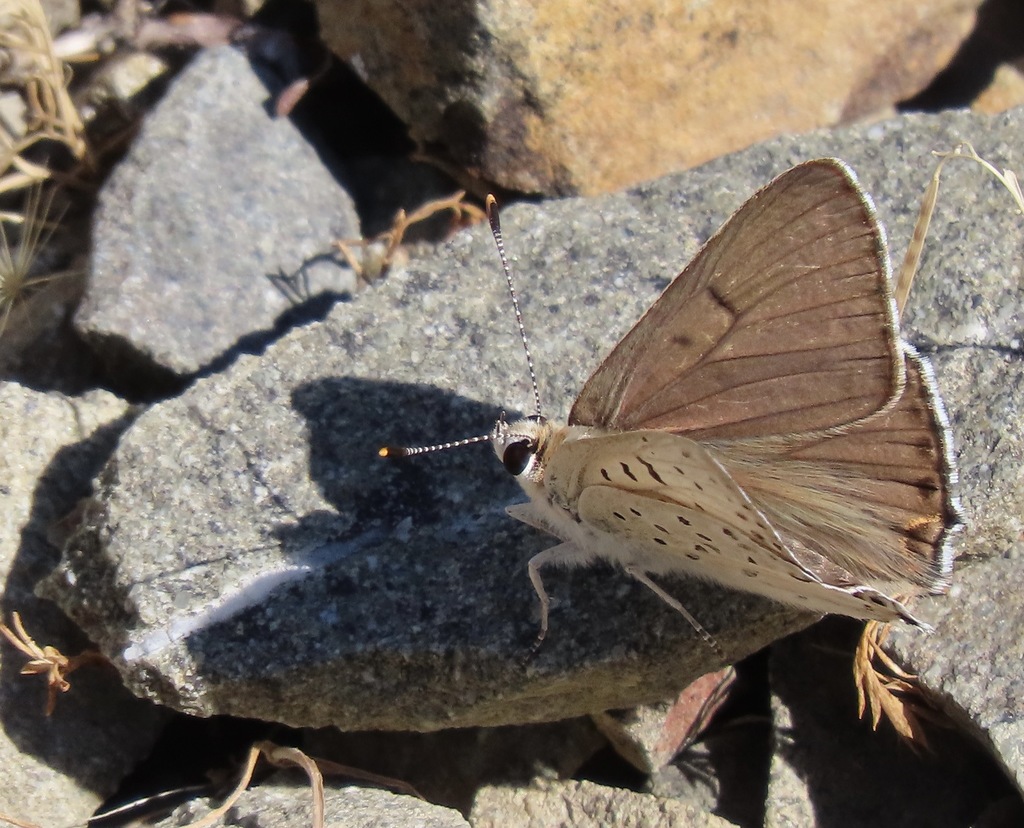
(c) John Hibbard, some rights reserved (CC BY) · licence
Family: Lycaenidae · Class: Insecta · Order: Lepidoptera
Tharsalea xanthoides (Great Copper) is a California animal in the Lycaenidae family.
The Great Copper is a medium-sized butterfly with males displaying bright orange forewings marked with dark borders and scattered black spots. Males measure approximately 28-32 mm (1.1-1.3 inches) in wingspan, while females are larger at 32-38 mm (1.3-1.5 inches). Females exhibit more subdued coloration with orange-brown forewings containing prominent black spots and a distinctive row of orange lunules along the hindwing margins. The undersides of both sexes show pale gray-white coloration with black spots and orange marginal bands on the hindwings. Males possess specialized scent scales on their forewings used in courtship displays. The Great Copper ranges from southern Oregon south through the western regions of California to extreme northern Baja California, Mexico. In California, the species occurs primarily west of the Sierra Nevada and Cascade ranges, inhabiting coastal counties and the Central Valley. Historical records document populations from San Francisco Bay south to San Diego County, though current distribution may be more fragmented than the historical range suggests. This species inhabits wetland margins, stream corridors, and areas with permanent or seasonal moisture where host plants thrive. Great Coppers are typically found at elevations from sea level to approximately 1,200 meters (4,000 feet), favoring riparian zones, irrigation ditches, pond edges, and marshy areas. The butterflies require proximity to their host plants and access to mud or moist soil for puddling behavior, particularly important for males seeking mineral nutrients. Great Coppers are dependent on several dock species (Rumex spp.) as larval host plants, including curly dock (Rumex crispus) and willow dock (Rumex salicifolius). Females deposit single eggs on host plant leaves, typically on the undersides near leaf bases. Larvae feed on dock foliage, developing through five instars before pupating. The species produces two to three generations annually in California, with flight periods extending from March through October, depending on local climate conditions. Adults nectar on various flowering plants including mint family species, composites, and their own host plants when in bloom. Males establish territories near host plant patches and engage in aerial courtship flights with females. Currently, the Great Copper holds no federal or state conservation listing status. However, populations face pressure from habitat loss due to wetland drainage, urban development, and agricultural conversion. Stream channelization and removal of riparian vegetation eliminate both host plants and adult nectar sources. Water diversions and groundwater pumping can dry wetland habitats essential for host plant survival. Invasive plant species may compete with native dock species, while herbicide applications targeting weedy dock species can inadvertently harm Great Copper populations. Climate change poses additional threats through altered precipitation patterns affecting wetland hydrology and host plant distribution. Conservation efforts focus on protecting riparian corridors and maintaining wetland habitats where dock species can persist.
Classification
Class: Insecta · Order: Lepidoptera · Family: Lycaenidae
Frequently asked questions
How is Tharsalea xanthoides classified?
Tharsalea xanthoides belongs to class Insecta, order Lepidoptera, family Lycaenidae.
What family does Tharsalea xanthoides belong to?
Tharsalea xanthoides is in the Lycaenidae family.
What is Tharsalea xanthoides?
The Great Copper is a medium-sized butterfly with males displaying bright orange forewings marked with dark borders and scattered black spots.
Is Tharsalea xanthoides found in California?
Yes. Tharsalea xanthoides is recorded in California in The California Species Project's catalogue.
Related species
Other California species in the same genus, family, or bioregion.
Data from The California Species Project — 14,000+ California species with verified data from CNPS, CDFW, USFWS, and more.