Thaumatopsis repandus
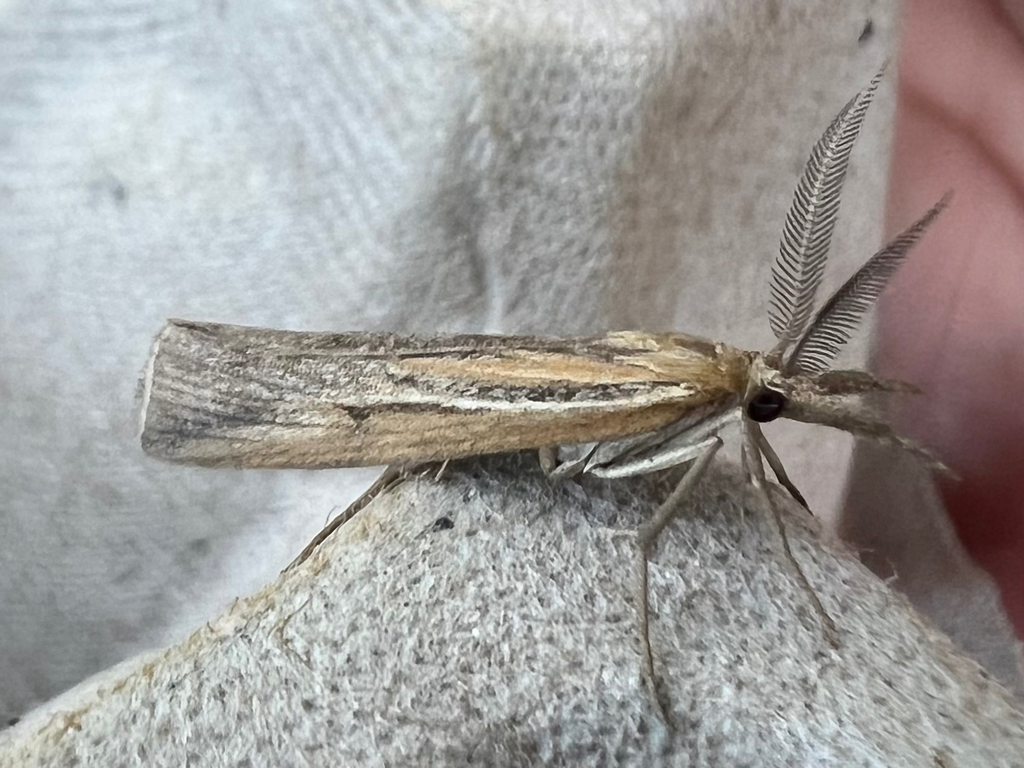
no rights reserved · CC0
Family: Crambidae · Class: Insecta · Order: Lepidoptera
Thaumatopsis repandus is a California animal in the Crambidae family.
Thaumatopsis repandus is a small moth species belonging to the family Crambidae, commonly known as grass moths or crambid snout moths. This species represents one of the lesser-documented members of the genus Thaumatopsis, which comprises several North American moth species characterized by their distinctive wing patterns and grass-associated ecology. The adult moth displays typical crambid morphology with a wingspan ranging from 18 to 25 millimeters (0.7 to 1.0 inches). The forewings are elongated and narrow, featuring a pale brown to gray-brown ground color with subtle darker markings along the wing margins. The hindwings are lighter in coloration, typically pale gray to whitish. Like other Crambidae, adults exhibit the characteristic forward-projecting labial palps that give the family its "snout moth" designation. The antennae are thread-like in both sexes, though males may display slightly more prominent antennal segments. The documented range of Thaumatopsis repandus includes portions of western North America, with records from California and adjacent southwestern states. However, the full extent of its distribution remains incompletely mapped due to limited survey efforts targeting this group of small moths. Within California, the species likely occurs in suitable habitat from coastal regions to interior valleys, though specific county-level distribution data are not readily available through current databases. This species inhabits grassland and open woodland environments where its larval host plants occur. Like many crambid moths, Thaumatopsis repandus is associated with graminoid vegetation, with larvae likely developing within grass stems or root systems. The species shows preference for areas with native bunch grasses and may occur from sea level to moderate elevations in foothill regions, though specific elevation ranges have not been definitively established. Adult moths are primarily nocturnal and are attracted to artificial lighting during their flight period. Flight timing likely follows patterns typical of western Crambidae, with peak adult activity occurring during late spring through early fall months. Larvae are internal feeders, boring within grass stems or roots where they complete their development. The species presumably overwinters in the larval stage, emerging as adults the following growing season. Mating and oviposition behaviors follow standard lepidopteran patterns, with females depositing eggs on or near suitable host plant material. Currently, Thaumatopsis repandus does not appear on federal or state conservation lists, and its conservation status remains unassessed. The species' actual abundance and population trends are unknown due to limited systematic surveying of small moth species. Potential threats may include habitat conversion from grassland development, invasive plant species displacement of native grass communities, and pesticide applications in agricultural and urban interface areas. Given the general decline of native grassland ecosystems in California, species dependent on these habitats warrant monitoring attention despite their current unlisted status.
Classification
Class: Insecta · Order: Lepidoptera · Family: Crambidae
Frequently asked questions
How is Thaumatopsis repandus classified?
Thaumatopsis repandus belongs to class Insecta, order Lepidoptera, family Crambidae.
What family does Thaumatopsis repandus belong to?
Thaumatopsis repandus is in the Crambidae family.
What is Thaumatopsis repandus?
Thaumatopsis repandus is a small moth species belonging to the family Crambidae, commonly known as grass moths or crambid snout moths.
Is Thaumatopsis repandus found in California?
Yes. Thaumatopsis repandus is recorded in California in The California Species Project's catalogue.
Related species
Other California species in the same genus, family, or bioregion.
Data from The California Species Project — 14,000+ California species with verified data from CNPS, CDFW, USFWS, and more.