Theridion melanurum
Common House Combfoot
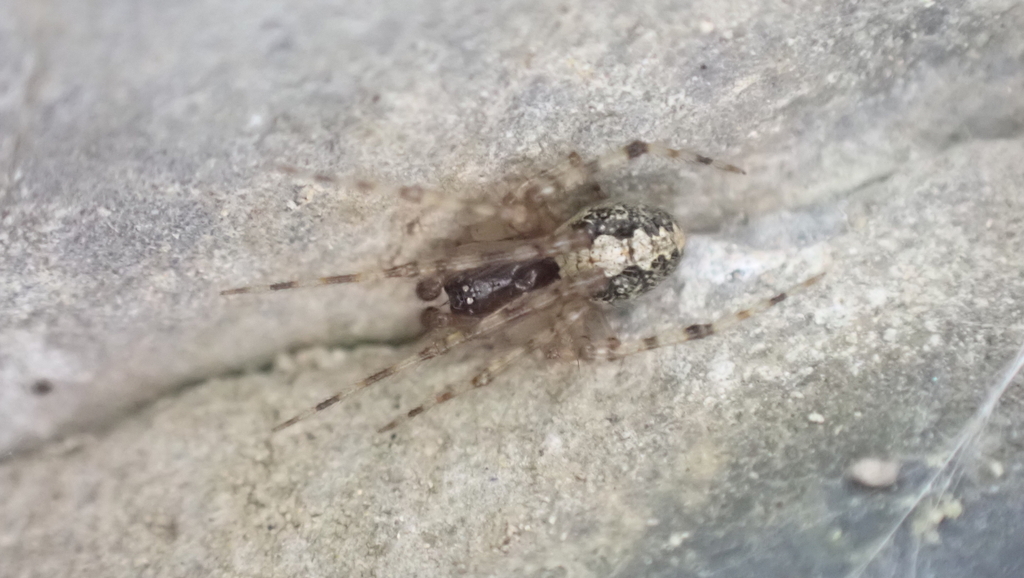
(c) Julien Tchilinguirian, some rights reserved (CC BY) · licence
Family: Theridiidae · Class: Arachnida · Order: Araneae
Theridion melanurum (Common House Combfoot) is a California animal in the Theridiidae family.
The Common House Combfoot (Theridion melanurum) is a small spider in the family Theridiidae, measuring approximately 3 mm in body length. The species exhibits considerable morphological variation, with a generally dark head and variable abdominal patterns. The most distinctive feature is a zig-zag band across the abdomen, which can range from prominent white markings to barely visible patterns depending on the individual (NatureSpot). The cephalothorax is typically dark brown to black, while the legs are lighter in coloration. Theridion melanurum has a widespread distribution across temperate regions. In North America, the species is documented from various locations, though specific range details within California require further documentation. The species has been recorded in the Azores islands, indicating a broad geographic distribution that may include both native and introduced populations (Borges et al. 2019). This cosmopolitan distribution suggests the species has successfully adapted to diverse climatic conditions. This species is notably synanthropic, meaning it lives in close association with human habitations. Common House Combfoot constructs its webs in and around buildings, making it one of the more frequently encountered house spiders (British Spiders Portal). The species shows a preference for protected locations within structures, utilizing corners, window frames, and other architectural features for web construction. Unlike some related theridiids that require specific natural habitats, T. melanurum has adapted well to urban and suburban environments. As a member of the tangle-web spider family, the Common House Combfoot constructs irregular, three-dimensional webs to capture prey. The species is primarily insectivorous, feeding on small flying insects that become entangled in its webs. A notable physiological adaptation of this species is its ability to obtain the majority of its water requirements through the prey it captures, reducing its dependence on environmental moisture sources (British Spiders Portal). This adaptation likely contributes to its success in indoor environments where humidity levels may be lower than natural habitats. Reproductive biology follows typical theridiid patterns, though specific details regarding egg-laying cycles and developmental timing in California populations have not been well documented. Currently, Theridion melanurum has no special conservation status at federal or state levels. The species appears to be stable and possibly expanding its range through human-mediated dispersal. As a synanthropic species, it faces few conservation threats and may actually benefit from human development that provides suitable habitat. The primary ecological concern relates not to the species' survival, but rather to its potential role as an introduced species in some regions. However, the extent to which California populations represent native versus introduced occurrences requires further taxonomic and biogeographic investigation. The species' adaptability to human-modified environments suggests it will likely remain common where suitable building habitats exist.
Classification
Class: Arachnida · Order: Araneae · Family: Theridiidae
Frequently asked questions
How is Theridion melanurum classified?
Theridion melanurum belongs to class Arachnida, order Araneae, family Theridiidae.
What family does Theridion melanurum belong to?
Theridion melanurum is in the Theridiidae family.
What is Theridion melanurum?
The Common House Combfoot (Theridion melanurum) is a small spider in the family Theridiidae, measuring approximately 3 mm in body length.
Is Theridion melanurum found in California?
Yes. Theridion melanurum is recorded in California in The California Species Project's catalogue.
Related species
Other California species in the same genus, family, or bioregion.
Data from The California Species Project — 14,000+ California species with verified data from CNPS, CDFW, USFWS, and more.