Thomomys mazama
Mazama Pocket Gopher
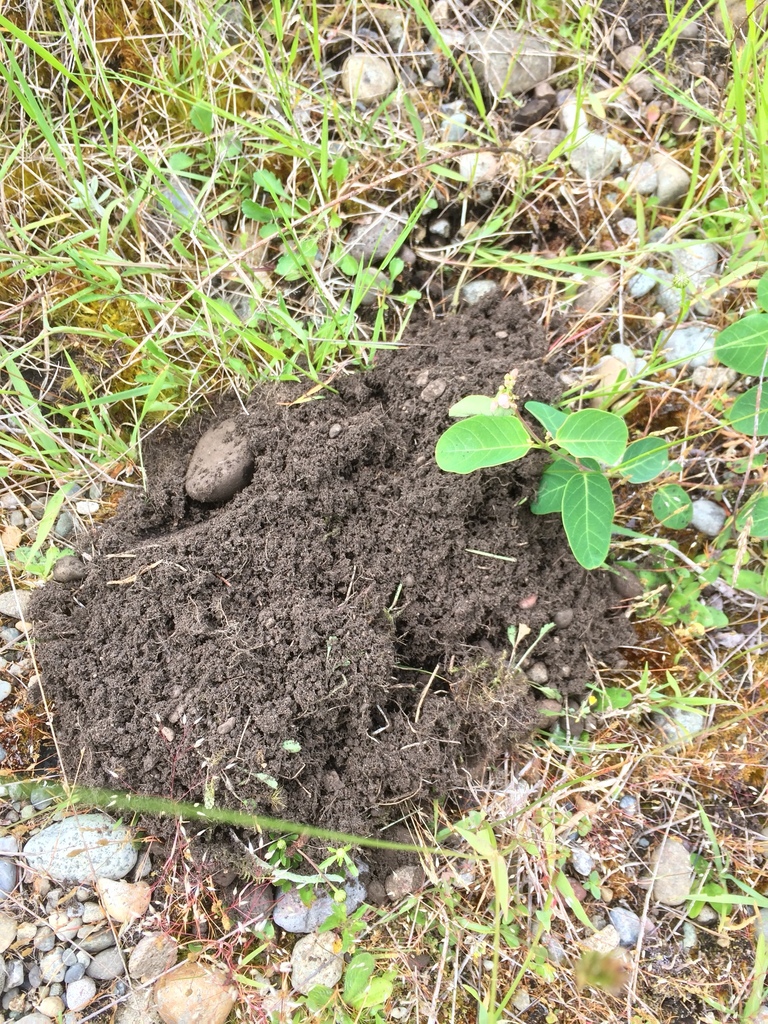
no rights reserved · CC0
Family: Geomyidae · Class: Mammalia · Order: Rodentia
Thomomys mazama (Mazama Pocket Gopher) is a California animal in the Geomyidae family.
The Mazama pocket gopher is a small, fossorial rodent endemic to the Pacific Northwest. Adults measure 150 to 200 mm (5.9 to 7.9 inches) in total length, with females typically larger than males. The body is cylindrical and compact, adapted for subterranean life. Pelage coloration varies geographically, ranging from grayish-brown to dark brown dorsally, with lighter underparts. The species possesses characteristic pocket gopher features including small eyes and ears, prominent orange-yellow incisors, and large forefeet with elongated claws for digging. The tail is sparsely haired and comprises approximately one-third of the total body length. Historically, Thomomys mazama occupied prairies and oak woodlands from southwestern Washington through western Oregon to northwestern California. The species' range extended from the Puget Sound lowlands south through the Willamette Valley and into scattered locations in northern California. Current distribution is severely fragmented, with populations restricted to isolated habitat patches. In California, the species occurs in Humboldt County and possibly Del Norte County, though recent surveys have documented few extant populations. Mazama pocket gophers inhabit well-drained soils in prairie grasslands, oak savannas, and woodland edges. The species requires deep, sandy or loamy soils suitable for extensive burrow systems. Elevation ranges from sea level to approximately 300 meters (980 feet). Preferred habitats feature native grasses and forbs, though populations persist in some agricultural areas and managed grasslands. Soil depth must exceed 60 cm (24 inches) to support the elaborate tunnel networks essential for survival. This species constructs complex underground burrow systems extending 30 to 150 meters (98 to 492 feet) in length. Tunnels typically occur 15 to 46 cm (6 to 18 inches) below ground surface, with deeper chambers for nesting and food storage. Mazama pocket gophers are solitary except during brief mating periods. Breeding occurs from spring through early summer, with females producing one to two litters annually. Litter size ranges from two to five young after a gestation period of approximately 18 days. The species feeds primarily on underground plant parts including roots, bulbs, and tubers of native grasses and forbs. Population declines have been severe throughout the species' range due to habitat conversion and fragmentation. Agricultural development, urbanization, and fire suppression have eliminated an estimated 95% of historical prairie habitat. Several subspecies face extreme risk of extinction, with some populations reduced to fewer than 100 individuals. The Roy Prairie subspecies (T. m. glacialis) was federally listed as threatened in 2014, and the Olympia subspecies (T. m. yelmensis) was listed as endangered in 2014. Conservation efforts focus on habitat restoration, population monitoring, and captive breeding programs. Prescribed burning and invasive species control aim to restore native prairie ecosystems. Climate change poses additional threats through altered precipitation patterns and vegetation shifts that may further reduce suitable habitat.
Classification
Class: Mammalia · Order: Rodentia · Family: Geomyidae
Frequently asked questions
How is Thomomys mazama classified?
Thomomys mazama belongs to class Mammalia, order Rodentia, family Geomyidae.
What family does Thomomys mazama belong to?
Thomomys mazama is in the Geomyidae family.
What is Thomomys mazama?
The Mazama pocket gopher is a small, fossorial rodent endemic to the Pacific Northwest.
Is Thomomys mazama found in California?
Yes. Thomomys mazama is recorded in California in The California Species Project's catalogue.
Related species
Other California species in the same genus, family, or bioregion.
Data from The California Species Project — 14,000+ California species with verified data from CNPS, CDFW, USFWS, and more.