Thomomys mazama tumuli
Tenino pocket gopher
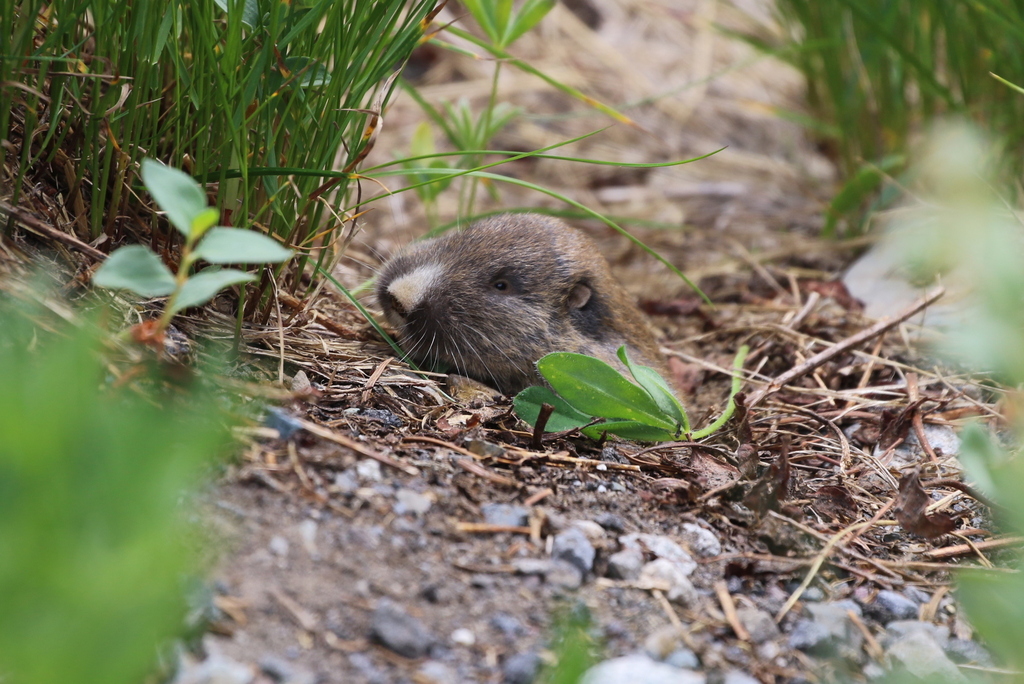
no rights reserved · CC0
Family: Geomyidae · Class: Mammalia · Order: Rodentia
Conservation status: Threatened
Thomomys mazama tumuli (Tenino pocket gopher) is a California animal in the Geomyidae family.
The Tenino pocket gopher is a small fossorial rodent endemic to south Puget Sound prairies in Washington State. As a subspecies of the Mazama pocket gopher complex, it shares the characteristic morphology of the family Geomyidae: short, strong legs adapted for digging, small ears and eyes, and specialized lip structures that can close behind the front incisors to prevent dirt and debris from entering the mouth during excavation (USFWS 2014). The subspecies was originally distinguished from other Mazama pocket gopher subspecies based on characteristics of the baculum (penis bone) and other morphological features. Historically, Tenino pocket gophers were found in the vicinity of Rocky Prairie Natural Area Preserve near Tenino, Washington, in Thurston County. This represented a relatively small-extent prairie area that served as the type locality when the subspecies was first described in 1949 (Gardner 1950). The current range remains extremely restricted to south Puget Sound prairies, specifically within Thurston County. Recent surveys indicate intermittent occupancy of the Rocky Prairie area, with Washington Department of Fish and Wildlife researchers noting inconsistent presence in recent years, suggesting that colonies located in the Natural Area Preserve may represent satellite populations (USFWS 2012). Tenino pocket gophers inhabit native prairie ecosystems characterized by deep, well-drained soils suitable for extensive burrow construction. These grassland habitats have been severely fragmented and reduced due to urban development, agriculture, and invasive species encroachment. The subspecies requires areas with appropriate soil composition for tunnel excavation and foraging, as pocket gophers spend virtually their entire lives underground in complex burrow systems. Like other pocket gophers, this subspecies exhibits highly fossorial behavior, creating extensive underground tunnel networks for foraging and nesting. Home range size varies based on factors such as soil conditions and resource availability. The species is primarily herbivorous, feeding on roots, bulbs, and other underground plant parts accessed through their tunnel systems. Reproduction typically occurs during spring months, with females producing small litters in underground nest chambers. The Tenino pocket gopher was listed as threatened under the Endangered Species Act in April 2014, along with three other Mazama pocket gopher subspecies (USFWS 2014). Critical habitat was designated for the subspecies to protect remaining suitable prairie habitat. The primary threats include habitat loss and fragmentation due to urban development, agricultural conversion, and invasion of non-native plant species that alter soil conditions and native plant communities. The U.S. Fish and Wildlife Service completed a Recovery Plan for Four Subspecies of Mazama Pocket Gopher in 2022, which outlines specific management actions necessary to achieve recovery. Recovery efforts focus on habitat protection, restoration of degraded prairie areas, and population monitoring to track subspecies persistence across their limited range.
Classification
Class: Mammalia · Order: Rodentia · Family: Geomyidae
Conservation status
Threatened
Frequently asked questions
How is Thomomys mazama tumuli classified?
Thomomys mazama tumuli belongs to class Mammalia, order Rodentia, family Geomyidae.
What family does Thomomys mazama tumuli belong to?
Thomomys mazama tumuli is in the Geomyidae family.
Is Thomomys mazama tumuli protected or of conservation concern?
Thomomys mazama tumuli carries the following status: Threatened.
What is Thomomys mazama tumuli?
The Tenino pocket gopher is a small fossorial rodent endemic to south Puget Sound prairies in Washington State.
Is Thomomys mazama tumuli found in California?
Yes. Thomomys mazama tumuli is recorded in California in The California Species Project's catalogue.
Related species
Other California species in the same genus, family, or bioregion.
Data from The California Species Project — 14,000+ California species with verified data from CNPS, CDFW, USFWS, and more.