Thomomys monticola
Mountain Pocket Gopher
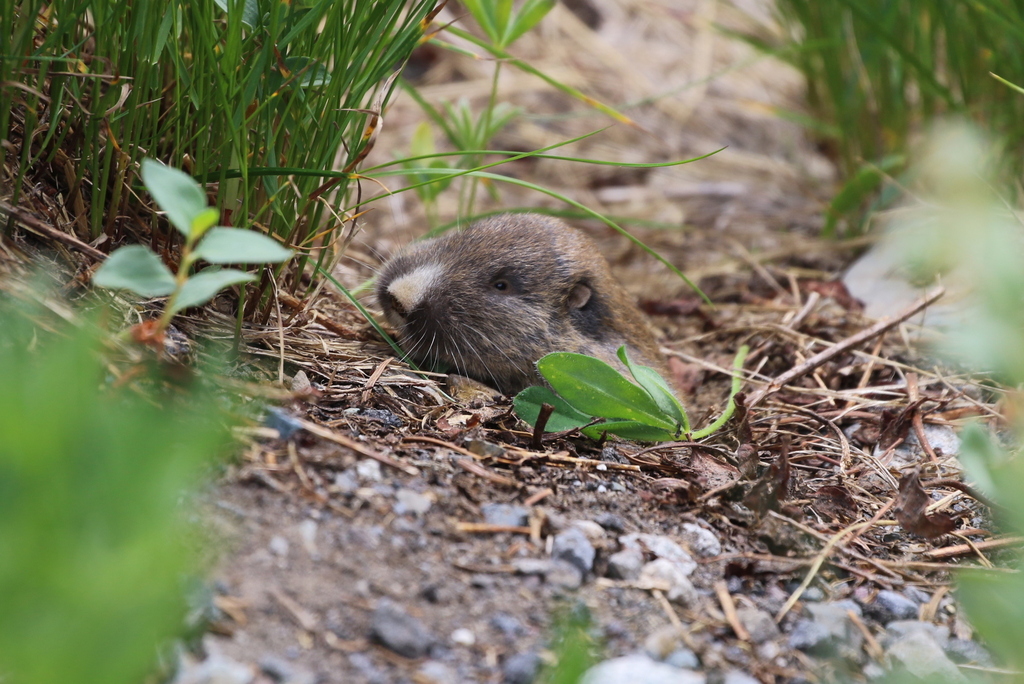
no rights reserved · CC0
Family: Geomyidae · Class: Mammalia · Order: Rodentia
Thomomys monticola (Mountain Pocket Gopher) is a California animal in the Geomyidae family.
The Mountain Pocket Gopher (Thomomys monticola) is a medium-sized fossorial rodent endemic to the mountains of California and southern Oregon. Adults measure 140 to 180 mm (5.5 to 7.1 inches) in total length, with tail length ranging from 45 to 65 mm (1.8 to 2.6 inches). Body weight typically ranges from 35 to 85 grams (1.2 to 3.0 ounces). The pelage varies from grayish-brown to dark brown dorsally, with lighter underparts. The species exhibits the characteristic adaptations of pocket gophers, including prominent orange-yellow incisors, small eyes and ears, and powerful forelimbs with enlarged claws for digging. The tail is sparsely haired and the lips close behind the incisors to prevent soil ingestion while burrowing. Mountain Pocket Gophers historically occurred throughout the Sierra Nevada, Cascade Range, and northern Coast Ranges of California, extending into southern Oregon. In California, the species ranges from Siskiyou and Modoc counties south through the Sierra Nevada to Tulare County, and in scattered populations in the northern Coast Ranges including Lake, Napa, and Sonoma counties. Current distribution appears fragmented compared to historical range, particularly at lower elevations where habitat conversion has occurred. The species inhabits montane and subalpine environments, typically at elevations between 1,200 and 3,400 meters (4,000 to 11,200 feet). Mountain Pocket Gophers prefer areas with deep, well-drained soils that support meadow vegetation, including mountain meadows, forest clearings, and alpine zones. They are commonly found in association with coniferous forests dominated by ponderosa pine, Douglas-fir, white fir, and red fir. The species requires friable soils for efficient burrowing and areas with sufficient herbaceous vegetation for foraging. Mountain Pocket Gophers are solitary, highly territorial animals that spend most of their lives underground in complex burrow systems. These burrows typically extend 0.5 to 1.5 meters (1.6 to 4.9 feet) below ground surface and may exceed 150 meters (490 feet) in total length. The species feeds primarily on roots, bulbs, tubers, and other underground plant parts, though they occasionally consume aboveground vegetation pulled into burrows. Breeding occurs once annually, typically from April to June following snowmelt. Females produce litters of 2 to 5 young after a gestation period of approximately 18 days. Young remain in maternal burrows for 6 to 8 weeks before dispersing. The Mountain Pocket Gopher is not currently listed under federal or state endangered species acts, though populations face localized threats from habitat fragmentation, development, and recreational activities. Climate change may impact the species through alteration of montane precipitation patterns and upward shifts in vegetation zones. Some subspecies have experienced range reductions, particularly T. m. monticola in the northern Sierra Nevada. The species' fossorial lifestyle and specific soil requirements make populations vulnerable to habitat disturbance, though their secretive nature makes comprehensive population assessment challenging.
Classification
Class: Mammalia · Order: Rodentia · Family: Geomyidae
Frequently asked questions
How is Thomomys monticola classified?
Thomomys monticola belongs to class Mammalia, order Rodentia, family Geomyidae.
What family does Thomomys monticola belong to?
Thomomys monticola is in the Geomyidae family.
What is Thomomys monticola?
The Mountain Pocket Gopher (Thomomys monticola) is a medium-sized fossorial rodent endemic to the mountains of California and southern Oregon.
Is Thomomys monticola found in California?
Yes. Thomomys monticola is recorded in California in The California Species Project's catalogue.
Related species
Other California species in the same genus, family, or bioregion.
Data from The California Species Project — 14,000+ California species with verified data from CNPS, CDFW, USFWS, and more.