Thorybes mexicana
Mexican Cloudywing
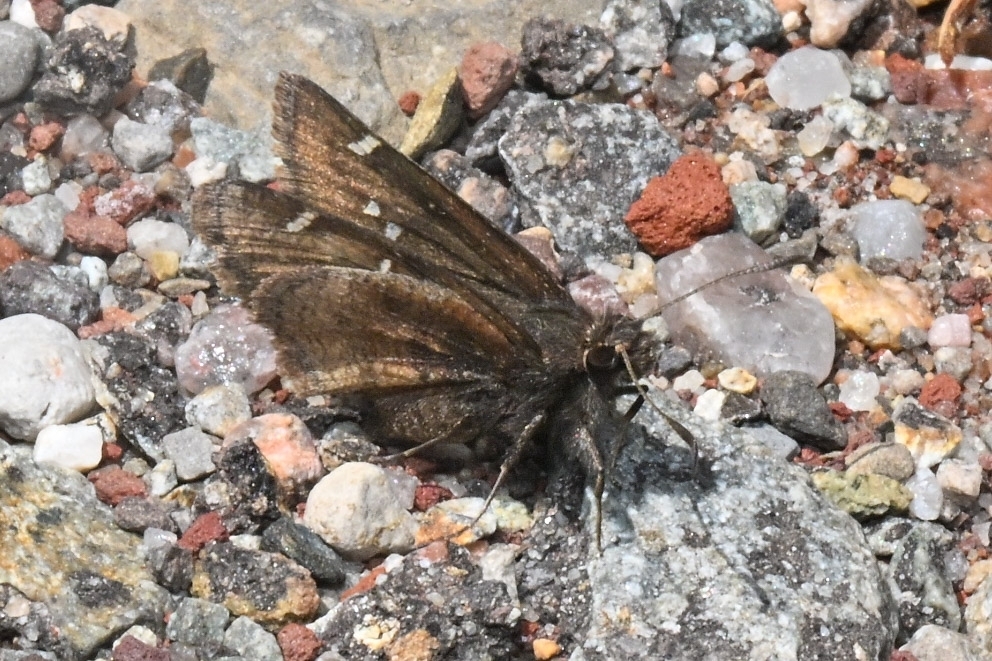
(c) Tom Kennedy, some rights reserved (CC BY) · licence
Family: Hesperiidae · Class: Insecta · Order: Lepidoptera
Thorybes mexicana (Mexican Cloudywing) is a California animal in the Hesperiidae family.
The Mexican Cloudywing is a small to medium-sized skipper butterfly in the family Hesperiidae. Adults have a wingspan of approximately 28-35 mm (1.1-1.4 inches). The forewings are dark brown with distinctive white or translucent spots arranged in a characteristic pattern, giving the wings their 'cloudy' appearance. Males typically display more prominent white markings than females. The hindwings are uniformly dark brown with subtle lighter spotting along the margins. The body is robust and covered with dense grayish-brown scales, typical of skipper butterflies. The antennae are relatively short with club-shaped tips that curve backward in a distinctive hook. The Mexican Cloudywing occurs in high elevation mountains of the western United States south into Mexico. In California, the species is found primarily in the Sierra Nevada, Cascade Range, and higher elevations of the Coast Ranges. The distribution extends from southern British Columbia through the western states to central Mexico. Within its range, populations are typically found at elevations between 1,200 and 3,000 meters (4,000-10,000 feet), though specific elevation preferences may vary by geographic region. This species inhabits mountain meadows, forest openings, and riparian areas where host plants are abundant. Preferred habitats include subalpine and montane zones with mixed coniferous forests, particularly areas with natural clearings or edge environments. The species requires proximity to leguminous host plants and typically occurs in areas with adequate moisture during the growing season. Adults are frequently observed nectaring on wildflowers in mountain meadows and along forest edges. Mexican Cloudywing larvae feed exclusively on leguminous plants, including clover (Trifolium), wild pea (Lathyrus), and vetch (Vicia). Females deposit eggs singly on host plant leaves, and caterpillars construct leaf shelters by folding or rolling leaves together. The species is univoltine in most locations, producing one generation per year. Adults typically emerge in mid to late summer, with flight periods varying by elevation and latitude. Flight season generally extends from June through August at higher elevations. Adults exhibit rapid, darting flight patterns characteristic of skipper butterflies and are often observed basking on bare ground or rocks in sunny locations. The Mexican Cloudywing is not federally or state listed as threatened or endangered. However, like many montane species, it may face challenges from climate change as suitable habitat shifts to higher elevations. Habitat fragmentation and development in mountain areas could potentially impact local populations. The species' dependence on specific leguminous host plants makes it vulnerable to changes in plant community composition. Population trends and conservation status require further study, as comprehensive surveys of high-elevation butterfly populations are limited. The species' relatively restricted habitat requirements and specialized host plant associations suggest that monitoring of population trends would be valuable for long-term conservation planning.
Classification
Class: Insecta · Order: Lepidoptera · Family: Hesperiidae
Frequently asked questions
How is Thorybes mexicana classified?
Thorybes mexicana belongs to class Insecta, order Lepidoptera, family Hesperiidae.
What family does Thorybes mexicana belong to?
Thorybes mexicana is in the Hesperiidae family.
What is Thorybes mexicana?
The Mexican Cloudywing is a small to medium-sized skipper butterfly in the family Hesperiidae.
Is Thorybes mexicana found in California?
Yes. Thorybes mexicana is recorded in California in The California Species Project's catalogue.
Related species
Other California species in the same genus, family, or bioregion.
Data from The California Species Project — 14,000+ California species with verified data from CNPS, CDFW, USFWS, and more.