Thorybes pylades
Northern Cloudywing
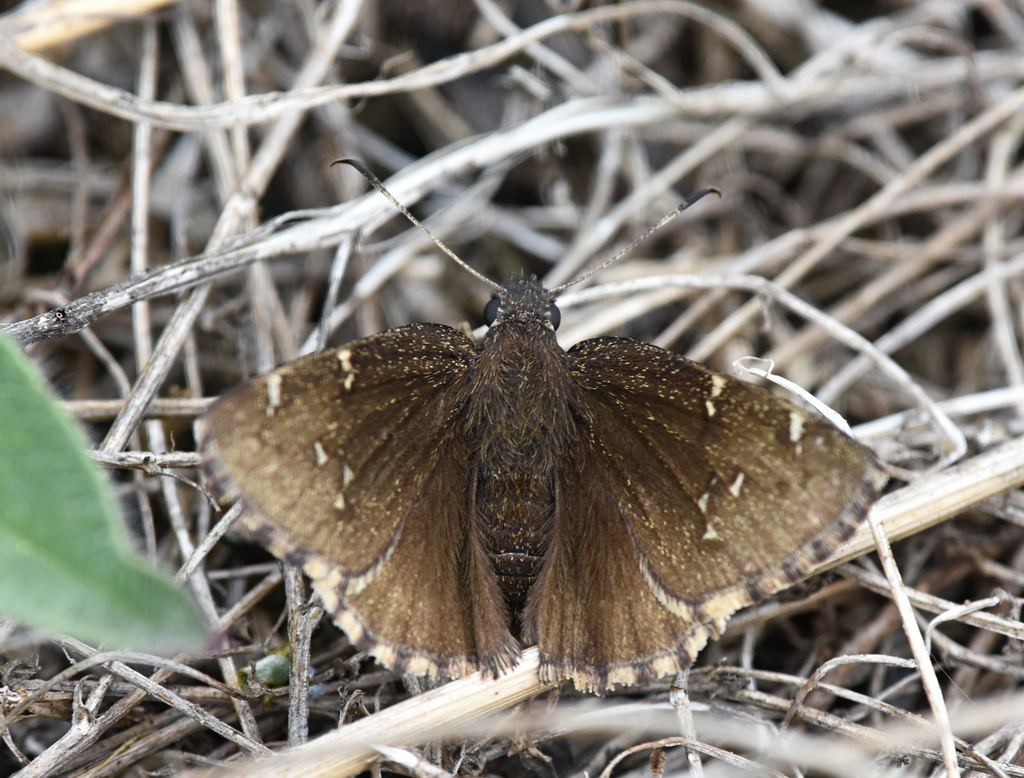
(c) Jimmy Dee, some rights reserved (CC BY-SA) · licence
Family: Hesperiidae · Class: Insecta · Order: Lepidoptera
Thorybes pylades (Northern Cloudywing) is a California animal in the Hesperiidae family.
The Northern Cloudywing is a medium-sized skipper butterfly with a wingspan ranging from 32 to 38 mm (1.3 to 1.5 inches). Males exhibit dark brown forewings marked with distinctive white spots arranged in a band across the wing, while the hindwings are uniformly dark brown. Females are similar but typically larger with more prominent white markings. The body is robust and covered in grayish-brown scales, giving the species its characteristic cloudy appearance. The antennae are club-shaped with a distinctive hooked tip, and the head features large compound eyes. The Northern Cloudywing ranges from Nova Scotia west across southern Canada to British Columbia, extending south through California and the Rocky Mountain states to Mexico, Texas, the Gulf states, and Florida. In California, the species occurs throughout much of the state except for the most arid desert regions, with documented populations in the Coast Ranges, Sierra Nevada, and Central Valley. The species demonstrates considerable adaptability to varying climatic conditions across this extensive range. This skipper inhabits diverse open and semi-open environments including meadows, prairies, old fields, woodland edges, and disturbed areas. The species occurs from sea level to elevations of approximately 2,400 meters (8,000 feet) in montane areas. Adults prefer sunny locations with abundant nectar sources and require proximity to host plants for reproduction. The species tolerates both natural and anthropogenic habitats, often thriving in agricultural areas and suburban environments. Northern Cloudywings are active from late spring through early fall, with flight periods varying by latitude and elevation. In California, adults typically fly from April through September, with peak activity during summer months. Males exhibit territorial behavior, perching on prominent vegetation and engaging in aerial pursuits of other butterflies. Adults nectar on various flowers including thistles, dogbane, milkweeds, and mints. Females lay single eggs on host plants in the pea family (Fabaceae), including beggar's ticks (Desmodium), bush clover (Lespedeza), clover (Trifolium), lotus (Hosackia), and other legumes. Larvae construct leaf shelters by folding or rolling host plant leaves and feeding within these protective structures. The species overwinters as mature larvae in leaf shelters. The Northern Cloudywing is not federally or state listed and maintains stable populations across most of its range. The species benefits from habitat disturbance that creates early successional environments where host plants thrive. Agricultural practices that maintain field margins and allow leguminous weeds to persist can support local populations. While not considered threatened, habitat loss through intensive development and agricultural intensification may affect some local populations. The species' broad host plant range and adaptability to various habitats contribute to its overall stability, though continued monitoring of population trends remains important for long-term conservation planning.
Classification
Class: Insecta · Order: Lepidoptera · Family: Hesperiidae
Frequently asked questions
How is Thorybes pylades classified?
Thorybes pylades belongs to class Insecta, order Lepidoptera, family Hesperiidae.
What family does Thorybes pylades belong to?
Thorybes pylades is in the Hesperiidae family.
What is Thorybes pylades?
The Northern Cloudywing is a medium-sized skipper butterfly with a wingspan ranging from 32 to 38 mm (1.3 to 1.5 inches).
Is Thorybes pylades found in California?
Yes. Thorybes pylades is recorded in California in The California Species Project's catalogue.
Related species
Other California species in the same genus, family, or bioregion.
Data from The California Species Project — 14,000+ California species with verified data from CNPS, CDFW, USFWS, and more.