Thryomanes bewickii
Bewick's Wren
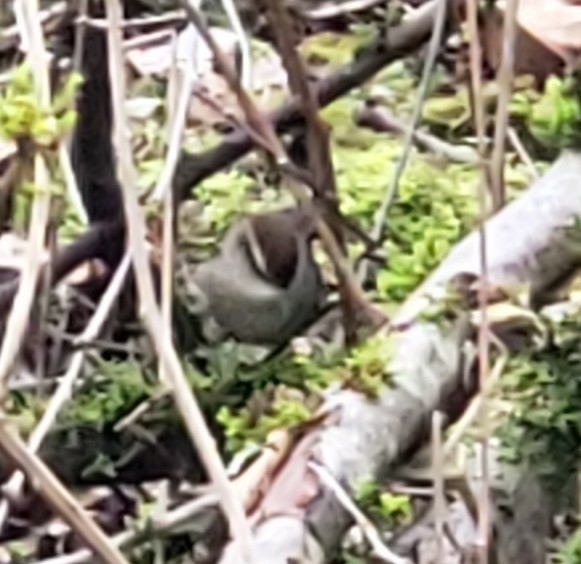
(c) Gavin Slater, some rights reserved (CC BY) · licence
Family: Troglodytidae · Class: Aves · Order: Passeriformes
Thryomanes bewickii (Bewick's Wren) is a California animal in the Troglodytidae family.
Bewick's Wren is a small, active songbird measuring 13 to 14 cm (5.1 to 5.5 inches) in length with a wingspan of 18 to 20 cm (7.1 to 7.9 inches). Adults weigh 8 to 12 grams. The upperparts are brown to grayish-brown, while the underparts are pale gray to white with buffy flanks. A distinctive white eyebrow stripe extends from the bill to the nape, contrasting with a dark eye line. The long, slightly curved bill is dark above and pale below. The tail is relatively long for a wren, dark brown with white outer tail feathers that are conspicuous during the bird's frequent tail-flicking behavior. Historically, Bewick's Wren ranged throughout much of North America from southern British Columbia to central Mexico. In California, the species was once widespread from sea level to approximately 2,100 meters (6,900 feet) elevation, occurring in suitable habitat throughout most of the state except for high desert regions and the highest elevations of the Sierra Nevada. Current distribution has contracted significantly, particularly in the eastern United States, though California populations remain relatively stable across much of their historic range. Bewick's Wren inhabits a variety of brushy and woodland environments, showing preference for areas with dense understory vegetation. Primary habitat types include chaparral, oak woodlands, riparian forests, scrublands, and residential areas with mature landscaping. The species thrives in edge habitats where open areas meet dense vegetation, including canyon bottoms, hillsides with scattered trees, and parks with native plant communities. Elevation ranges from sea level in coastal areas to mountainous regions up to 2,100 meters. This insectivorous species forages actively through dense vegetation, gleaning insects, spiders, and other arthropods from bark crevices, foliage, and ground litter. Bewick's Wrens are known for their diverse and melodic song repertoires, with males capable of producing 100 or more distinct song types. Breeding occurs from March through July, with pairs potentially raising two broods per season. Nests are constructed in cavities including natural tree holes, nest boxes, and various artificial structures. Females lay 4 to 6 white eggs marked with brown spots, which are incubated for 12 to 14 days. Young fledge after 12 to 14 days in the nest. Bewick's Wren is not federally listed and maintains stable populations across much of its western range, including California. However, the subspecies Thryomanes bewickii altus from the Appalachian Mountains is considered critically imperiled. In California, populations appear stable according to Breeding Bird Survey data, though localized declines may occur due to habitat loss from urban development and fire management practices. The species benefits from habitat restoration efforts that maintain native shrubland communities and preserve woodland edges. Climate change may affect future distribution patterns, potentially shifting suitable habitat to higher elevations.
Classification
Class: Aves · Order: Passeriformes · Family: Troglodytidae
Frequently asked questions
How is Thryomanes bewickii classified?
Thryomanes bewickii belongs to class Aves, order Passeriformes, family Troglodytidae.
What family does Thryomanes bewickii belong to?
Thryomanes bewickii is in the Troglodytidae family.
What is Thryomanes bewickii?
Bewick's Wren is a small, active songbird measuring 13 to 14 cm (5.1 to 5.5 inches) in length with a wingspan of 18 to 20 cm (7.1 to 7.9 inches).
Is Thryomanes bewickii found in California?
Yes. Thryomanes bewickii is recorded in California in The California Species Project's catalogue.
Related species
Other California species in the same genus, family, or bioregion.
Data from The California Species Project — 14,000+ California species with verified data from CNPS, CDFW, USFWS, and more.